Iran says Hormuz deal close but its conditions must be met
Published in News & Features
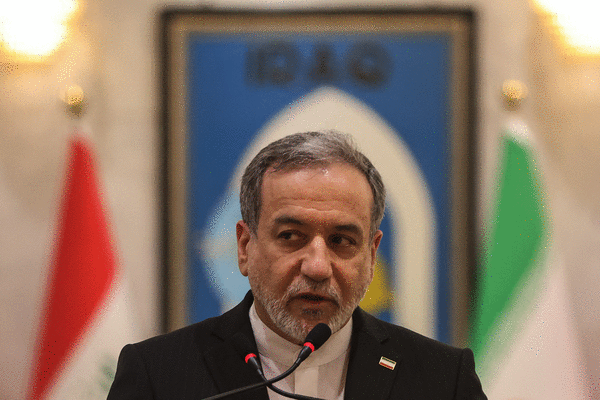
Iran said it’s “very close” to a deal with Oman on a new maritime transit route in the Strait of Hormuz, even as the Islamic Republic renewed a list of demands for the U.S. to agree to before the waterway would open.
Iranian Foreign Minister Abbas Araghchi said on Saturday that negotiators are closing in on temporary maritime transit route for ships entering and exiting the Persian Gulf. He cautioned that any agreement won’t result in an immediate reopening of the strait, signaling that any respite for energy supplies may be limited.
“The opening of the Strait is subject to other conditions, including the compensation for the U.S.’s violations of the Islamabad Agreement,” Araghchi added. He was referring to the now-lapsed memorandum of understanding signed in June, which lasted less than a month before collapsing over disagreements about control of Hormuz.
Besides compensation, Iran wants the U.S. to lift the naval blockade and withdraw military forces from around Iran, remove U.S. sanctions on Iran, and unconditionally release frozen assets among other things, according to Mohammad Bagher Zolghadr, a hard-liner who heads Iran’s Supreme National Security Council.
Oman said separately, in a post on X, that negotiations are progressing in “a positive and constructive atmosphere” and called for a halt on actions in the strait to avoid impacting diplomatic efforts to reach an agreement on navigation.
It’s unclear how Washington will respond to a final agreement. U.S. President Donald Trump has said for months that open navigation through Hormuz must resume, threatening fresh attacks on Iran if it fails to reopen the strait.
Vice President JD Vance suggested there has been some progress in the last few days but that it’s not clear yet whether the final result will be satisfactory for the U.S.
“I try to remind people that we’re really in the middle of the game here,” Vance said in an interview on Fox News on Saturday. The question is whether Iran will be able “to give the things that are necessary for us to be happy, for us to feel like we’ve gotten what we need out of this particular engagement.”
He also said Iranian mines laid in the strait earlier in the war must be cleared and Tehran must commit not to fire on commercial vessels transiting Hormuz.
“What we’re really working through now is how you can actually set up a traffic scheme so that the ships that pass can pass through safely.”
Abu Dhabi National Oil Co. said missiles targeted one of its vessels while transiting Hormuz early on Saturday, the United Arab Emirates’s state-run WAM news agency reported. The attack caused no injuries and the situation has been brought under control, it added. Three other ships from the UAE’s biggest oil producer were attacked this week.
The incident highlights the ongoing risks for shippers attempting to make the crossing during the conflict.
“Deals to reopen the Strait of Hormuz remain elusive, with investors teetering in the balance,” said Rob Haworth, senior investment strategy director at U.S. Bank Wealth Management. “For now, traffic remains low and the path to a durable deal remains unclear.”
Washington has repeatedly suggested that it’s part of negotiations over the management of Hormuz, which Iran disputes. The U.S. will walk back its restrictions enforced by the blockade once a deal between Oman and Iran to restore commercial shipping is announced, citing a U.S. official.
Oil prices have swung between gains and losses this week, as traders monitored the prospects of a deal that’s expected to clear the way for millions of barrels of supply from the Persian Gulf to be restored. Brent settled above $83 a barrel, notching a third straight weekly loss.
Traffic through the choke point has been largely blocked since the start of the war, but some ships have continued to ferry cargoes through as part of a shuttle program involving help from the U.S. military. Many have done so turning off their transponders, making trips harder to track.
Any deal for the Strait of Hormuz will need to be approved by Iran’s Supreme Leader Mojtaba Khamenei. Iranian officials have said that it takes time to reach him, potentially delaying any announcement. There’s no indication as yet over whether Khamenei has given his assent to current plans.
Clashes between the Iran-backed Houthi militants and the Saudi-aligned, internationally recognized government in Yemen also threaten to further escalate tensions in the Middle East.
Yemen said on Saturday its armed forces carried out a military operation overnight against the Houthis, who control much of the country, marking the first known retaliation to attacks this week.
The Houthis and the Saudi-led coalition have observed a ceasefire since 2022, but hostilities have erupted in recent weeks. These included incidents in the Red Sea, from where the majority of Saudi Arabia’s oil exports have departed since the closure of the Strait of Hormuz.
©2026 Bloomberg L.P. Visit bloomberg.com. Distributed by Tribune Content Agency, LLC.






Comments