A Colorado mountain town is going to court to stop ICE from holding immigrants in a strip mall
Published in News & Features
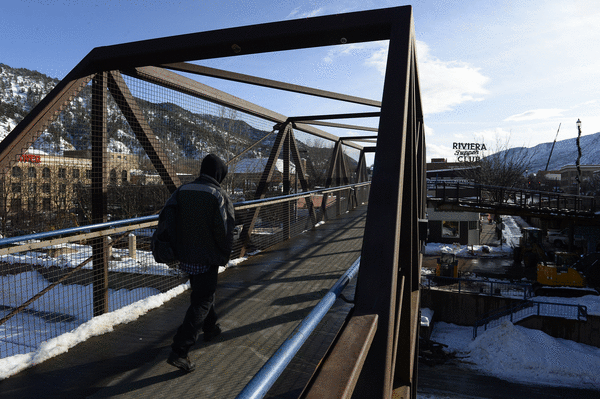
DENVER — A Colorado mountain town is wielding its zoning codes in an attempt to stop federal immigration agents from locking people up in a strip-mall holding cell.
The City Council in Glenwood Springs, the Roaring Fork Valley destination known for its historic hot springs, voted Thursday night to sue the landlord who leases the property used as a processing facility by U.S. Immigration and Customs Enforcement after months of pressure from the local community.
The 6-1 vote was met by celebration inside the packed council chambers after dozens spoke out, imploring the council to move forward with the lawsuit.
“For months, we have had rooms like this full of passionate people who plead with us to take action, and it feels like we’re just sitting on our butts doing nothing,” Mayor Pro Tem Erin Zalinski said after voting in favor of the legal action. “We had to wait until we had something tangible and actionable and defensible, so it felt like we weren’t listening and weren’t taking action and we were dying up here… Just know our intentions are to represent our community with integrity and in the best way possible with the tools we have available to us, so what felt like negligence was just trying to be purposeful.”
Wedged between a chiropractor’s office and a gym at 100 Midland Ave., the ICE processing center is used by federal agents to hold immigrants before they are sent to the state’s only large-scale detention facility in Aurora.
For many in the community, the ICE operation was under the radar until the Trump administration’s deportation push prompted people to start asking questions about what was going on inside the building.
After hearing from people detained in the holding facility, filing open records requests with the city and teaching themselves the intricacies of zoning codes, locals like attorney Claire Noone began uncovering information about ICE’s operations in Glenwood Springs and sharing it with residents who demanded accountability from their elected officials.
The inconspicuous facility had been operating for more than 20 years, Noone said she learned at the beginning of the year. In a decades-old agreement, the city granted use of the facility as a detention center, but agents could not hold immigrants for more than 12 hours.
Community members listened to detainees’ accounts of being held longer than that, and found federal records to back that up, which they presented to the city’s planning and zoning commission. The commission went against staff recommendations and voted 5-1 in April to revoke a special-use permit that enabled ICE to detain immigrants at that address.
An unidentified representative from the U.S. Department of Homeland Security denied that immigrants were being held at the Glenwood Springs facility for more than 12 hours. The agency said immigrants held at the strip-mall location are “quickly processed and transferred to permanent housing at a detention facility.”
Legal avenue opens up
The revocation of the special-use permit stripped the facility of its ability to hold immigrants. Neither the U.S. General Services Administration, ICE nor the property owner appealed the city’s revocation within the allotted time limit, Glenwood Springs City Attorney Karl Hanlon said.
The city determined ICE violated the special-use permit revocation on July 24 when the Glenwood Springs Fire Department responded to a call at the location, alerting city officials that the building was still being used to detain immigrants, “making the question of whether to pursue judicial enforcement ripe for consideration,” Hanlon said in a Monday memo to the City Council.
Hanlon advised the elected body to pursue legal avenues as a means of enforcement.
During Thursday’s City Council meeting, Hanlon recommended the council sue the property owner, Jeff Gillespie, in state court over the zoning violation rather than immediately targeting the federal government.
Gillespie operates JG Housing Solutions LLC, which owns the property. Gillespie could not immediately be reached for comment.
The lawsuit does not hinge on the question of whether ICE should be operating at the Glenwood Springs strip mall, Hanlon reminded the council, asking the members to take their feelings about the federal agency out of the equation. Instead, the legal maneuver focuses on whether the City Council can enforce the existing zoning code violation.
Hanlon said the city had a higher likelihood of success suing the landlord in state court, although he admitted it’s still a long shot.
“We’re in uncharted territory here,” Hanlon said during the council meeting. “As an attorney, intellectually, this is an interesting area to practice in. But I have to recognize the law is not necessarily on our side.”
Hanlon predicted ICE would claim the zoning permit revocation interfered with a core function of the federal government, trumping state laws.
Hanlon said he would argue Glenwood Springs isn’t saying ICE can’t enforce the administration’s immigration laws. The city is simply saying ICE can’t violate the zoning regulations by detaining people at the strip-mall facility.
“I would like to be the person who tells you I’m going to get you everything you ever dreamed of,” Hanlon said. “But these are tough cases.”
‘The building was never a secret’
Thursday’s vote is the culmination of months of pressure from the Glenwood Springs community.
In November, Noone got a call from a single mother who was detained at 100 Midland Ave., separated from her young children and in need of language translation. Noone arrived to translate with her 2-year-old on her hip and couldn’t imagine being separated from her baby like the woman in the facility. The lawyer wasn’t allowed inside the building and became curious about what the government was doing.
After months of questions and records requests, Noone discovered that ICE was never granted a final certificate of occupancy allowing the agency to operate in the Glenwood Springs facility — an error from the early 2000s that the city described in a March news release as an “administrative oversight.”
After inspecting the building this year, Glenwood Springs granted the building a certificate of occupancy, but immigrants were still no longer permitted to be held for more than 12 hours. The city confirmed that federal documents showed the facility detained immigrants for longer than 12 hours multiple times.
Community members continued to show up to city meetings demanding their leaders stand up to ICE and hold the federal agency accountable for its violation of the city’s zoning code.
Glenwood Springs residents said during Thursday’s meeting that they had been waved off by the city for months until proof the community gathered about the building’s purpose and violations was undeniable.
“This building was never a secret,” said Ashley Stahl. “Our immigrant neighbors have known exactly what happened at this building for years. They were right first and nobody listened. What took us 20 years wasn’t finding out what was happening, it was listening.”
Hanlon, the city attorney, said Glenwood Springs was gearing up for a tough legal fight that would likely take years and, potentially, cost hundreds of thousands of dollars in legal fees.
“If little old Glenwood Springs can do this, anybody can,” Stahl said.
_____
©2026 MediaNews Group, Inc. Visit at denverpost.com. Distributed by Tribune Content Agency, LLC.






Comments