Years after attempted assassination of Donald Trump, Butler mayor struggles to bring focus back to community needs
Published in News & Features
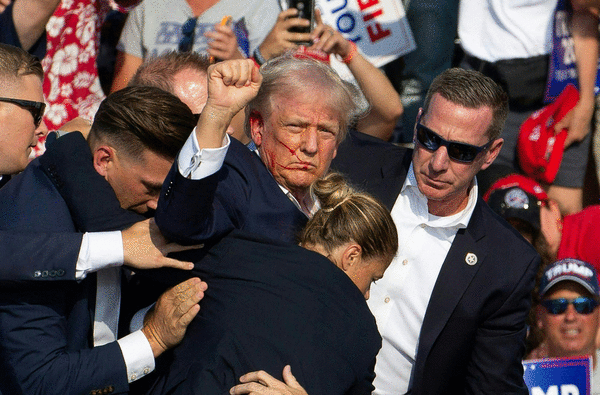
PITTSBURGH — The attempted assassination of Donald Trump in Butler County has left a long shadow on the community.
Even two years later, Butler Mayor Bob Dandoy said the events of July 13, 2024, still cloud his efforts to improve the town of about 13,000 people.
“I’m trying to work on things like, how do I feed the people of my community? How do I make sure they’re safe? How do I make sure they have affordable housing? And this keeps getting in the way,” Dandoy said.
The shooting, which occurred during an outdoor campaign rally at the Butler Farm Show grounds technically happened outside Dandoy’s jurisdiction — he governs the city of Butler and the fairgrounds are beyond city limits – but in the hours, days and years that have followed, he became the de facto spokesperson for the event.
He also became the punching bag.
Dandoy heard from mayors all over the country, and even then-President Joe Biden. They all had the same message for him.
“They told me: ‘Watch out. There’s going to be so much stigma and negativity,’” he said. “Somehow, everyone had been given carte blanche to be angry at the city of Butler.”
Immediately, those other leaders were proven correct.
The calls and emails and posts on social media started right away, blaming Dandoy for not doing enough to stop the shooting, insulting him and demanding he address the conspiracy theories that spread in the wake of the assassination attempt.
While they’ve slowed in the years since, they haven’t stopped completely, despite his attempts to refocus people’s attention on the core work that needs to be done to improve the community.
“It’s not just that I don’t want to be known as the place Trump was shot — I don’t — but there’s so many good things I’m trying to do and … I can’t keep people focused on that. This keeps getting in the way,” he said.
The polarization, threats and hatred Dandoy has been dealing with in the aftermath of the assassination attempt are just one example of what local leaders are increasingly dealing with across the country.
The Butler mayor shared his story Thursday morning as part of a discussion with a group of city leaders from across the U.S. during the Strong Cities Network’s third annual retreat for mayors and city officials, hosted at the Pittsburgh Theological Seminary.
The gathering organized by the Strong Cities Network, a global organization focused on bringing cities together to work against violence, extremism and hate, drew about 30 mayors from as far away as Fairbanks, Alaska.
Actions by the federal government – like increased immigration enforcement – have recently stoked fear among vulnerable communities across the country, while international conflicts, the proliferation of artificial intelligence and the spread of venomous messages on social media have fueled hateful rhetoric and violence.
The events that drive the disturbing messages vary: the war with Iran, the Israel-Hamas conflict, elections, data centers, violent ideologies and even the Epstein files. All have led to an increase in violence or threats of violence, said Katherine Keneally, the director of threat analysis and prevention at the Institute for Strategic Dialogue.
All of it has created an atmosphere of fear, Dandoy said, making it harder for officials to serve their communities and do the regular, day-to-day tasks of running a local government.
Among immigrant communities in Columbus, Ohio, fear of detention by federal agents has led to a significant decrease in the number of people attending faith-based gatherings, said Mike Schadek, the director of international affairs for the city.
“Fear is the biggest issue facing us right now,” Schadek said.
A similar story is unfolding in Pittsburgh, which is already intimately familiar with the danger that anger over immigration can lead to.
In 2018, Pittsburgh was the site of the deadliest antisemitic attack in the U.S., when a gunman killed 11 people inside a synagogue in Squirrel Hill. The shooting was motivated by a hatred for immigrants and the groups assisting them.
“Pittsburgh is a midsize city with an outsized exposure to this polarization,” Ankur Sakaria, a policy manager for Mayor Corey O’Connor said at the conference. “Not only because of the events that have taken place here, but because it has a growing immigrant community.”
Postpartum mothers are missing newborn checkups, parents are facing truancy charges because their kids are too afraid to go to school — all because of increased immigration enforcement — and many are afraid to seek help, said Rosamaria Cristello, the executive director and founder of the Latino Community Center in Pittsburgh.
“Our community is facing both physical and emotional trauma and pain everyday,” she said.
But leader after leader at Thursday’s conference said there are solutions.
In Columbus, they’re printing guides in multiple languages so everyone is aware of what their rights are when it comes to immigration enforcement.
In Western Pennsylvania, 19 nonprofits and community groups have banded together to avoid competing for resources and increase the number of people that are receiving services.
The city of Pittsburgh recently hired five specialists, who will work directly with young people to steer them away from violence.
“These are our residents that want to talk to our youth about why they should make changes in their lives,” Mayor Corey O’Connor said.
Many at the conference lamented that the work to support residents has become more difficult under the second Trump administration as top federal officials have amplified and spread divisive messages, yet they remained hopeful about the future.
“The good news is everybody in this room is the solution,” Schadek said to the group. “There’s not going to be answers to these problems we’re talking about coming from Washington, D.C., or our state house … We are the solution.”
Ultimately, their success or failure will rest on the people they serve, Allegheny County Executive Sara Innamorato told the group.
"The strength of a city isn't measured by the beauty of its skyline or the GDP it puts out," Innamorato said. "It's really measured by whether we trust one another and whether people feel that they belong."
_____
© 2026 the Pittsburgh Post-Gazette. Visit www.post-gazette.com. Distributed by Tribune Content Agency, LLC.





Comments