UN report details killings, rapes in Haiti's capital during months of fighting by gangs
Published in News & Features
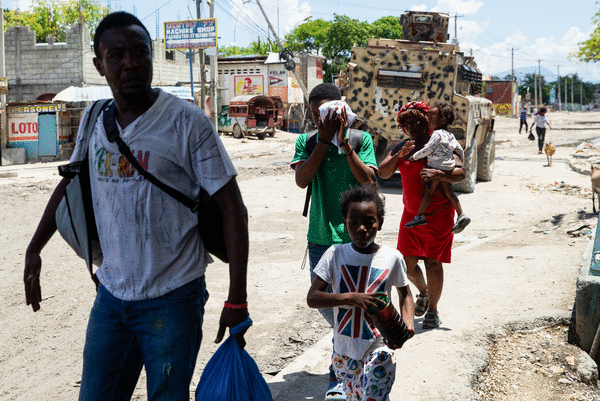
At least 613 people have been killed and 375 others injured in months of violent confrontations between armed criminal gangs in Port-au-Prince’s Cité Soleil neighborhoods and sprawling Plaine du Cul-de-Sac, according to a new report from the United Nations detailing one of the capital’s deadliest outbreaks since 2024.
The casualties occurred between March 6 and July 31, when shifting alliances within the powerful Viv Ansanm gang coalition erupted into open warfare even as Haitian security forces, backed at times by private military contractors, intensified operations against armed groups, the U.N. Integrated Office in Haiti said in its report.
Ground zero for the violence was the Cité Soleil commune and the strategic Plaine du Cul-de-Sac, an important economic corridor east of the capital that is home to a number of commercial enterprises and traversed by roads that enable trucks traveling from the capital’s container port and the Varreux oil terminal to access the country’s main highway to the north.
While Haitian security forces and private military contractors carried out at least 20 operations during the time of the fighting, the report cites allegations of links between gang members involved in the clashes and elements of the Haiti National Police in the commission or facilitation of criminal activities.
Violation of human rights laws
The report noted that the current level of gang warfare and human rights abuses had not been documented in this part of Port-au-Prince since territorial wars between members of the rival G9 and G-PèP criminal alliances in January and February 2024.
“The available information indicates that several of the documented acts, including killings, gang rapes, and the destruction of property and buildings housing providers of essential services, may amount to serious violations of international human rights law,” the U.N. said.
Among the deadliest incidents was an attack that occurred shortly after the FIFA World Cup match between Haiti and Scotland on June 13. At least 61 people were killed and 20 others wounded when gang members attacked a crowd of more than 300 people. Among the victims were at least seven children, the youngest of whom was seven.
The 33-page report found that 64% of those killed were gang members, while nearly one-third were civilians who were either struck by stray bullets or deliberately killed or assaulted on suspicion of having links with rival gangs. Among the dead were 111 women and 77 children.
Overall 90% of those killed and injured were documented in incidents of gang violence, while nearly 9% occurred during security force operations and 1% as a result of acts of popular violence against people suspected of being affiliated with gangs.
The U.N. Haiti offices’ Human Rights Service also documented that more than 176 women and girls, between aged 10 and 71, were raped by gang members, often as a form of punishment because they lived in areas controlled by rival gangs. The office cautioned that the actual number of rapes are likely higher due because many cases go unreported by the victims due to fear of reprisal and stigmatization.
Gang Suppression Force
“The particularly heavy human toll of the gang clashes in the Port-au-Prince metropolitan area in recent months underscores the urgent need to strengthen the protection of the population, notably by ensuring that the Gang Suppression Force is provided with the resources necessary for its full and rapid deployment,” said Carlos Ruiz Massieu, the special representative of the secretary-general for Haiti and head of the U.N. Integrated Office.
The surging violence comes as many as 350,000 living in the United States face the possibility of deportation after losing Temporary Protected Status in the aftermath of a U.S. Supreme Court decision in June.
The report said armed gangs also attacked public and private buildings, leading to the suspension of most commercial activities and basic services in the neighborhoods affected by the violence. The humanitarian and socio-economic impact has been severe, with more than 18,000 people forced to flee their homes, adding to the more than 1.4 million already displaced by years of violence.
The armed clashes have also disrupted access to health care for thousands of people. The Isaïe Jeanty Maternity Hospital in Cité Soleil, operated by Doctors Without Borders/Médecins Sans Frontières, was forced to suspend operations in June before resuming them in mid-July.
The medical facility was forced to suspend its activities on June 19, following five days of intense fighting between armed groups in Cité Soleil, the French medical charity said.
“It was a particularly difficult decision, as we know how significant the sexual and reproductive health needs are in Cité Soleil,” said Diana Manilla Arroyo, the medical charity’s head of mission in Haiti. “But continuing under these conditions would have put more lives at risk.”
The fighting has also severely affected residents of Cité Soleil, forcing many of them to flee their homes.
Despite security forces operations in the Plaine du Cul-de-Sac and Cité Soleil that were launched at the end of March, efforts “remain limited in the face of the scale of gang violence in these areas,” the report said.
Gang clashes
According to the U.N. Haiti office, the violence began when members of the Tokyo gang arrived in Cité Soleil’s Village de la Renaissance locality in February, after being driven out of the Lower Delmas area by security forces.
The gang’s presence in an area that until then had not been under control of any gang because of its relative isolation immediately led to a shift in alliances between the gangs operating in the nearby Plaine du Cul-de-Sac.
Tokyo gang members quickly established an illegal checkpoint to extort cargo trucks and public transport vehicles travelling towards the northern part of the capital. The checkpoint at the southern entrance to Village de la Renaissance was opposed by the Chen Mechan, Pierre VI and Terre Noire gangs, which operate nearby and also derive revenue from extorting trucks using National Road No. 1.
The 400 Mawozo and Canaan gangs, based in Croix-des-Bouquets, supported the establishment of the checkpoint, as they also sought to expand their influence in the area. It all came to a head on March 6, after the killing of two Canaan gang members by the Chen Mechan gang, and continued until March 11.
Police links
The report notes that a month before the clashes erupted, a criminal network composed of 17 individuals — including five police officers accused of having supported the Tokyo gang and to have been involved in kidnappings in the communes of Delmas, Pétion-Ville and Port-au-Prince — was dismantled by law enforcement. The arrested police officers, some of whom were also employed by Haitian private security companies, allegedly acted as escorts for gang members or supplied them with weapons and ammunition, the police said.
The U.N. report makes several recommendations, including an acceleration of the full deployment of the new international Gang Supression Force. The U.N. also called for the investigation of any human rights violations that may arise from security operations.
©2026 Miami Herald. Visit at miamiherald.com. Distributed by Tribune Content Agency, LLC.




Comments