Overnight SpaceX national security launch could bring sonic boom to Central Florida
Published in News & Features
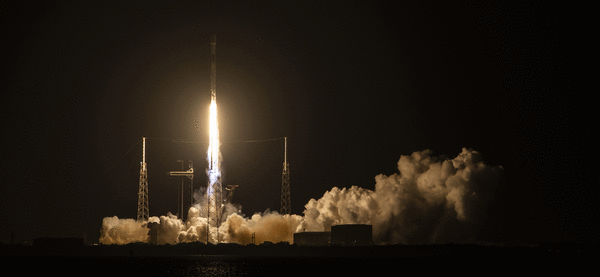
ORLANDO, Fla. — That bump in the night that might be heard in Central Florida in the wee hours of Thursday morning might be for national security.
That’s because a SpaceX Falcon 9 rocket on the NROL-95 mission carrying a classified payload for the National Reconnaissance Office is set to launch from Cape Canaveral Space Force Station’s Space Launch Complex 40 at 3:09 a.m. EDT with a backup on Friday at 2:55 a.m.
The first-stage booster for the mission is making its seventh trip to space, and could be the source for a loud noise about eight minutes after liftoff.
That’s because the booster will attempt a recovery landing back at Landing Zone 2 south of the launch pad, and with that brings the possibility for a sonic boom to be heard across Central Florida.
“There is the possibility that residents of Brevard, Orange, Osceola, Indian River, Seminole, Volusia, Polk, St. Lucie, and Okeechobee counties may hear one or more sonic booms during the landing, but what residents experience will depend on weather and other conditions,” SpaceX warned.
Space Launch Delta 45’s weather squadron forecasts a 70% chance for good conditions at the launch site, which decreases to 65% if delayed 24 hours. The concern comes from a weak frontal boundary in north Florida that could bring remnant storms and cloud cover in the overnight period.
If it launches, it will be the 49th orbital mission flown from the Space Coast in 2026, with all but seven coming from SpaceX.
United Launch Alliance has flown five times including once with Vulcan and four with Atlas V. Blue Origin has had one New Glenn launch. And NASA has flown its Space Launch System rocket once on the Artemis II mission.
No provider other than SpaceX will be flying anytime soon, though. ULA is still working through fixes to its Vulcan rocket related to solid rocket boosters from Northrop Grumman. Blue Origin’s launch pad is being rebuilt after a massive explosion damaged it during a test hot fire earlier this year. And NASA is not slated to fly SLS again until Artemis III targeting launch in mid 2027.
For now, SpaceX Falcon 9 rockets continue to add onto the year’s total with a mission to fly three satellites for AST SpaceMobile as early as August 5 and then its next Starlink mission on August 10.
SpaceX has its more powerful Falcon Heavy lining up for what would be its second launch of the year as well, targeting August 30 to send up NASA’s Nancy Grace Roman Space Telescope from Kennedy Space Center Launch Pad 39-A.
SpaceX has limited its KSC pad use to just Falcon Heavy to allow the company to continue more work on its new Starship and Super Heavy launch tower being constructed adjacent to the existing launch pad. The company continues to target a debut Florida launch from the KSC tower before the end of the year, although it’s continuing test flights from Texas.
SpaceX is also building out the first of two launch towers for Starship at Canaveral’s Launch Complex 37, but that one won’t be ready until 2027.
SpaceX has shifted all Falcon 9 launches to Canaveral’s SLC-40 in the meantime, including its Crew Dragon missions. The next human spaceflight from Florida will be Crew-13, targeting launch no earlier than September 12.
On board will be Central Floridian and NASA astronaut Luke Delaney, making his debut spaceflight. He will be pilot for Crew-13 alongside NASA astronaut and commander Jessica Watkins, making her second trip to space, and first-time flyers Canadian Space Agency astronaut Joshua Kutryk and Roscosmos cosmonaut Sergey Teteryatnikov.
_____
©2026 Orlando Sentinel. Visit orlandosentinel.com. Distributed by Tribune Content Agency, LLC.






Comments