US says Iran attacked forces while Saudi Arabia strikes Iraq
Published in News & Features
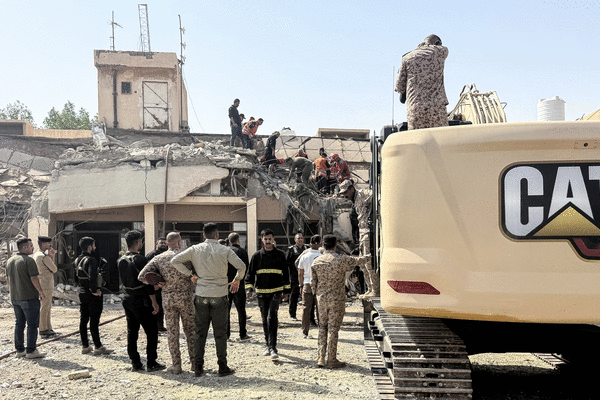
The U.S. said its forces were targeted by Iran overnight while Washington and Saudi Arabia struck Tehran-backed militias in Iraq, abruptly ending a days-long lull in hostilities.
The U.S. and Iran had paused tit-for-tat strikes at the end of last week to allow time for a diplomatic conclusion to their five-month war, leading to a significant drop in energy prices.
But Saudi Arabia said late Tuesday it intercepted drones launched by Iraqi groups that were targeting its oil facilities for a second straight day. Shortly after, the U.S. military said the Islamic Revolutionary Guard Corps fired multiple ballistic missiles from Iran at American troops in the region, with all the projectiles being thwarted. Iranian media said the IRGC targeted a base in Jordan in response to “aggressive U.S. actions,” without giving details.
The U.S. and Saudi Arabia then jointly hit weapons and other sites belonging to “Iran-aligned terrorists” in Iraq, the American military said. The IRGC had, according to the Americans, directed the same militias to launch more than 30 drone attacks in the past few days.
Iraq’s Popular Mobilization Forces, an umbrella organization for Shia militias in the country, said the strikes resulted in 20 deaths and more than 30 injuries.
The latest clashes underscore how far Iran and the U.S. are from formally restarting peace negotiations, let alone agreeing a deal to permanently end their war and reopen the Strait of Hormuz.
Oil jumped on Wednesday, with Brent trading up almost 4% to $87.10 a barrel. That extends its gain for July to 20%, though it remains far below the level of $100 reached on Thursday, just before the U.S. and Iran halted attacks on one another.
The conflict is now in its sixth month and causing plenty of frustration for U.S. President Donald Trump. With U.S. gasoline prices having soared and Americans increasingly against the war, his standing is taking a hit ahead of midterm elections in November.
The series of strikes came hours after Trump said he’d prefer to avoid escalating the conflict and sounded optimistic about the chances of a diplomatic breakthrough.
The Strait of Hormuz remains effectively shut, with hardly any ships traveling through — at least with their transponders on. Early Wednesday, Iran’s state-run IRIB News said the IRGC claimed to have “struck and brought to a halt” three tankers in recent hours. They were, according to the report, “moving along an unsafe and illegal route.”
Talks between Iran and Oman to get more traffic through the waterway, a vital conduit for flows of energy and other commodities such as aluminum and helium, seem to have faltered. Iranian negotiators rejected an Omani proposal that they open a channel equally controlled by each country, according to Iran’s media. Instead, Iran’s Deputy Foreign Minister Kazem Gharibabadi said Tehran wants to have sole control over vessels coming into the Persian Gulf.
Oman had hoped to be able to make a statement in the coming days signaling progress, Bloomberg reported on Monday. Omani officials believe a shipping agreement with Iran would enable Washington and Tehran to get back to the negotiating table.
Iraqi militias join fray
The decision by Iraqi militias to join the fray adds to the risk of a new front opening and the war escalating. Saudi Arabia isn’t known to have attacked Iraqi territory in years.
Iran has funded and trained Shia militant groups in Iraq, its western neighbor, since around 2003, when the U.S.’s invasion toppled dictator Saddam Hussein and led to chaos in the Arab country.
Washington is trying to dilute Iran’s influence over such groups. This month, at the White House, Trump hosted Iraq’s new Prime Minister Ali al-Zaidi, who’s promised to try to disarm the militias. They remain powerful — politically as well as militarily — and many of them have members who are elected lawmakers.
Iran denied having any role in the Iraqi groups’ strikes on Saudi Arabia. “Attributing every action against U.S. interests in the region to the Islamic Republic of Iran is a major miscalculation,” IRIB reported an unnamed source as saying.
The Iraqi militias’ actions follow attacks on Saudi Arabian oil facilities and ships in the Red Sea by the Houthis, an Iran-backed group based in Yemen. The Islamist organization announced a blockade of Saudi ports and struck some ships last week.
The kingdom’s forces then attacked Houthi military sites, with the group retaliating by firing drones and missiles at the Saudi port towns of Yanbu and Jizan on Saturday.
The Houthi operations opened a new front in the war and may effectively close the Bab el-Mandeb strait at the southern tip of the Red Sea, another important chokepoint for the global oil and liquefied natural gas markets.
While some ships are still going through Bab el-Mandeb, several have turned away.
In other news related to the war
•Israeli Prime Minister Benjamin Netanyahu met Trump at the White House on Tuesday and said “it was one of the best meetings that we’ve had.” He gave few details, beyond saying he pressed the U.S. leader to make sure Iran never acquires nuclear weapons
•Tensions between Ukraine and Iran — caused by a deadly Ukrainian strike on an Iranian ship in the Caspian Sea over the weekend — seemed to ease after a phone call between their foreign ministers. “Our goal is to avoid unnecessary escalation,” Ukraine’s Andrii Sybiha said after the call. His counterpart, Abbas Araghchi, said he’d been reassured by Sybiha that the attack was unintentional
©2026 Bloomberg L.P. Visit bloomberg.com. Distributed by Tribune Content Agency, LLC.






Comments