Trump says US will strike Iran hard as war escalates again
Published in News & Features
WASHINGTON — President Donald Trump said the U.S. would strike back at Iran after a recent attack that targeted a military base in Jordan, as the war in the Middle East flared up again following a pause in hostilities.
“We’ll be hitting them hard,” Trump said in a phone interview, Fox News reported Wednesday, adding that “they’re going to get a beating.”
The comments sent oil surging. Brent settled near $91 a barrel, spiking about 8%. A days-long halt to strikes ended Tuesday night after U.S. forces said they were targeted by Iran — in what Trump called a “surprise attack” — while Iran’s state-run IRIB News said the U.S. struck a location in the country’s West Azerbaijan province.
Iranian media said the Islamic Revolutionary Guard Corps targeted a base in Jordan in response to “aggressive U.S. actions,” without giving details.
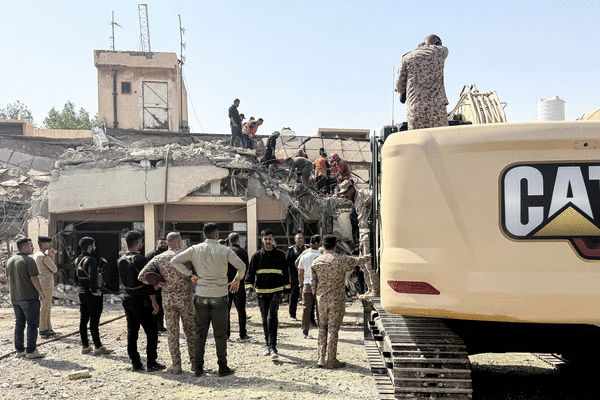
The U.S. and Saudi Arabia also struck Iran-backed militants in Iraq, after Riyadh said it intercepted drones launched by Iraqi groups that were targeting its oil facilities. Iraq’s Popular Mobilization Forces, an umbrella organization for Shia militias in the country, said the U.S.-Saudi strikes killed 20 people. Four members of IRGC were also killed, the semi-official Mehr news agency reported.
Finally, fires broke out aboard two liquefied natural gas vessels at the Egyptian port of Damietta on the Mediterranean Sea. Maritime security firm Ambrey said the vessels were struck by drones, caught fire and have been moved outside the port. The blazes were brought under control and no one was injured, according to the Egyptian Ministry of Petroleum and Mineral Resources.
The rapid-fire developments came days after the U.S. and Iran had paused tit-for-tat strikes at the end of last week to allow time for a diplomatic conclusion to the five-month war, leading to a significant drop in energy prices. That hiatus now looks over.
Futures have been whipsawed this month as the U.S. and Iran went from escalation to diplomacy and now back to fighting.
“We’re going to let them keep talking,” Trump told Fox News about the possibility of future discussions with Iran. A formal resumption of negotiations looks like a distant prospect, however.
That leaves the conflict likely set to drag on, possibly for months, with the different sides unable to break a deadlock over the strait, according to several current and former officials from the U.S., Iran and Europe, who asked not to be named discussing sensitive matters.
The resumption of hostilities is causing plenty of frustration for Trump, who reveled in the signing of an interim peace deal in June that now appears obsolete. With U.S. gasoline prices having soared and Americans increasingly against the war, his standing is taking a hit ahead of midterm elections in November.
About 34% of U.S. voters said they support the military action against Iran, with more than 60% opposed, according to a July 23-27 Quinnipiac University poll published Wednesday. That is the lowest level of support and highest level of opposition since the survey began in early March, soon after the conflict began.
The latest strikes came hours after Trump said he’d prefer to avoid escalating the conflict and sounded optimistic about the chances of a diplomatic breakthrough.
The result is that the Strait of Hormuz remains effectively shut, with hardly any ships traveling through — at least with their transponders on. Early Wednesday, Iran’s state-run IRIB News said the IRGC claimed to have “struck and brought to a halt” three tankers in recent hours. They were, according to the report, “moving along an unsafe and illegal route.”
Talks between Iran and Oman to get more traffic through the waterway, a vital conduit for flows of energy and other commodities such as aluminum and helium, seem to have faltered. Iranian negotiators rejected an Omani proposal that they open a channel equally controlled by each country, according to Iranian media. Instead, Iran’s Deputy Foreign Minister Kazem Gharibabadi said Tehran wants to have sole control over vessels coming into the Persian Gulf.
The decision by Iraqi militias — often trained and funded by Iran — to join the fray adds to the risk of a new front opening and the war escalating. Saudi Arabia isn’t known to have attacked Iraqi territory in years.
Iran denied having any role in the Iraqi groups’ strikes on Saudi Arabia. “Attributing every action against U.S. interests in the region to the Islamic Republic of Iran is a major miscalculation,” IRIB reported an unnamed source as saying.
The Iraqi militias’ actions follow attacks on Saudi Arabian oil facilities and ships in the Red Sea by the Houthis, an Iran-backed group based in Yemen. The Islamist organization announced a blockade of Saudi ports and struck some ships last week.
The Houthi operations opened a new front in the war and may effectively close the Bab el-Mandeb strait at the southern tip of the Red Sea, another important chokepoint for the global oil market.
_____
With assistance from Arsalan Shahla, Patrick Sykes, Eltaf Najafizada and Carla Canivete.
_____
©2026 Bloomberg L.P. Visit bloomberg.com. Distributed by Tribune Content Agency, LLC.





Comments