Germany calls Berlin Pride attack an act of Islamist terror
Published in News & Features
German police fanned out in pursuit of the suspect in a deadly van ramming at Berlin’s Pride festival on Saturday night that authorities called an Islamist terror attack.
Speaking at a press conference, Interior Minister Alexander Dobrindt identified the fugitive as German-born Abdul Ballout, 21, a citizen whose mother was naturalized in 2002 after immigrating from Lebanon.
“Everything we see here points to us dealing with an Islamist terror attack,” Dobrindt said.
Chancellor Friedrich Merz described the incident as “an attack on our society” and said those responsible would be pursued “with the utmost severity.”
“We will not allow that this poison — that terrorism and this poison — against our freedom takes hold further in our society,” Merz said before a memorial service in Berlin on Sunday. “We will defend the freedom, openness and liberality of our life and our society with everything we have.”
Ballout is alleged to have driven a white van into a crowd of people in Berlin’s Tiergarten park, on the sidelines of the city’s pride celebration late Saturday night, killing a woman and injuring at least 29 people. Ballout is alleged to have attacked additional people with a machete.
“It was a horrific scene,” Dobrindt said, noting that the van left multiple injured people scattered in its wake along a pedestrian path through the park. Others at the scene immediately administered first aid, he said, followed shortly thereafter by mounted police officers who were already in the vicinity.
One or more people are believed to have fled the vehicle, police said, adding that the suspect may be armed and dangerous, and that members of the public should avoid “direct contact.” There’s been no specific mention of a potential accomplice to Ballout.
The search is continuing across Berlin as well as at airports and Germany’s borders, Dobrindt said, adding that Ballout was known to have been radicalized and had committed previous crimes. He’d been on probation with a suspended sentence of one year and 10 months; prosecutors had appealed the suspension, Dobrindt said. The investigation into Saturday’s attack will be transferred to the federal level, he said.
Heavily armed police were seen at the Anhalter Bahnhof subway station, Bild reported. Dozens of officers also searched the suspect’s apartment in the Tiergarten district, a short distance from the attack site, the newspaper said. Police had earlier searched an apartment in the city’s Schöneberg district.
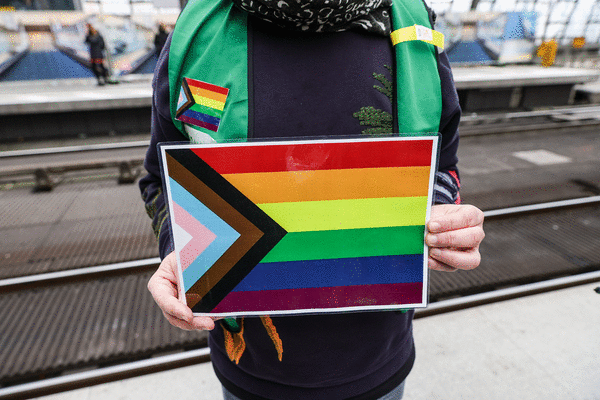
At the memorial service Sunday afternoon at St. Mary’s Church in central Berlin, a Pride flag was draped at the front of the church and participants lit candles. A representative of Berlin’s Muslim community in Berlin made remarks, saying that universal values of human life hold true across religions.
Election impact
The incident is likely to further inflame tensions over immigration in Germany that have driven increasing support to the far-right Alternative for Deutschland (AfD) party in recent years. AfD is currently the strongest party in Germany with 28% support, according to a recent Insa poll.
Closely watched elections are coming up in September in Berlin, Saxony-Anhalt and Mecklenburg-Western Pomerania. AfD is already the strongest party in the latter two states, both in the former East Germany.
Saturday’s attack came a week after Germany raised its threat level over the risk of terror incidents.
“The increased volume of reporting and intelligence has prompted me to raise the previously defined abstract threat level to a high threat level,” Dobrint told Welt am Sonntag in a July 18 interview. There are “clearly identifiable” plans targeting infrastructure, individuals and institutions, he said at the time.
Vehicles have been the weapon of choice in terror attacks many times in Europe over the past decade, including in Berlin. A Tunisian man who’d been rejected for asylum killed 13 people in an attack on one of the city’s largest Christmas markets in 2016, an incident that drove criticism of former Chancellor Angela Merkel’s open-border refugee policy.
Security had been tight along the Berlin parade route on Saturday, with a strong police presence and barriers — including the kind used to deter car attacks — blocking streets. Hundreds of thousands of people marched along a route through Tiergarten, a downtown urban park, toward a closing rally at the Brandenburg Gate that featured German singer Sarah Connor.
The van ramming happened at about 10 p.m., a short distance from the closing celebration. Police canceled the rest of the event.
Berlin’s Christopher Street Day, marking the anniversary of the Stonewall riots, when police raided LGBT patrons at New York City’s Stonewall Inn in Greenwich Village in 1969, is one of Europe’s largest Pride events.
“Following a peaceful and vibrant Pride parade, the rally for a tolerant and peaceful Berlin was brutally attacked,” Berlin Mayor Kai Wegner said on X. “Berlin is the city of freedom — and our freedom has been horrifically violated today.”
_____
(With assistance from Arne Delfs, Tony Czuczka and Kamil Kowalcze.)
_____
©2026 Bloomberg L.P. Visit bloomberg.com. Distributed by Tribune Content Agency, LLC.





Comments