Modi punctured as awakened India students force retreat
Published in News & Features
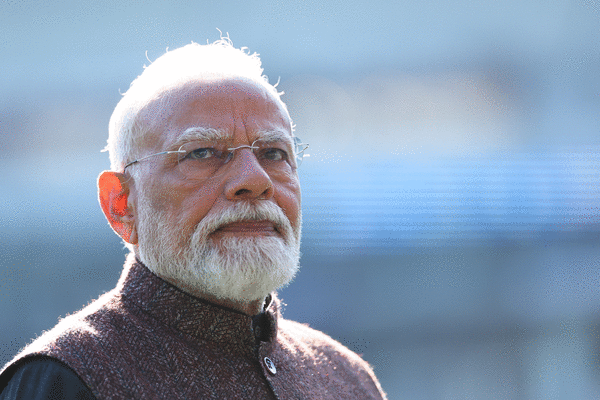
For much of Narendra Modi’s 12 years ruling India, he’s looked nearly unbeatable at the polls. This weekend he swiftly yielded to a group that didn’t exist a few months ago, energizing opponents who have struggled to rattle one of the nation’s most powerful leaders ever.
Education Minister Dharmendra Pradhan resigned on Saturday to take accountability for a series of exam scandals in the face of a student protest movement that mobilized thousands of young people in New Delhi and started to spread around India. The Cockroach Janta Party, which formed two months ago as a social media joke, declared victory and called off its demonstrations while vowing more action “to solve all the problems in this country.”
It was the first time since Modi took power in 2014 that one of his cabinet ministers had resigned under public pressure, a sign of the threat posed to the prime minister and the prospects of his ruling Bharatiya Janata Party. He soon faces a key election in Uttar Pradesh, India’s most populous state, where jobs for young people are a major concern for many voters.
“It is a very big defeat for Mr. Modi,” said Nilanjan Mukhopadhyay, author of the biography "Narendra Modi: The Man, The Times." “For the Modi brand, for this image that’s been built of him as a no-nonsense, populist strongman leader.”
The protests, which began about a month ago, quickly escalated after police used tear gas and batons to prevent students from marching to the parliament on July 20. Visuals of the violence quickly spread online and in the media, drawing widespread public sympathy, including from Bollywood stars, and backlash against the police action.
Opposition lawmakers threw their support behind the students, disrupting proceedings in the parliament as they called for the minister to resign. By the end of the week, protests had spread to other major cities, including Mumbai and Kolkata, drawing thousands of young people onto the streets.
On Saturday, students erupted in joy as news of the education minister’s resignation filtered through the crowd at the designated protest site in New Delhi. Saurav Das, a spokesman for the Cockroach Janta Party, said the country’s youth were now “awakened” and would push for more change.
“As a party, as a movement, this is obviously not the end,” he said. “Now we will go across the country, listen to the youth, bring the best policies for them and continue to demand accountability from everyone. This is just the beginning.”
During his monthly radio address on Sunday, Modi made no mention of the student protests and instead covered topics from water conservation to a rocket launch.
Modi in his typically prerecorded 30-minute address commemorated sacrifices made by Indian soldiers in a 1999 conflict with Pakistan and congratulated the country’s youth for performing well in global Olympiads. He celebrated sporting successes, local entrepreneurship and campaigns to reduce plastic waste. He also urged India’s youth to participate in science competitions and innovation programs.
The absence of any reference to the student protests suggests a preference for selective engagement with politically sensitive issues. Modi has historically reserved the Mann Ki Baat, which means ‘from the heart,’ radio address for themes of nation-building rather than day-to-day political controversies.
In Mumbai on Sunday, Finance Minister Nirmala Sitharaman told the audience at a business leadership event that every generation of young people has felt the need to protest when circumstances were “not ideal,” and she is “not undermining what has happened.”
“We have to keep our ears closer to the ground so that we hear what’s going on, understand what’s going on in time,” Sitharaman said when asked whether the administration was caught off-guard by the protests. “We responded to the voice of our youth,” she said, adding that is what’s “due for a responsible government.”
It’s not the first time that Modi’s government has bowed to public pressure. In 2021, his administration agreed to repeal controversial farm laws after tens of thousands of farmers across northern India protested for months. This time, demonstrators forced Modi’s hands within days, surprising many observers.
“Modi was left with little choice given the groundswell of students participating in the protests,” said Amit Ranjan, a research fellow at the Institute of South Asian Studies at the National University of Singapore. “Over the past several years, Modi has worked to cultivate support among young voters. His response to the protest suggests he recognizes the political importance of this constituency and the risk of losing its support.”
The prime minister in recent days made direct appeals to students in a bid to calm the anger, posting late-night selfie videos on Instagram two days in a row. He pledged strict action against those behind the exam paper leaks, including fast-track courts to tackle the issue.
Late Sunday, Modi said a high-powered task-force on exam reforms will be set up, and it will be led by Nandan Nilekani. Nilekani is chairman of Infosys Ltd., one of India’s largest software services firms.
“This task force will focus on examination reforms, and based on its report, steps will be taken to ensure the credibility of upcoming examinations at the earliest,” Modi said in a post on Instagram.
The quick response allows Modi to contain the political fallout after more established opposition groups sought to capitalize on the student protests.
“Modi is adept at reading the tea leaves,” said Harsh Pant, vice president at the Observer Research Foundation, a New Delhi-based policy research group. “He was quick to repeal the farm laws because the farmers’ protest lasted much longer and represented a more powerful constituency. Similarly, this movement shows the prime minister’s flexibility.”
Rahul Gandhi, the leader of the opposition in the parliament, called on other groups disillusioned with Modi’s party to also make their voices heard.
The youth-led protests are a “signal to other parts of the society — farmers, laborers, poor people, anybody whom this regime is attacking and repressing — there is wisdom, courage in standing up,” Gandhi said in a video posted on X. “Don’t be scared. Let’s get rid of this regime.”
It’s uncertain whether opposition groups, particularly Gandhi’s Congress party, can convert the street anger into electoral victories, according to political scientist Ramu Manivannan. Modi’s landslide wins in recent state elections, notably in West Bengal, show his ruling BJP remains in a dominant position over the opposition even if it retreated in this case, he said.
“The protest and the violence against students had made it unpopular and left it isolated and cornered,” said Manivannan, who formerly headed the Department of Politics and Public Administration at the University of Madras.
Although the unrest had little impact on markets, it served a warning sign of simmering tension over the state of India’s education system. Even though growth of about 7% has made India one of the world’s fastest expanding major economies, the country has struggled to create enough jobs for the millions of graduates entering the workforce each year.
While Modi has time to recover politically, his ability to pass laws will face both an emboldened opposition as well as cautious members of his own coalition and within his own party, according to Aparna Pande, a senior fellow at the Washington-based Hudson Institute. More broadly, she said, the nation’s youth has given hope for the future of Indian democracy.
“India’s democracy and democratic politics were the winner in this entire development,” she said. “This protest shows that while every democracy is facing challenges, India included, the average Indian believes in dissent as being at the core of democracy.”
_____
(With assistance from Shruti Srivastava, Swati Pandey and Bhaskar Dutta.)
_____
©2026 Bloomberg L.P. Visit bloomberg.com. Distributed by Tribune Content Agency, LLC.





Comments