Republican lawmakers are blaming Canada for wildfire smoke, but cause is complicated
Published in News & Features
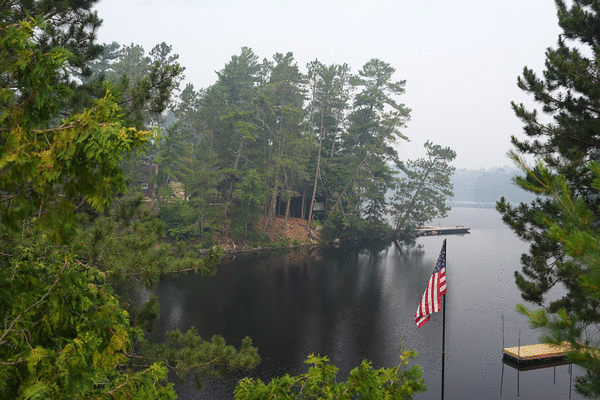
Wildfire smoke is once again straining relationships between Minnesota and its neighbor to the north.
For the second year in a row, Minnesotans experienced some of the worst air quality in the world as hundreds of Canadian wildfires, along with more than a dozen in northern Minnesota, burned out of control and spread massive plumes of smoke across the state right at the peak of summer.
Last week’s wildfires shattered air pollution records in many places, prompted the full closure and evacuation of the Boundary Waters Canoe Area Wilderness and temporarily shut down water parks, outdoor concerts and art fairs across the Twin Cities area due to poor air quality.
In response, 19 Republican members of Congress, including U.S. Reps. Brad Finstad and Pete Stauber of Minnesota, wrote a scathing letter to the U.S. Environmental Protection Agency on Monday. In the letter, the lawmakers blame Canada for the fires and accuse its government of violating a 1991 environmental treaty initially created to address acid rain.
“We request the Environmental Protection Agency take all appropriate measures under the U.S.-Canada Air Quality Agreement (AQA) to address the impact of Canadian wildfire smoke on families in the Great Lakes and the Northeast,” the GOP lawmakers wrote in the July 20 letter. “Canada must meet its clean air promise and prevent future wildfires from impacting our communities.”
It’s the second time since last summer that Finstad and Stauber signed onto a letter blaming Canada for high concentrations of wildfire smoke making its way into the state. Unlike last year, however, a significant portion of the air pollution last week came from wildfires ignited by lightning on Minnesota’s side of the border.
The lawmakers also take their criticisms of Canada’s forest management practices a step further in this year’s letter, accusing its government of violating the AQA. As evidence, they point to a 2022 report from Parks Canada, which shows that the federal agency completed fewer prescribed burns almost every year between 2014 and 2021.
“In recent years, the Canadian government has elected to reduce the number of controlled or prescribed burns,” the lawmakers wrote. “Responsible wildfire management, such as controlled burns, is critical to reducing the frequency and severity of wildfires and protect families from harm.”
Parks Canada — Canada’s equivalent of America’s National Park Service — didn’t respond to questions sent by the Minnesota Star Tribune. A spokesperson for the Manitoba government said in a statement to the Star Tribune that it “continues to conduct burns to reduce hazards in certain areas, where warranted” and is working “to build capacity and skill in controlled burns.”
Nicknamed the “Acid Rain Treaty,” the AQA was signed in 1991 by then U.S. President George H. W. Bush and Canadian Prime Minister Brian Mulroney. It set strict limits on sulfur dioxide and nitrogen oxide emissions, the toxic air pollutants primarily responsible for causing acid rain, and charged environmental regulators in both nations to reduce the levels of those pollutants.
The treaty was later amended to include other air pollutants that contribute to smog.
University of British Columbia ecologist Lori Daniels, who studies forest management practices and assists the Canadian government with its prescribed burns, said the American lawmakers’ accusations are unfair and uninformed.
Daniels said the GOP lawmakers have based their opinion on one federal agency that manages a fraction of Canada’s total forests. In British Columbia, she said, the provincial Wildfire Service conducts 40 to 50 prescribed burns every year in coordination with Indigenous nations and community organizations — more than double the number reported in most years by Parks Canada in the 2022 report.
“That report is for such a limited area compared to the 1.3 billion acres of forest in Canada,” Daniels said. “It’s a bit cherry picking.”
Daniels also believes the lawmakers failed to account for the potential reasons Parks Canada completed fewer burns. While she can’t speak on behalf of the agency, she said, fire officials will often cancel a planned prescribed burn when weather and climate conditions could lead to dangerous outcomes.
For example, she said, conditions need to be windy enough to disperse smoke from the prescribed burn so nearby communities aren’t affected, but it can’t be so windy that the fire spreads rapidly and fire officials risk losing control. Climate change, she said, has also diminished Canada’s snowpack, which has led to especially dry springs in recent years that can make any controlled burn difficult to execute.
The report’s data suggest Parks Canada didn’t intend to complete fewer prescribed burns over the years. The agency planned roughly 30 to 45 burns per year, even as completed burns declined. In 2020, Parks Canada completed just 8 prescribed burns — its lowest annual amount during that time range — but planned for 33.
Daniels also criticized the U.S. lawmakers for turning their scrutiny on Canada but not themselves. Canada has largely adopted U.S. wildfire policies, including more recent efforts to implement prescribed burns, she said, and the two countries work closely together on fire suppression efforts and share similar firefighting and fire prevention procedures.
For most of the 1900s, putting all wildfires out was standard practice for fire officials in both the U.S. and Canada. The U.S. Forest Service only began to incorporate prescribed burning into its official forest management strategy in 1995, federal documents show.
Minnesota state Rep. Peter Fischer, a Democrat who co-chairs the House Environment and Natural Resources Finance and Policy committee, said Minnesota lawmakers should hold themselves to the same standards as Canada.
“This letter feels more like an attempt to deflect blame rather than responsibly govern,” he said.
Rep. Finstad didn’t respond to requests for an interview. In a statement to the Star Tribune, Rep. Stauber defended his position when asked to respond to criticisms of his letter.
“Regarding the ongoing fires in the Boundary Waters, I’m fully aware they were sparked by lightning strikes,” Stauber said in a statement to the Star Tribune. “As I have said for years, we need to do better here in the United States to get rid of the overgrowth that has turned our forests into tinderboxes.”
Stauber has supported legislation in recent years that would open up more Minnesota forests to logging, arguing that it would help clear out debris that acts as fuel for wildfires. But ecologists have largely rejected that approach, saying that logging can make the situation worse by removing fire-resistant mature trees, drying out soil on the forest floor and leaving behind even more flammable debris after trees are cut down.
Many forest management officials have also criticized suggestions from American politicians that Canada should log more or “rake” the forest ground to reduce wildfires, calling them impossible tasks in such a vast and remote forest. Canada’s forests span more than 1.4 million square miles, accounting for nearly 9% of forests worldwide, according to Natural Resources Canada. That’s enough area to fit the entire country of India or about half of the contiguous United States.
_____
©2026 The Minnesota Star Tribune. Visit startribune.com. Distributed by Tribune Content Agency, LLC





Comments