India youth protests end as Modi bows to group's demands
Published in News & Features
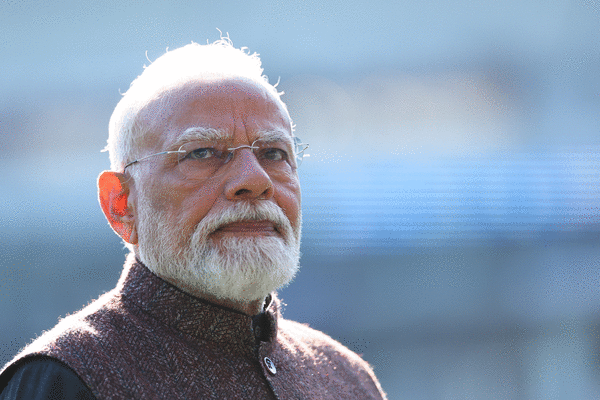
India’s youth protesters called off their nationwide demonstrations after the government accepted their key demands including the resignation of Education Minister Dharmendra Pradhan, marking rare concessions to a popular movement.
Federal ministers and leaders of the Cockroach Janta Party announced the agreement at a joint media briefing in New Delhi on Saturday, bringing an end to weeks of protests over examination paper leaks and irregularities in India’s testing system.
Earlier, Pradhan submitted his resignation to Prime Minister Narendra Modi, saying in a post on X that recent events had left him “deeply pained” and he was stepping down in the interest of students and the country.
The government also agreed to drop police cases against protesters and will provide compensation to families of students who died by suicide following the exam paper leaks, CJP leaders said.
The developments were met with scenes of exultation at the main protest site in New Delhi, and came as Modi’s administration faced mounting public anger over unemployment and the credibility of the examination system. In recent weeks, the CJP, a youth movement that began as an online satirical campaign, led protests that spread to the financial capital of Mumbai, as well as Kolkata in the east and Kochi in the southern state of Kerala.
“Congratulations CJP, Gen Z of the nation and thank you all citizens for shedding fear,” Sonam Wangchuk, a prominent activist whose 26-day hunger strike over the paper-leak scandal helped galvanize the youth movement, said on X.
Pralhad Joshi, who is currently a cabinet minister, will take over responsibility for the Education Ministry. Joshi currently holds the portfolios of Consumer Affairs, Food and Public Distribution, and New and Renewable Energy.
The demonstrations, among the biggest since farmer protests in 2020–2021, reflected growing frustration over limited opportunities for educated young people. Analysts say repeated paper leaks, recruitment irregularities and delays have eroded confidence in the system.
“From day one, I took responsibility for this and never turned my back on the situation,” Pradhan said in his resignation letter. “My resolve was that we will not let the future of any meritorious student be ruined by exam mafias, nor will we allow injustice to happen to any student.”
Under pressure
Although the CJP’s key demand was Pradhan’s resignation, many demonstrators also targeted Modi, reflecting broader frustration with his government.
“The move shows that the government is finally taking accountability and responsibility for the leaks that impacted millions of youth,” said Neerja Chowdhury, a political analyst and columnist. “The government had to act as it did not expect the outpour of thousands of students on the street.”
The government had earlier resisted calls for Pradhan to be removed, instead announcing a series of measures to address the crisis including a pledge to establish fast-track courts to prosecute those involved in leaks. But protests spread across the country, with opposition parties maintaining demands for the minister’s resignation.
“India’s youth appears to be increasingly disillusioned with the education system and the lack of employment opportunities,” said Harsh Pant, vice president at Observer Research Foundation. “Addressing these concerns will require broader course correction, something the government will need to seriously consider.”
Pradhan, 57, held several key portfolios in Modi’s cabinet over the past 12 years, including in petroleum and natural gas, steel and skills development. He took charge of the education ministry in 2021 and retained the portfolio after the 2024 general election.
Leaders from Modi’s Bharatiya Janata Party stood by Pradhan, with party president Nitin Nabin saying the decision to step down reflected the “highest standards of integrity.”
Political commentators highlighted the significance of the rare move.
Pradhan’s exit is “a big defeat for Mr. Modi,” said Nilanjan Mukhopadhyay, author of "Narendra Modi: The Man, The Times," which explores the leader’s rise. “This is the first time he has taken a step backward in the face of public protests and pressure.”
While the developments leading up to Pradhan’s departure impacted the political landscape, the nation’s financial markets have largely been unmoved and are more likely to be driven by geopolitical tensions and oil prices, traders said.
“Markets are being driven by crude price movement and will react accordingly — the student demands being met, while welcome, may not have a direct impact,” said Rajeev Pawar, head of treasury at Ujjivan Small Finance Bank.
_____
(With assistance from Shruti Srivastava and Ruchi Bhatia.)
_____
©2026 Bloomberg L.P. Visit bloomberg.com. Distributed by Tribune Content Agency, LLC.





Comments