Trump seethes as Iran war spirals anew with no end in sight
Published in News & Features
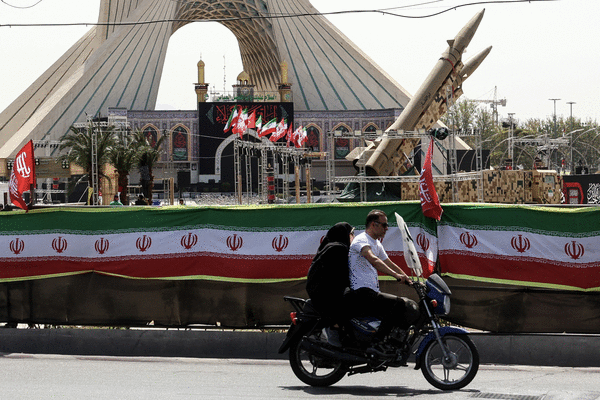
WASHINGTON — President Donald Trump has increasingly flashed frustration with the war in Iran, as the conflict that his team once predicted would end in a matter of weeks stretches into its fifth month and fighting intensifies.
The war’s seemingly intractable new chapter has unleashed fresh economic turmoil and driven up energy prices, which threatens to further imperil Republicans’ already dim prospects in the November midterm elections. Yet since his ceasefire with Iran collapsed, Trump has voiced anger about recent U.S. casualties and expressed skepticism about returning to negotiations.
A leader who has long resisted the path of retreat, Trump has now gone into revenge mode against the Islamic Republic, according to one ally who spoke on condition of anonymity to discuss his thinking. The president is frustrated with the state of the war and is looking to exact a toll on Iran, said another person familiar with the matter.
The developments show the conflict the U.S. launched alongside Israel in late February has become more than Trump bargained for. The president in March declared his in-and-out operation in Venezuela was the “perfect scenario” for Iran. That same month, Defense Secretary Pete Hegseth insisted the U.S. was not getting bogged down in “a forever war or a quagmire.”
Nonetheless, the president’s months-long efforts to pressure Tehran into negotiations have failed to yield a lasting peace.
The unpopular conflict now threatens to become a defining feature of Trump’s presidency. He posts about it frequently on social media and mentions it in almost all of his public appearances. During an event Thursday at the Environmental Protection Agency, he suggested he had to leave for a White House meeting about next steps.
Trump told attendees that he had built the “greatest military anywhere in the world” and conceded “we’re using it a little more than I thought, but that’s alright.” He told reporters on Friday that he had not yet made a decision on whether to launch new major strikes.
“We’re locked and loaded and ready to go. But we’re talking to them, so I think while we’re talking, we’ll see what comes of it,” Trump said, adding he saw Iran “getting more and more serious as the days go by, for maybe the obvious reason.”
The effective stalemate has offered a cold dose of reality for Trump, who campaigned in 2024 on a pledge to keep the U.S. out of foreign wars.
Trump now faces a menu of unattractive options, according to Aaron David Miller, a senior fellow at the Carnegie Endowment for International Peace. Retreat would be politically embarrassing, escalation carries risks and the previous round of negotiations led by Vice President JD Vance, envoy Steve Witkoff and son-in-law Jared Kushner produced only a flimsy memorandum of understanding.
“If you ask me what is the way out of this, I will tell you, on July 23, I don’t see one,” he said when asked Thursday if there was an exit for Trump.
U.S. strikes continued daily this week, fueled in part by the Iranian attacks that killed four more American soldiers and pushed the U.S. death toll to 18. The administration has remained ambiguous on whether the drumbeat of attacks, for 13 nights in a row so far, will continue or whether Trump will order a weekend flourish, as he did earlier in the conflict.
“The United States signed an MOU with Iran and they broke it, shot at commercial ships, and killed American soldiers. President Trump is not going to stand by and allow this terrorist behavior to occur,” White House Press Secretary Karoline Leavitt said in a statement. “Iran is paying in massive bombs, night after night, and they will continue to pay until they come to the table in, what President Trump deems, a meaningful way.”
Over the past two weeks, Trump has offered a hodgepodge of proposals to unlock the conflict that underscore his desire to see it end. He announced a 20% toll on shipping in the Strait of Hormuz before pulling it back under pressure from Gulf allies. He rolled out a plan to use seized Iranian funds to pay for damage from attack without offering details.
Trump has also threatened even more intense retaliation for Iranian attacks and those from proxy groups — scenarios that Secretary of State Marco Rubio called a “head for an eye.” Some of his threats against civilian infrastructure could constitute war crimes if they’re carried out.
So far, that has not deterred Iran and its proxy groups. Yemen-based Houthi attacks on shipping in the Red Sea have opened a new front in the conflict and raised new doubts about the safety of a crucial alternative route to the Strait of Hormuz, which the Iran war has largely closed.
“I think what we are looking at is an extended period of escalation between the U.S. and the Iran threat network, which includes the Houthis,” said Michael Knights, head of research at the advisory firm Horizon Engage. “Both can sustain the conflict for many months to come.”
The conflict continues to takes its toll, with Brent crude oil prices surging above $100 this week and politically sensitive U.S. gasoline prices following suit. Trump’s GOP allies had hoped the conflict would ebb around now to blunt its political impact on the midterms, and Iran appears to be betting that time favors their side.
Polls this week offered grim news for Trump, who has said he expects to be impeached again if Democrats take the House of Representatives. Democrats have opened up an 11-point lead over Republicans in an Emerson College Polling survey’s generic-ballot test, a sizable gap in America’s bitterly divided electorate. A Fox News poll found Democrats with a nine-point lead on handling of the economy, a subject that is typically a key strength for Trump.
Questions are swirling over how to pay for the war, with a supplemental funding package all but stalled in Congress. That has forced the administration to scrounge for funds elsewhere. The dynamic is further straining ties between the administration and Congress, one of the people said. Trump is doing little to woo votes for the spending measure, and there’s little upside for lawmakers to back it as Americans grapple with rising energy prices, the person said. Pressure on prices could also come from Trump’s newly announced global tariffs.
During a rally this week in Georgia, Trump declared that oil prices would fall “maybe lower than when we even started” but pleaded with voters to “just give me a little time.”
Former officials outlined Trump’s reasons for optimism: a belief that Iran’s ability to retaliate can be near-fully degraded within weeks. One Trump ally argued that Trump has plenty of financial flexibility still, and that Iran fails to realize Trump can start and stop the war for months to come.
Yet Iran has retained the ability to retaliate for U.S. strikes against Gulf allies with drones and missiles and maintains a chokehold on Hormuz, despite the might of the U.S. Navy. Another former official insisted Trump’s strikes could further degrade Iran’s ability to hit back in the coming few weeks but conceded one-off drone attacks will be very difficult to fully snuff out.
“I don’t think Iran wants endless escalation,” said Michael Ratney, a U.S. ambassador to Saudi Arabia during the Biden administration. “They can absorb a lot of pain, but it doesn’t serve their interests to have so much infrastructure destroyed. That said, Iran does seem to believe that the Gulf and other U.S. partners are more susceptible to pain than they are.”
_____
With assistance from Jen Judson, Courtney Subramanian, Skylar Woodhouse, Nancy Cook and Jeff Mason.
_____
©2026 Bloomberg L.P. Visit bloomberg.com. Distributed by Tribune Content Agency, LLC.






Comments