Haiti electoral council sets calendar for first elections in a decade. Is it realistic?
Published in News & Features
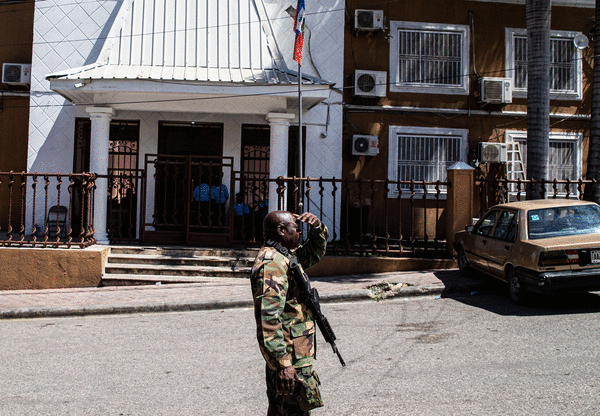
Haiti’s Provisional Electoral Council has set the first round of presidential, legislative and municipal elections for Dec. 13, with final results expected on March 12, 2027, in what would be the country’s first general elections in more than a decade.
Whether that timetable is achievable remains an open question.
Before gang violence engulfed much of Port-au-Prince and its two neighboring regions, organizing nationwide voting in Haiti typically took between 12 and 16 months. This time, according to the calendar transmitted to Prime Minister Alix Didier Fils-Aimé on Thursday by electoral officials, the elections council is attempting to organize the vote in just under five months.
The council has provided 90 days for voters to register, said Line Balthazar, an expert on Haiti’s electoral process whose Haitian Tèt Kale Party, PHTK, did not officially register to field candidates. But after four days, he added, no one has registered.
Haiti’s election is taking place amid an unprecedented security and humanitarian crisis in which millions of voters risk being disenfranchised.
A basic calculation reveals what an enormous take the council faces. Assuming that half of Haiti’s estimated population of 12 million is eligible to vote, and 1.5 million register within the 90-day period provided by electoral law, the electoral authorities would have to register approximately 16,700 citizens a day.
That represents nearly 700 registrations every hour nationwide if calculated over a full 24-hour day. More realistically, if 100 registration centers were operating for 10 hours a day, each center would need to process approximately 167 people per day, or about 17 registrations per hour. In practical terms, each center would have to complete one registration approximately every three and a half minutes, without interruption, every day for 90 days.
In the southeastern city of Jacmel, registrations haven’t even started, the Miami Herald learned. Officials at the mayor’s office told residents that they are in the process of changing their local administration and are not yet allowing registration, a resident who tried to change his voter registration on Friday from Port-au-Prince to the city, said.
Before assessing whether the elections calendar, which also calls for a runoff election on Feb. 21, 2027, is realistic, Balthazar said the more immediate question is whether the electoral council can successfully register voters.
“How many voters does it believe are necessary to hold elections? Will the [council] exclude the West, Artibonite and Center departments from the elections it wants to hold?” he asked, referring to the three regions now under control of armed groups. If the council cannot register people in the “safe” departments, he added, it will not be able to hold elections, regardless of the calendar.
That’s not the only issue facing Haiti’s electoral process.
Haiti’s last census
Haiti’s last nationwide census was conducted in 2003, and the country’s demographics have undergone dramatic shifts since. After the devastating 2010 earthquake, tens of thousands fled to South America, Mexico and the neighboring Dominican Republic. More recently, gang violence has emptied out entire neighborhoods as more Haitians have fled both within the country and abroad to Canada and the United States.
More than 1.4 million people are now internally displaced, many living in makeshift camps or with relatives outside the electoral districts where they are registered. Under Haitian law, voters must cast ballots where they are registered, a process that began this week.
At the same time, the government has pledged to allow Haitians living abroad to vote for president for the first time. While Miami-Dade County is home to one of the largest Haitian communities outside Haiti, the diaspora is spread across dozens of countries, raising additional logistical questions about organizing overseas voting and determining eligibility of voters.
The logistical challenges extend well beyond voter registration, and security remains one of the biggest.
The newly created Gang Suppression Force is operating at roughly one-third of its planned 5,500-strength and is not expected to be fully deployed until the fall. Its one-year United Nations mandate expires on Sept. 30 and must be renewed.
Even if extended, the mission will need time to acclimate after what its leadership described on Monday to the United Nations Security Council as “deliberately incremental” operations.
“The most populous part, Port-au-Prince has this security situation that would make holding elections difficult there,” Michael Kozak, a senior diplomat in the State Department’s Bureau of Western Hemisphere, told members of the House Foreign Affairs committee Tuesday during a hearing on Haiti.
Kozak, who has long experience working in Haiti, said one of the problems facing the Caribbean country over the years is that different international groups would say, “Oh, you have to have this’… and you’d end up with 187 different requirements for an election,” and end up without an election as a result.
“It won’t be a Cadillac election,” he said of the planned vote. “They need an elected government. It doesn’t need to be perfect.”
That view was echoed by the U.S. chargé d’affaires in Haiti, Henry Wooster, in a press conference on Thursday. Wooster said he has seen countries worldwide carry out elections “in all sorts of state,” including in the midst of war.
“It’s not the ideal way to carry on elections, obviously, and it is going to reduce the ability of other people to participate in an election,” he said. “But it doesn’t mean no one can participate. It does mean that your numbers go down, and your logistics become more challenging, getting ballot boxes out to areas.”
The United States, he said, welcomes Haitian authorities’ promise to restore democratic government and Washington has no intentions on dictating how that vote is to be conducted.
“The United States doesn’t take a position on the particulars of how the Haitian authorities will run an election,” Wooster said.
The diplomat, who is known for his bluntness, also said he’s never known a country to conduct an election where everyone walks away happy.
Particulars matter
Haiti observers warn that considering the country’s vexing history with electoral fraud, violence, problematic votes and post-election crises, the particulars of its electoral machinery do matter.
“In every democracy, elections involve administrative mistakes, isolated irregularities and occasional disputes,” said Michel Eric Gaillard, a political analyst in Port-au-Prince. “What ultimately matters is whether the process inspires confidence in the legitimacy of its outcome.”
Gaillard, who served as a member of Haiti’s Independent Electoral Verification Commission that investigated the contested 2015 general elections, said he doesn’t believe anyone is expecting perfection in Haiti. But today’s electoral process is considerably more complex than the one Haiti organized during its democratic transition in the late 1980s and 1990s or even the one it held in 2015, when there were 54 presidential candidates on the ballot and the results were later annulled.
“The central question is whether all the conditions required for a credible election can realistically be put in place within the five months remaining before Haitians are expected to vote,” Gaillard told the Miami Herald. “These are not merely technical details; they are the building blocks of electoral legitimacy.”
Stakes couldn’t be higher
In a July 15 analysis, published in Le Nouvelliste, the country’s leading daily, Gaillard argued that the unprecedented number of authorized political parties, 316, in itself presents a formidable challenge.
Even if many of the parties form coalitions as the electoral law encourages, the electoral council is still tasked with vetting, accrediting and overseeing potentially thousands of election day monitors while ensuring the integrity of the vote.
In the rerun of the 2016 general elections, there was an electoral map of 5.9 million eligible voters along with 13,700 polling stations grouped into roughly 1,500 voting centers nationwide, most of them located in schools or other public buildings.
Municipality, and geographic regions known as a departments determine the number of polling stations, using a ratio of approximately 400 voters per polling station. The electoral council then prepares a voter list, which is posted at the entrance to polling stations, and only citizens whose names appear on the list are eligible to cast a ballot.
“Such an infrastructure must be designed to allow every eligible voter to exercise their right to vote, regardless of the eventual turnout. Ten years later, the first question that arises is this: Does this electoral map still reflect the reality of the country?” Gaillard asked.
The stakes, he said, couldn’t be higher today.
“Success will not be measured simply by whether ballots are cast on Dec. 13. Success will mean that, in 2027, Haiti has elected officials who are, beyond reasonable doubt, the genuine choice of the electorate and who possess the legitimacy to lead the country toward democratic renewal, the restoration of the rule of law, and national rebirth,” said Gaillard.
“If the process fails to earn the confidence of Haitians, the country risks yet another cycle of political crisis, leading to a disputed presidential election requiring a recount or the annulment of the results. Ultimately, it is the Haitian people who will bear the consequences.”
©2026 Miami Herald. Visit at miamiherald.com. Distributed by Tribune Content Agency, LLC.





Comments