California's Bonta, other AGs fight Trump EPA's attempt to weaken 'super pollutant' regulations
Published in News & Features
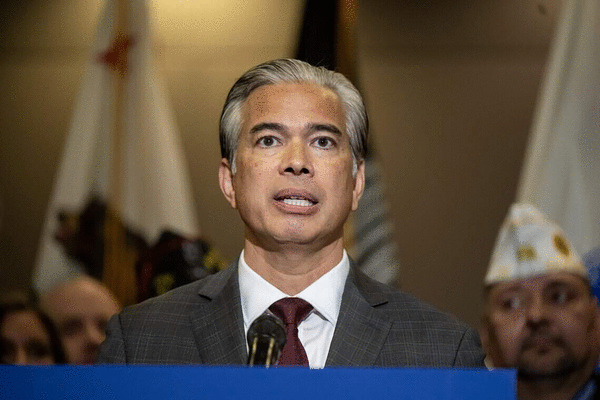
California Attorney General Rob Bonta has filed a lawsuit against the Trump administration’s Environmental Protection Agency challenging its attempt to weaken restrictions on the climate “super pollutant,” hydrofluorocarbons.
President Donald Trump and EPA Administrator Lee Zeldin announced in May the agency would ease requirements for grocery stores, air-conditioning companies and semiconductor plants to reduce the production and use of these chemicals, which are also known as HFCs.
Bonta said the move violates existing law that mandates the phasing out of HFCs during a virtual press conference on Tuesday, where he announced the lawsuit.
“The Trump administration is trying to pass a final rule that would relax necessary restrictions on these chemicals, a move that is both detrimental to our climate process, unfair to the businesses that have complied and most importantly, unlawful,” he said.
The rule, which the EPA finalized in May and takes effect July 27, would extend deadlines for HFC reduction in several sectors and make a wider variety of refrigerants available to businesses.
Along with Massachusetts Attorney General Andrea Campbell and Washington Attorney Nick Brown, Bonta is co-leading a coalition of 19 attorneys general and New York City in an attempt to strike it down.
The core claim of the lawsuit, Bonta said, is that the EPA’s rule is “arbitrary and capricious, and violates the American Innovation and Manufacturing Act.”
Congress passed the American Innovation and Manufacturing Act in 2020 with the goal to phase out production and consumption of HFCs by 85% over the next 15 years. HFCs, a potent category of greenhouse gas used for refrigeration and cooling, can have an impact on global warming that is thousands of times greater than the equivalent amount of carbon dioxide.
The AIM Act authorizes the EPA to regulate these “super pollutants,” including by restricting their use and helping facilitate the transition to other gases. President Trump signed the bipartisan bill into law during his first administration.
Afterward, the EPA then worked with industry groups, environmental NGOs and other stakeholders to create regulations. Many refrigerant manufacturers have since transitioned over to non-HFC gases, according to Bonta.
“The EPA’s new rule would undo the progress we’ve made and penalize the companies that have complied with the law,” he said.
Bonta called the weakening of restrictions on HFCs “the latest instance of Trump doing the bidding of corporations who seek to skirt the law, of Trump again putting industry profit over the health and well-being of the American people and the future of our planet.”
California has long supported strong federal regulation of HFCs, Bonta said. Before the American Innovation and Manufacturing Act was passed, California was the first state to adopt laws to reduce HFCs. It will continue to enforce these restrictions.
“At a time when our world is facing record heat, devastating wildfires, rising sea levels and extreme weather, Trump and his EPA are choosing to roll back our climate progress,” he said.
_____
©2026 The Sacramento Bee. Visit sacbee.com. Distributed by Tribune Content Agency, LLC.





Comments