Flight carrying first batch of $100 million in US aid to Cuba departs from Miami
Published in News & Features
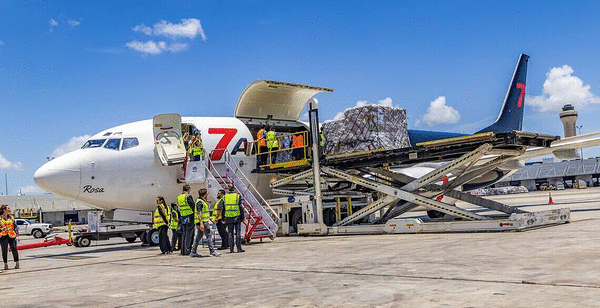
MIAMI — Despite ongoing diplomatic tensions between the Trump administration and the government of Cuba, a flight carrying the first batch of $100 million worth of U.S. humanitarian assistance to the Cuban people was scheduled to depart from Miami on Tuesday.
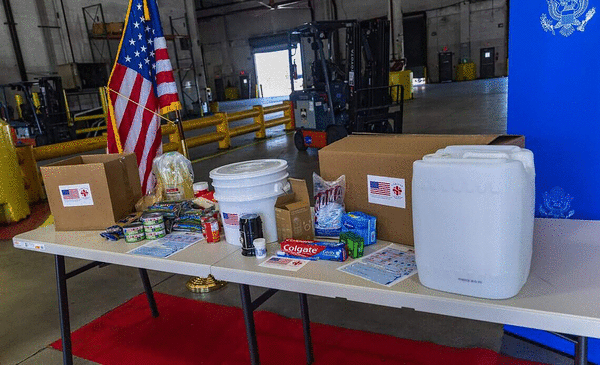
Tuesday’s 7Air Cargo flight will carry hygiene kits and food for 700 families, the State Department said. The packages include food staples like rice, beans and cooking oil, as well as other items like soap, water purification tablets and solar lamps. The flight will be received in Havana by the U.S. Ambassador Mike Hammer.
The aid will be delivered directly to the population through “trusted, independent, and faith-based partners and charitable organizations,” including Catholic Relief Services, Cáritas Cuba, and the Catholic Church in Cuba, the State Department said.
“While we take on the national security threats posed by the regime, our commitment to the Cuban people is ironclad, and we want to be able to deliver assistance, critical assistance that their government should be able to provide for them, but isn’t,” said Jeremy Lewin, senior official for Foreign Assistance, Humanitarian Affairs and Religious Freedom at the State Department. “We’re going to be watching closely to make sure that the regime doesn’t interfere with the assistance in any way.“
In the tarmac at the cargo area of Miami International Airport, next to where the boxes were being loaded to the plane, U.S. State Department officials said the $100 million in assistance would benefit an estimated 196,000 of the most vulnerable families across the island who have been identified by local churches.
Sean Callahan, the president and CEO of Catholic Relief Services, said he had traveled to Cuba recently to see the aid distribution in action.
“When I went to Cuba, we actually visit some of the centers,” he told reporters. “So often times, it’s elderly, single women-headed households and vulnerable children in different areas. And so the church has identified a list of individuals who will get it.”
Catholic Relief Services works with local churches, he said, and they have an extensive network of volunteers and people to reach out to those who are most in need. The church is distributing the assistance “in a way that is very accountable, we know where it goes and who it goes to,” Callahan said.
The $100 million in assistance had been the subject of controversy between the two governments. The U.S. government offered the aid privately to Cuban authorities. Then in May, Secretary of State Marco Rubio came out publicly about the offer and said that the Cuban government had not accepted it.
“It’s the regime that’s standing in the way of it,” Rubio said at the time. Cuban Foreign Minister Bruno Rodriguez then accused Rubio of lying and said that Cuba had no knowledge of the offer. But a week later, Cuba’s leader, Miguel Díaz-Canel, said his government was open to it and would not oppose it.
The U.S. government began sending humanitarian aid in January as part of a $3 million assistance offer to help Cubans affected by Hurricane Melissa in eastern Cuba. Rubio later increased the amount to $9 million, which was delivered by the Catholic Church and Caritas.
It took almost three months to iron out the details of the aid delivery that will reach a population enduring the worst humanitarian crisis since the 19th Century. The country’s power grid collapsed three times this month, while water service, food production, transportation, garbage collection and medical services have been severely disrupted.
The aid comes at a time the Trump administration is increasing the pressure on the Cuban government to make economic and political changes, expanding sanctions to Cuban and foreign companies. Because the administration is exerting control over Venezuela’s interim government after capturing its former leader Nicolás Maduro and threatening other Cuba oil suppliers with tariffs, the Cuban government has not been able to import oil in six months, with the sole exception of a Russian tanker in March.
The Cuban government and critics of the Trump administration, including a group of Democratic House members who recently traveled to the island, have called on the U.S. government to lift the de facto oil embargo on the island, which they say is a form of collective punishment.
Rubio and other U.S. officials have responded to the criticism by pointing out that the Cuban power elites and the military’s conglomerate GAESA have been siphoning the country’s resources and prioritizing the distribution of the scarce fuel to benefit themselves and the government’s repressive apparatus. The $100 million aid package also seems a gesture to counter the impact of U.S. sanctions on the population.
“This assistance underscores the significance of the United States’ sustained commitment to the Cuban people, delivering critical humanitarian relief to provide vital support to those facing worsening shortages of food, medicines, fuel, and other essential services amid deteriorating humanitarian conditions across Cuba,” the State Department said.
The first flight will arrive in Cuba as the two countries have been trading accusations this week. On Monday, the State Department published a report accusing Cuba of fueling far-left extremism and running spy rings in the U.S. Díaz-Canel responded by accusing the United States of inciting terrorism against Cuba.
____
©2026 Miami Herald. Visit miamiherald.com. Distributed by Tribune Content Agency, LLC.






Comments