Hiring of University of Kentucky law dean opens path for Trump to appoint conservative federal judge
Published in News & Features
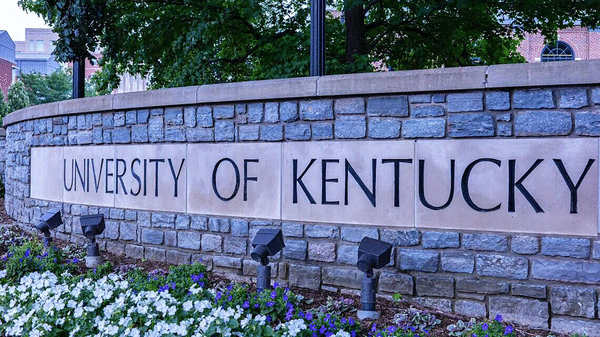
LEXINGTON, Ky. — An expected vacancy on Kentucky’s federal bench after the hiring of the University of Kentucky’s new law school dean makes way for President Donald Trump to further cement the state’s conservative judiciary.
Gregory Van Tatenhove is still a judge in the U.S. District Court for the Eastern District of Kentucky, according to the court’s website and the Federal Judicial Center, but UK’s administration appointed him in March to be dean of its College of Law and he started the role Monday, according to him and Jay Blanton, a university spokesperson.
Van Tatenhove, who was appointed by former President George W. Bush in 2005, is expected to resign from his lifetime bench appointment due to restrictions on outside employment for federal judges.
Van Tatenhove, his office and Blanton denied the Herald-Leader’s requests for comment on whether he is still serving as a judge and who might succeed him. Officials with Trump’s administration did not respond.
Van Tatenhove’s calendar has largely cleared, with few hearings expected in the coming months and notices filed in those cases indicating Van Tatenhove could recuse himself.
Van Tatenhove could become a senior judge after leaving his current position on the bench, which handles a reduced case load and is paid the same amount as what they received at the time of taking senior status.
The president has the constitutional authority to appoint federal judges, who must then be confirmed by the U.S. Senate.
Senators in the federal judge vacancy’s home state — in this case, Republican Sens. Mitch McConnell and Rand Paul — would usually recommend to the president a shortlist of candidates with similar political views, who the president usually would but does not have to choose from, according to Jonathan Shaub, a law and public policy professor.
But the White House under Trump has become more involved in vetting potential federal judges who are loyal to the president, rather than merely supported by their state’s senators, Shaub said.
“I think it’s more people recognizing the importance of the judiciary, the sort of concerted effort to make sure you’re appointing a particular kind of judge and a certain political persuasion or ideology …,” Shaub said. “There’s a lot of vetting to make sure that the people being appointed now are loyal to Trump … and I think that’s relatively new.”
“In the past, a lot of times it was just, ‘Who do you want, senator?’ then make sure that person sort of checks out, and that would be the nominee,” he said.
Carl Tobias, a law professor at the University of Richmond, and TJ Litafik, a Lexington-based GOP strategist, said McConnell and Paul have likely discussed or already sent their recommendations to Trump.
They said McConnell’s recommendations would take priority over Paul’s due to his longstanding power in the Senate, having served as majority and minority leader, and chair of the Senate Appropriations’ Subcommittee on Defense.
But the appointment process can take months, and is contingent on McConnell’s health and whether the Senate approves Trump’s pick.
“There may be some urgency lest they lose the leverage they have as a majority …,” Tobias said. “I think it would be high on the priority list.”
McConnell’s office did not say Friday if McConnell’s health would delay his recommendation to the president or if he sent Trump a shortlist of names.
“As you may know, for any judicial vacancies, the President will make his nomination,” said Stephanie Penn, McConnell’s communications director.
Senators and the president will undoubtedly put forward a Republican, who is likely a young and experienced attorney or judge, Litafik said.
“I think it’s nice to have some judicial or prosecutorial experience (and) it probably makes more sense that the position would go to somebody that’s in their 30s to 50s, that’s old enough to have some experience, but is young enough to be able to fill the role for the rest of their professional lives,” Litafik said.
He and others familiar with the process said the appointment will go to someone with political ties, even if they’re not high profile. And it takes more than being an experienced attorney to fit the bill, according to Litafik.
“I don’t think it’s necessarily as much (about) formal influence, as it is that (they) have just been Trump loyalists in Congress and that he would probably really be apt to listen to their perspectives,” he said.
Can Van Tatenhove be both U.S. district judge and dean?
Some court cases that Van Tatenhove presided over have already been reassigned to other judges, but there were still cases on his docket as of Monday, according to an online court calendar.
U.S. District Court judges have some limitations on outside employment that relate to higher education.
A district court judge cannot “practice a profession that involves a fiduciary relationship for compensation,” or a paid role that serves duties and manages finances for an institution, according to ethics and conduct statutes by the Judicial Conference, the policy-making body for the federal court system.
These judges also can’t “receive compensation for … teaching a course of study at an accredited educational institution; participating in an educational program of any duration that is sponsored by such an institution and is part of its educational offering (e.g. a lecture, lecture series or symposia sponsored by a law school or college); or continuing legal education programs for which credit is given by licensing authorities, or programs that are sponsored by recognized providers of continuing legal education,” Judicial Conference policies say.
It was unclear how these statutes could impact Van Tatenhove and how long he will continue serving as a federal judge.
Lawsuit to block new dean
Van Tatenhove’s appointment as dean of UK’s law school also is at the center of a lawsuit filed last week by a professor.
The lawsuit, which aims to stop Van Tatenhove from being dean, arose after a “substantial majority” of the university’s law professors opposed hiring him, but UK’s administration hired him anyway, according to emails from faculty to UK Provost Robert DiPaola.
The American Bar Association’s standards for accreditation consider factors including whether a dean has tenure and support from faculty.
Kentucky Gov. Andy Beshear has repeatedly criticized UK’s administration for hiring someone he believes isn’t qualified to be a dean.
“... The continued comment (by UK) that the regular policy was followed when they ended up throwing out all of the things they said the next dean had to have is just not true,” Beshear said Thursday at a press conference.
In response to Beshear’s comments, Blanton told the Herald-Leader that Van Tatenhove doesn’t need tenure to be a dean, and said his decades as a federal judge make him qualified.
“Judge Van Tatenhove’s record is scholarship – scholarship at the highest level,” Blanton said.
_____
©2026 Lexington Herald-Leader. Visit at kentucky.com. Distributed by Tribune Content Agency, LLC.






Comments