What should you do to stay safe amid wildfire smoke? What health experts suggest
Published in News & Features
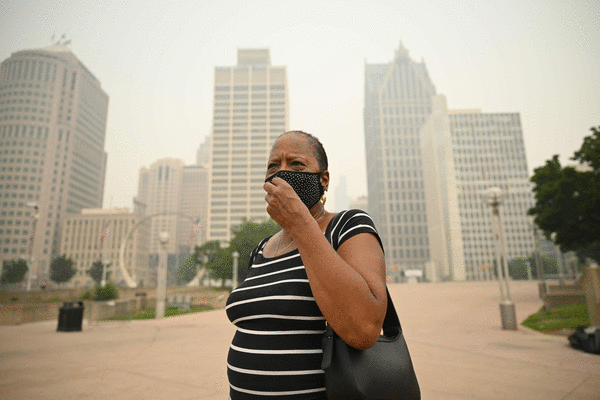
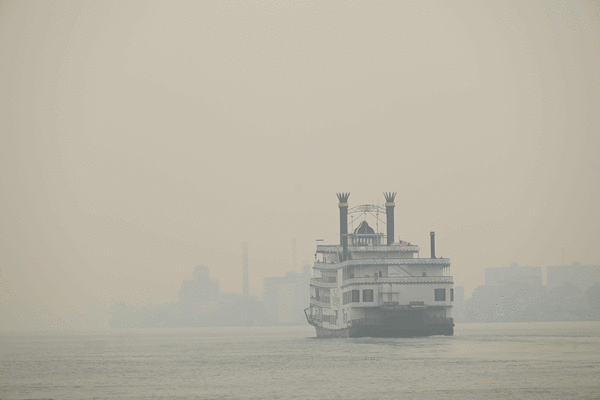
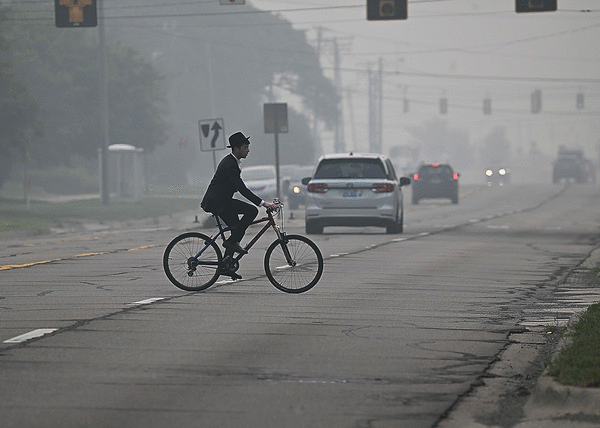

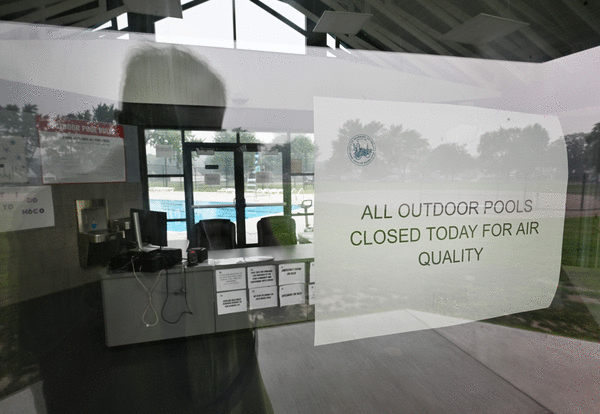
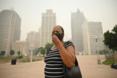
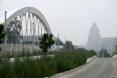
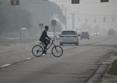

As thick smoke blanketed Metro Detroit on Thursday from wildfires in Canada and Minnesota, health officials are urging residents to take precautions.
Dr. Avani Sheth, chief medical health officer for Wayne County Health, Human and Veterans Services, on Thursday said the best way for residents to protect themselves is to stay indoors in air conditioning, keep windows closed, reduce outdoor activity and check the Air Quality Index before going outside.
Some health systems on Thursday said they've seen an uptick in visits to their emergency rooms from people struggling with the poor air quality, especially those with asthma or COPD.
"Obviously, this is really bad," Dr. Devang Doshi, a Corewell Health pulmonologist. "I don't recall seeing levels like this even a couple years ago, and ... it's supposed to improve by the weekend."
He said his clinic in Royal Oak has received calls from patients with safety questions, like whether it's safe to go outdoors. Some asthma and COPD patients have called the clinic about symptoms they are experiencing, such as shortness of breath, cough or irritation.
With temps also expected to be in the 90s on Thursday, health officials noted that the combination of heat and wildfire smoke can place additional stress on the body, particularly for older adults, young children, people with chronic medical conditions, outdoor workers and anyone without access to air conditioning.
Who is most impacted by wildfire smoke?
Smoke exposure can trigger severe breathing responses in people with lung diseases.
Dr. Christian Nageotte, the service chief of allergy and immunology at Henry Ford West Bloomfield, said that when the Air Quality Index is above 100, that could pose a significant risk, especially for vulnerable patients, including those with asthma, chronic obstructive pulmonary disease (COPD), pregnant women, older adults and some very young children. An Air Quality Index exceeding 300 becomes "a significant health issue" for those patients, he said. The index was 440 in Detroit at 1 p.m. Thursday.
According to the U.S. Environmental Protection Agency, children up to 18 are at greater risk of smoke-related health effects, because their lungs are still growing.
"In addition, compared to adults, they are more likely to be exposed to smoke because they spend more time outdoors," according to the EPA. "Children also engage in more vigorous activity and inhale more air per pound of body weight than adults, both of which affect the dose of smoke they experience and their risk of a health effect."
What health systems are seeing
Dr. David Donaldson, Emergency Center chief for Corewell Health Beaumont Troy Hospital, said in a statement that his hospital has experienced an uptick in patients presenting with respiratory complaints, especially those with underlying lung diseases such as asthma and COPD.
“Individuals with these conditions should consider staying indoors and avoiding unnecessary outdoor exposure to help reduce the risk of symptom flare-ups,” he said.
Dr. Crystal Arthur, chief medical director, emergency medicine for McLaren Health Care, said while the health system's emergency departments in southeast Michigan have treated patients whose chronic respiratory conditions have flared up and require a level of care "beyond what their home treatments can provide," the departments have not experienced an "influx of patients" with smoke-related conditions.
"To a notable extent, communities appear to be following the alerts and taking the proper precautions, which include limiting time outdoors and avoiding strenuous activities, and keeping windows and doors closed when possible," she said in a statement.
Dr. Jon Alterie, emergency physician for McLaren Northern Michigan and McLaren Northern Michigan – Cheboygan Campus, said that people in his area understand the risks and have been taking the necessary precautions, though his emergency departments have still seen an increase in smoke-related issues.
He noted that those have been mainly the exacerbation of an existing, chronic condition, such as asthma, COPD, emphysema and certain allergies.
What should people do to stay safe?
Nageotte of Henry Ford West Bloomfield said any unnecessary activity, including sports events, outdoor concerts and walking, should be postponed.
When the Air quality Index exceeds 300, people should make "quick dashes" from their home to the car, or from the car to the grocery store, he said. He also recommended wearing an N95 mask outside.
"We really see that cloth masks or bandanas don't help in this kind of air quality," he said. "The particulate matter is so small, approaching 2.5 microns, that it can pass through a lot of the cloth masks that people would wear in the past for preventing exposure to infectious agents."
Doshi, the Corewell Health pulmonologist, recommended keeping pets inside as much as possible.
Wayne County Public Health encourages resident to run air conditioning with MERV 13 or higher filters, if available. People can learn more about adjusting their air conditioner at EPA Indoor Air Quality.
What if you don't have A/C but should keep windows closed?
The Michigan Department of Health and Human Services recommends seeking shelter elsewhere if you do not have an air conditioner and it is too warm to stay inside with the windows closed.
The agencies recommends calling or texting 211, or contacting your local health department, to find out if there is a shelter or cooling center nearby. Health officials also suggest considering spending time in an air-conditioned public place such as a library, mall, or movie theater.
_____
©2026 The Detroit News. Visit detroitnews.com. Distributed by Tribune Content Agency, LLC.





Comments