Ferguson campaigns against initiative to repeal WA 'millionaires tax'
Published in News & Features
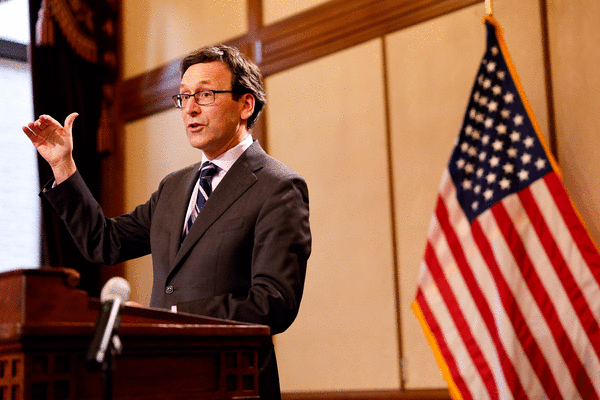
Gov. Bob Ferguson kicked off a campaign to preserve the state's new high-earners income tax on Tuesday, arguing an initiative to kill the tax would have disastrous consequences for schools, small businesses and families.
Ferguson joined other foes of Initiative 645, including Democratic allies and education advocates and union activists, calling on voters to reject the initiative sponsored by hedge fund manager Brian Heywood.
I-645 would repeal the so-called millionaires tax" signed into law by Ferguson earlier this year. The new tax on annual household incomes over $1 million is set to start in 2029, bringing in an estimated $3 billion or more a year.
Ferguson framed the initiative vote as a choice between tax breaks for a relatively small number of millionaires and forward progress for most Washingtonians.
"It's a choice between investing in our kids' education and childcare access and affordability, or going backward with cuts in education and limiting access to childcare. In short it's a choice between the future and the past," Ferguson said, flanked by dozens of tax supporters who held up red "No 645" signs for the news cameras.
Ferguson's leading presence at the No on I-645 campaign kickoff spotlighted the political and fiscal stakes for the state and the governor.
He didn't dream up the new tax, but Ferguson endorsed and shaped it, making the looming November vote a referendum on his leadership. If I-645 passes, it would mark a big rebuke for the governor and worsen an already daunting state budget outlook.
The Tuesday campaign kickoff event was held at Food Lifeline in South Park, a central food-bank supply hub for Western Washington — a location aimed at emphasizing programs such as universal school lunches that I-645 opponents contend are at risk if the initiative passes.
Most of the money from the new tax is dedicated to the state operating budget, which pays for K-12 schools, universities and other state agencies and services. A 5% slice is dedicated to childcare and early learning programs.
If I-645 passes, opponents estimate it would blow a $13 billion hole in the state budget over four years, putting such programs on the chopping block.
"It's hard to overstate how devastating these cuts will be to families that rely on them, or to kids whose futures we are shortchanging," said Soleil Boyd, executive director of the Children's Alliance, a child advocacy organization, at Tuesday's event.
A portion of the new tax is also slated to fund tax breaks for small businesses and state residents, including eliminating the sales tax on diapers. The new tax law also included a big expansion of the Working Families Tax Credit, making 460,000 more households eligible for annual rebate checks of between $330 and $1,330.
I-645 does not specifically repeal any of those tax breaks, but opponents of the measure say the tax cuts would be jeopardized if the revenue that pays for them goes away.
The opposition campaign to I-645 has already drawn $3 million in pledges from big public-sector unions that rely on state funding, including SEIU, the Washington Education Association and the Washington Federation of State Employees.
Heywood and other supporters of I-645 turned in more than 500,000 signatures earlier this month to the secretary of state's office, all but certainly qualifying it for the November ballot. The measure is expected to be formally certified as early as this week.
In a statement, Heywood blasted the pro-tax campaign, including Ferguson, as "a collection of sock puppet politicians" who are "afraid to stand up and challenge the pig trough agenda of more spending and higher taxes."
Christina Janis, state director for the Washington Realtors Association said in a statement she's already seeing bad impacts of the tax firsthand and is helping several families sell their homes as they consider moving out of state.
"While most of these families do not currently meet the millionaire threshold, they understand the broader implications of this tax and are concerned that its impact could eventually extend beyond high-net-worth individuals and affect working- and middle-class Washingtonians as well," Janis said.
Asked about such concerns at Tuesday's campaign kickoff, Ferguson said he doesn't buy the doomsday scenarios.
He pointed to continued growth in Washington even after passage of the capital gains tax in 2021. Critics of that tax, including Heywood, had also predicted it would be an economic disaster.
"Despite that, our economy is booming in Washington state. We're moving up in the rankings for best states to start a business. In measure after measure, Washington's doing very well," Ferguson said.
Ferguson has vowed to veto any effort to expand the new income tax to apply to households earning less than $1 million. He has also said he will propose no new taxes in his upcoming 2027-29 budget proposal, due out later this year.
But he stopped short Tuesday of pledging to veto other tax increases that might be sent to him by the Democratic-majority Legislature.
"What I am going to do is propose a budget that does not raise taxes," Ferguson said, adding that he's meeting with lawmakers to make his tax expectations clear.
Ferguson said Tuesday he plans to continue being personally involved in leading the No on I-645 campaign to help make the public aware of the stakes.
But the governor demurred when asked if he'll publicly debate Heywood.
"We'll cross that bridge when we get to it, he said.
©2026 The Seattle Times. Visit seattletimes.com. Distributed by Tribune Content Agency, LLC.





Comments