Another brutal summer tests Arizona's decline in heat-linked deaths
Published in News & Features
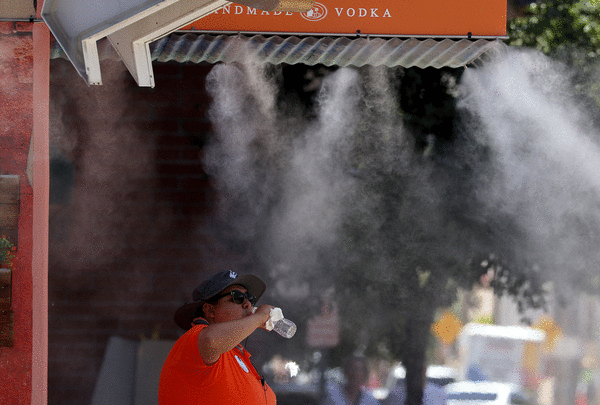
After nearly a decade of mounting heat-related deaths, Arizona’s Maricopa County, one of the nation’s hottest and most populous counties, finally saw its first drop in fatalities in 2024 and again in 2025.
But 2026 will be a crucial test. That’s not only because the county faces another brutally hot summer, but also because it's the final year of millions of dollars in federal funds that have gone towards expanding heat relief programs.
Maricopa County has long been a leader and testing ground for heat-death prevention policies, offering lessons to the rest of the nation as communities from Seattle to New York increasingly struggle with intense bouts of deadly heat. The county boasts the nation’s most sophisticated heat death surveillance system, and its biggest city, Phoenix, was among the first worldwide to establish a heat officer in 2021. It’s also been cracking the code on cooling centers, which have been traditionally underused, by opening in the evenings and offering free rides.
“The length and the severity of our extreme heat is predictable,” said Maricopa County’s chief medical officer Nicholas Staab. “It is something we can plan for and that’s what we really encourage amongst the community.”
Now officials are also racing to secure alternative funds to maintain strong heat protections as climate change complicates the task of keeping the public safe. According to the county’s preliminary data through July 4, which doesn’t account for this week’s local extreme heat warnings, Maricopa has already recorded 18 heat-linked deaths this year, with 215 more under investigation. Those numbers outpace last year’s heat-related deaths by this time.
Since 2024, the county — and the state — have relied on COVID-19-linked American Rescue Plan Act (ARPA) dollars to support heat relief. While the county has enough funds to keep services running through the summer, some programs, including a help line offering free rides to cooling centers, are set to lose funds mid-August.
“Funding has been an issue,” said Maren Mahoney, director of Arizona’s Office of Resiliency, which has helped Maricopa and other counties in their heat response. “With ARPA dollars going away at the end of this year, that is going to be a real cliff.”
In much of the U.S., extreme heat comes and goes all summer long. The intense heat dome that brought multiple days of 100-plus-degree weather to the East Coast last week was followed by cooler temperatures. Not so for Maricopa County, where the heat season officially runs from May to September.
Over the years, the county has been rolling out programs that tackle extreme heat from different angles, from avoiding heat illness in the first place to saving people on the verge of dying from it. As officials boosted defenses, the problem worsened. Then 2023 brought record-breaking temperatures, and with it a record 645 heat-related deaths county-wide.
A big part of response planning relies on robust data collection on direct heat deaths, like heat stroke cases, and indirect ones, such as someone who died of a heart attack after heat exposure.
“A lot of people will tell a story that the longer you live in Arizona or Maricopa County, the more accustomed you get to the heat — and that is not shown to be true,” said Staab. “We see really long-term residents being at highest risk and then we’re able to also break down the environment in which people die from heat.”
Some of the county’s most vulnerable to heat include individuals using substances or living in RV trailers, mobile homes or on the streets, according to Staab. The Black and American Indian populations are also disproportionately affected by hot temperatures.
Being at the frontlines of deadly heat forced residents to get creative. For example, in Phoenix, medical experts have rolled out a novel life-saving intervention called cold water immersion therapy, which involves quickly immersing someone struggling with heat stroke in an icy slurry to quickly bring down their core body temperature.
“Without exaggeration,” said David Hondula, Phoenix's director of heat response and mitigation, “what we’re hearing from partners in the healthcare setting is that patients who may never have left the hospital or would likely have been leaving with some type of permanent disability are now walking out under their own power.” His team has helped the effort by prepositioning ice across the city.
Then there’s the longer term work to help address the root of people’s heat exposure, such as helping the homeless secure housing or residents pay utilities before their power and air conditioning is shut off.
In the midst of a crisis, cooling centers have emerged as a big game changer, officials said. That’s in part because they have been co-locating social services in the heat relief spots.
A survey on cooling center use conducted in 2023 helped determine where to allocate funds, according to Staab. One conclusion: the centers need to stay open beyond business hours, and so officials worked to offer more locations and keep them open longer.
In Phoenix, “we are now in our third year of running a 24/7 site and multiple extended-hour sites,” said Hondula. In the nearby town of Avondale, the Arizona Complete Health Avondale Resource Center’s senior room doubles as a cooling center on weekends.
But simply having the centers isn’t enough to get residents to use them, so officials improved and increased the public signage on the streets — and on billboards — describing where to find the spaces.
211 Arizona has become a one-stop hotline where people can get help with social services, as well as find nearby cooling centers and get free Lyft rides to them. The service provided 9,147 rides in 2024, 8,676 in 2025 and 1,256 through June this year, according to Solari, the company that owns it.
The county stepped in with funds in 2025 — money that’s now set to soon expire. Mayo Clinic is also helping cover this year’s free ride costs, but it’s not enough to keep them running beyond mid-August. This comes as Mahoney and others assess how much money is needed to keep cooling centers running inside and outside Maricopa County.
Meanwhile, the heat isn’t letting up. This week, Phoenix and the surrounding areas experienced some of their hottest days this year, with multiple days seeing maximum temperatures of up to 112 degrees Fahrenheit (44 degrees Celsius).
Whether the heat death toll keeps going down this year, or jumps back up, government officials stressed that the long-term goal doesn’t change.
“Heat deaths are preventable,” said Mahoney, “and we’re continuing the long-term work to get the heat death count down to zero.”
©2026 Bloomberg L.P. Visit bloomberg.com. Distributed by Tribune Content Agency, LLC.






Comments