Philly can't force ICE agents to unmask, federal judge rules
Published in News & Features
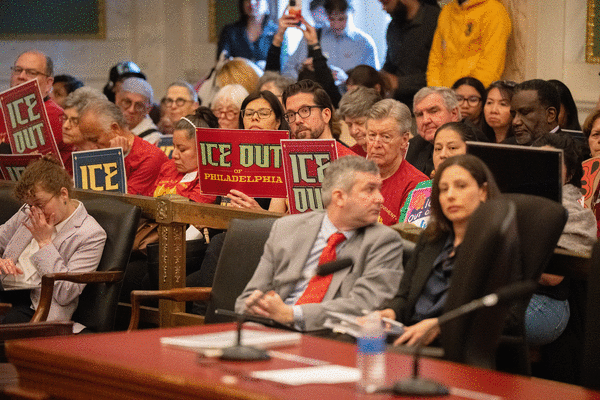
PHILADELPHIA — Philadelphia can’t prevent U.S. Immigration and Customs Enforcement agents and other federal officers from concealing their identities, a federal judge ruled Thursday.
U.S. District Judge Chad F. Kenney issued an order preventing Mayor Cherelle L. Parker’s administration and District Attorney Larry Krasner’s office from barring federal law enforcement officers from wearing masks, intentionally covering their badges, or using unmarked vehicles.
The U.S. Constitution’s Supremacy Clause prevents states — or a city in this case — from imposing requirements on how federal agencies carry out their duties, the judge appointed by President Donald Trump said.
When City Council passed the bill in April as part of the ICE Out legislative package, the lawmakers “attempted to sidestep the Constitution’s clear mandate and disregarded this fundamental principle of law that has informed American jurisprudence for over 200 years,” Kenney’s opinion said.
Parker allowed the bill to become law without her signature, following City Solicitor Renee Garcia’s advice that signing the bill “would send an inaccurate signal to the public that the Administration can legally and practically enforce” its provisions.
“Mayor Cherelle Parker acted with civic wisdom and courage to stand up for the Constitution and follow the rule of law to where it led, despite what may have been strong personal inclinations to the contrary,” the judge said.
While the ordinance’s requirements apply to all law enforcement, its inclusion in an “ICE Out” package suggested the city planned to be selective in its enforcement, Kenney said.
And even though the ordinance hadn’t taken effect yet, the judge said, the city never said it wouldn’t attempt to enforce its provision. Krasner’s past statements vowing to “arrest” and “put handcuffs” on ICE officers who break state law, as well as his involvement in a progressive prosecutors’ group committed to such prosecutions, suggest the threat of enforcement is real, Kenney said.
“The Department of Justice will keep fighting jurisdictions that try to obstruct President Trump’s immigration enforcement with policies that endanger agents and public safety,” a department spokesperson said.
The city did not respond to a request for comment.
Kenney showed an “unnecessary urgency” from the beginning of the case, Krasner said.
“The red-hot rush of this federal district court judge, a Delaware County Republican appointed by Donald Trump, was predictable,” the district attorney said.
Defending the ordinance put Parker and her administration in an awkward position. City Council passed the legislation with a veto-proof supermajority as part of a seven-bill package.
The ordinance at the heart of the litigation made it a crime for law enforcement officers, including Immigration and Customs Enforcement agents, to wear face coverings or conceal personal identifiers like badges and nameplates while carrying out their official duties in Philadelphia, and required officers to identify themselves. It also prohibited the use of unmarked vehicles.
The bill included exceptions allowing officers to wear masks in certain circumstances, such as medical emergencies or SWAT operations.
An officer could face up to 90 days in jail plus a fine for violating the ordinance.
The other bills prohibit federal immigration agencies from staging raids on city-owned property, ban discrimination on the basis of citizenship status, and prohibit the city from engaging in most forms of information-sharing with ICE.
The legislation also codified some of Philadelphia’s long-standing sanctuary city status, which a recent poll found most city residents support.
Parker signed the six other bills, which will take effect Tuesday.
The Justice Department sued the city, Parker, Krasner, and Garcia in federal court in Philadelphia last month and requested an injunction on the enforcement of the masking bill.
Officials from various federal agencies told the court the bill would harm their operations and officers.
Members of the public routinely dox ICE agents, who are later subject to threats, John Rife, acting director of ICE’s Philadelphia field office, said in a filing.
“Facial coverings reduce the risk of officers’ personal identities being shared publicly, which helps ensure that officers’ privacy and safety, and that of their family members, remains intact,” Rife said.
The city argued the litigation was premature as the ordinance hasn’t gone into effect and there was no attempt to enforce it.
The city also said federal agents had applied “aggressive enforcement tactics behind the mask of anonymity, undermining public safety and trust.”
But Kenney’s opinion said, “there can be no public interest” in enforcing a provision that violates the Constitution.
It doesn’t make sense that the city can’t hold federal officers to the same standard it holds its own police department, Councilmember Rue Landau, who authored the bills with fellow progressive Kendra Brooks, said in a statement.
The Trump administration has sued other jurisdictions, including New Jersey, over similar requirements. In April, the U.S. Court of Appeals for the Ninth Circuit found that a California bill requiring agents to “visibly display identification” was unconstitutional.
On Tuesday, a federal judge in Richmond enjoined Virginia from enforcing a law barring ICE agents from covering their faces.
“It’s unfortunate the Parker administration’s own doubts were used against the bill in this injunction,” Brooks said in a statement. “No one else is dealing with that dynamic in their lawsuits.”
©2026 The Philadelphia Inquirer, LLC. Visit at inquirer.com. Distributed by Tribune Content Agency, LLC.





Comments