Michigan lawmakers miss their budget deadline, OK gas price measure
Published in News & Features
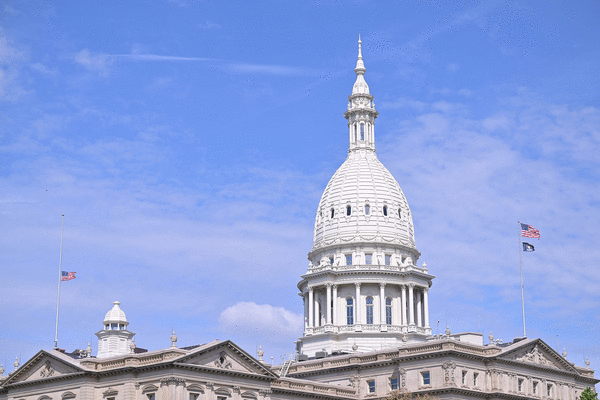
LANSING, Mich. — Michigan lawmakers failed Wednesday to meet their self-imposed deadline for approving a new budget, but their work on a funding plan for schools, universities and state government was expected to continue Thursday.
Under a state law designed to help school districts with fiscal years that begin on July 1, the Legislature is supposed to sign off on a state budget on or before July 1 each year.
However, this year marked the second in a row in which the Republican-led House and Democratic-led Senate were unable to hit their goal date. There is no penalty for missing the deadline, and the state's fiscal year doesn't begin until Oct. 1.
Sen. Darrin Camilleri, D-Trenton, acknowledged to reporters on Wednesday that a full agreement on the budget plan had not yet been reached. Still, he said progress was being made on the measures, expected to feature more than $80 billion in spending.
"When you're doing a lot of big policy bills or big items in the budget, it just takes a lot of time to get through each of those individual items," Camilleri said.
House Speaker Matt Hall, R-Richland Township, has been pushing for property tax cuts, as part of the budget negotiations. It appeared Wednesday the property tax provisions wouldn't be part of the final deal.
Meanwhile, Democratic Gov. Gretchen Whitmer has been backing a plan to increase the tax incentive cap on the state's transformational brownfield program, which allows businesses behind significant projects to keep tax withholdings resulting from their developments.
Further complicating the talks was the fact that lawmakers have less money to work with this year than in past years.
Jen Flood, Whitmer's budget director, previously said the state was facing a $1.8 billion financial gap.
Health care costs have jumped, lawmakers have recently dedicated more tax dollars to roads, and the federal government, led by Republican President Donald Trump, is forcing states to pay a larger share of the costs of food assistance for low-income families.
In a statement Wednesday, Robert McCann, executive director of K-12 Alliance of Michigan, said his organization was hearing the budget plan is "essentially done."
"If so, then the only thing standing between our schools and the certainty they need is politics, the worst reason imaginable to leave every district in this state guessing about how many teachers they can hire, how many programs they can run and how many students they can serve," McCann said.
Sen. Jonathan Lindsey, R-Coldwater, said many in Lansing were expecting final budget votes to come early Friday morning, ahead of the Fourth of July weekend.
"We get sent up here to do a job," Lindsey said. "It's not that hard. Sit down and go through the numbers and negotiate. The real failure here is in the process.
"People don't start this seriously enough."
Michigan lawmakers extend energy emergency to stave off gas price hike
Instead of voting on the budget Wednesday, lawmakers approved a resolution extending an energy emergency for 77 days to allow gas stations in southeast Michigan to further delay their transition to a higher-cost summer fuel blend.
Whitmer issued an executive order in early April, declaring the emergency and suspending a law that requires the fuel blend change. But Whitmer’s 90-day order was set to expire July 1 without legislative approval. Whitmer had issued the order in light of rising gas prices due to inflation and the war in Iran.
Under state law, gas blends across Michigan are supposed to begin reducing vapor pressure in April to comply with the lower-vapor-pressure blends used during the summer.
In southeast Michigan, in particular, state law requires Wayne, Oakland, Macomb, Washtenaw, Livingston, Monroe, St. Clair and Lenawee counties to switch over to a 7 pounds per square inch lower vapor pressure gasoline from June 1 through Sept. 15, a blend that is often more expensive and that is lower pressure than the rest of the state. The blend is believed to reduce pollution and is intended to address the history of poor air quality in southeast Michigan.
But Whitmer’s April 2 order and Wednesday’s vote by the Legislature extends the delay on that transition through the end of summer and the Sept. 15 close of the period where the blend is required.
The average price of regular gasoline in Michigan is currently $4.09 per gallon, compared to $3.23 per gallon a year ago, according to AAA Michigan.
In a statement, Whitmer said, “I’m grateful for partners in both chambers of the Legislature who worked across the aisle to get this done. Let’s keep working together to make a difference on the issues that matter and put money back in Michiganders’ pockets."
_____
©2026 The Detroit News. Visit detroitnews.com. Distributed by Tribune Content Agency, LLC.






Comments