Starmer says defense plan allows Burnham to counter UK threats
Published in News & Features
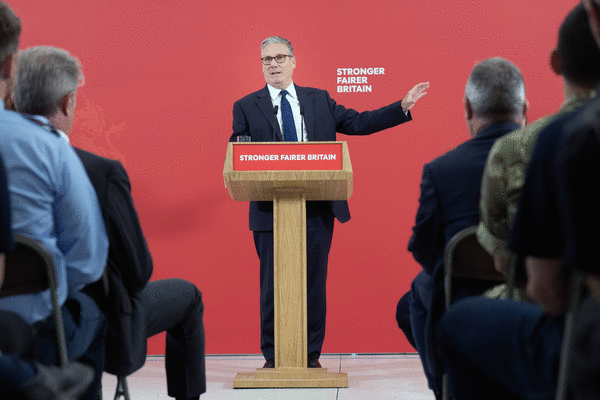
Prime Minister Keir Starmer said he was confident his likely successor, Andy Burnham, would maintain the U.K.’s commitment to defense, as he laid out plans to invest an extra £15 billion ($20 billion) to modernize the British military.
Starmer said the character of modern warfare was “changing before our eyes,” as he detailed proposals for new drone and artificial intelligence programs as part of a long-delayed Defense Investment Plan. The blueprint will increase overall military spending to almost £80 billion a year by 2029, including a record £5 billion of funding for drones and autonomous weapons over the next four years.
Starmer, who announced eight days ago that he’s stepping down as prime minister, is seeking to shore up his legacy by plowing cash into defense ahead of next week’s NATO summit in Turkey. The premier has repeatedly trumpeted “the biggest sustained increase in defense spending since the end of the Cold War” and said his latest plans would increase defense spending to 2.7% of economic output by 2030, from a planned 2.6% next year and 2.3% in 2024.
“This plan represents our best judgment of what the country needs to meet this moment and it is a platform on which I know my successor will build,” Starmer said on Tuesday in a speech at a drone company in Berkshire. That successor is likely to be Burnham, the former Greater Manchester mayor who returned to the House of Commons last week and is so far the only candidate to succeed the premier.
U.K. defense stocks reacted positively to Starmer’s announcement. Babcock International Group Plc rose as much as 3.5% with BAE Systems Plc and QinetiQ Group Plc gaining as much as 2.1% and 1.9%, respectively.
But the long-delayed military spending blueprint has been criticized by security hawks for failing to meet the level of challenge posed by a more aggressive Russia and a less certain guarantee of protection from the U.S. It will fall short of the 3% of GDP sought by former Defense Secretary John Healey before his resignation earlier this month.
The document was the subject of intense wrangling between the Treasury and Healey, who was seeking to plug a £28 billion gap. When just £13.5 billion was made available, he accused Starmer and Chancellor of the Exchequer Rachel Reeves of falling to provide “the resources that the nation needs to defend the country at this time of rising threats.”
Reeves countered in her own remarks on Tuesday that defense had been a “defining pillar” of Starmer’s leadership. “His absolute moral clarity in the face of the threats that we face as a nation will go down as part of his legacy,” she said.
Healey’s successor, Defense Secretary Dan Jarvis, secured an extra £1.5 billion from the Treasury, and is due to spell out more details of the plan in the House of Commons.
Starmer said the plan focused on the “readiness” of the U.K.’s armed forces and would rebuild depleted ammunition stocks and use lessons from Ukraine in efforts to turn back Russia’s full-scale invasion. It would “make the British people safer by driving a generational transformation of our armed forces,” he said.
Britain’s promise to NATO also includes getting wider spending on security — including critical infrastructure and energy security — to 5%. Tuesday’s plan will get such expenditure up to 4.2% by the end of the decade, Starmer said.
To pay for it all, Starmer said some capital projects, including roads and energy initiatives would no longer go ahead as planned. While the government had looked “very carefully” at the possibility of issuing defense bonds, he said it concluded that would push interest rates higher.
While funding for more expensive, extended projects such as the GCAP fighter jet program, the AUKUS submarine project and Britain’s nuclear deterrent was expected to be detailed, tight budgetary constraints meant that the U.K. has opted to cancel certain projects and delay others. Plans for a Type 83 destroyer will no longer go ahead, the purchase of 12 new U.S.-made F35-A jets able to carry tactical nuclear weapons will be pushed back and programs to recruit new cadets and refurbish military accommodation will be slowed down.
Instead, Starmer said the plan would take the first steps toward building a “hybrid” Royal Navy, in which uncrewed vessels would be serve as “outriders” to traditional ships. Likewise, Royal Air Force jets would be accompanied by “autonomous wingmen, making them invisible to enemy detection.” The British Army would be made “10 times more lethal,” with attack drones flying alongside Apache helicopters, he added. Even so, the plan wouldn’t fund such drones in sufficient numbers to sustain extended operations.
Starmer also promised:
•£500 million of investment in technology for Britain’s commandos ands special forces
•£115 million to boost defenses against the threats posed by AI.
•The creation of 60,000 new defense jobs
•The government will favor British businesses and innovators: “Our motto here is back British with every pound spent,” he said.
•The US will remain Britain’s “key ally,” while European nations including Britain “must take more primary responsibility for their own defense”
“We do this not because we want war, but because we want to avoid war,” Starmer said. “The best way to avoid war is to prepare for it. The best way to defend is to deter.”
—With assistance from Selina Chen and Will Standring.
©2026 Bloomberg L.P. Visit bloomberg.com. Distributed by Tribune Content Agency, LLC.





Comments