US government said ICE deported a Chicago man to Venezuela in 'error' and let him return to his family
Published in News & Features
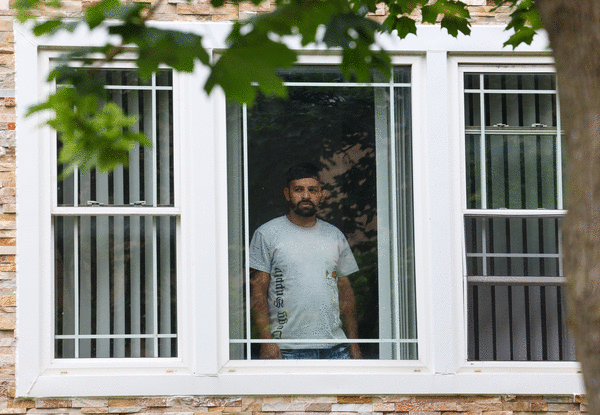
CHICAGO — After spending nearly eight months in detention facilities across the United States, Jose Enrique Ojeda Duarte was finally deported to his native Venezuela in early April. He had been detained while on his way to work in Chicago in September, at the height of Operation Midway Blitz.
Almost a month after arriving in Venezuela, the U.S. government acknowledged that his deportation was an “error,” according to court records reviewed by the Chicago Tribune. The week before Father’s Day, he arrived at O’Hare International Airport, reuniting with his partner and two young sons.
“It felt surreal. I couldn’t grasp what was happening. It felt like a true miracle to see him walk inside our home again,” said Leydimar Castillo, his partner.
Ojeda Duarte sat beside her on the black couch in the home they share with relatives on the South Side. His eyes shifted frequently toward the window. He startled at unexpected sounds as their children darted through the house, a puppy chasing after them. Though the effects of his harrowing ordeal still linger, he repeatedly expressed his gratitude for being home.
“I just want to get back to work,” he said.
Ojeda Duarte’s return is a rare admission of error by the Trump administration, which has taken a hard and often defiant approach to immigration enforcement. While a spokesperson for the U.S. Department of Homeland Security said Ojeda Duarte has “no legal status to be here” and blamed an “Obama-era judge” for his return, the government acknowledged in court records that Ojeda Duarte’s removal from the United States was an “inadvertent error due to a data quality issue” within its “case information system.”
Ojeda Duarte’s case, which stretched across detention centers, courtrooms, churches and international borders, raises broader questions about due process and the speed of immigration enforcement. Immigration attorneys and advocates ask: How many people may have been wrongfully deported but lack the legal representation, resources or access to the courts necessary to challenge their removal?
In the Chicago area alone, at least two other immigrants have returned to the United States after being wrongfully deported this year, according to the attorneys representing them.
Ojeda Duarte’s attorney argues the government’s admission that his deportation was erroneous is also an acknowledgment that authorities wrongfully detained him in the first place. It’s part of a pattern, she says, of immigration officials disregarding court orders and violating their own procedures.
“The government did acknowledge the error,” said Afshan J. Khan, owner of the Law Office of Afshan J. Khan. “They acknowledged that it was wrong. He was wrongfully removed.”
A husband and father of two boys, now 8 and 11, Ojeda Duarte said he fled Venezuela with his family after he refused orders that would have required him to harm innocent people while serving in then-President Nicolás Maduro’s military.
Ojeda Duarte and his family crossed into the United States in 2023 after a year-and-a-half journey by foot, bus and train across several countries. After arriving in the Chicago area, he applied for asylum and obtained a work permit, according to court records.
Despite his pending asylum case, immigration agents arrested him early on Sept. 15, 2025, while he was on his way to a construction job.
After processing him at the Broadview facility, authorities transferred him through multiple detention centers before ultimately placing him at the Montana Detention Center in El Paso, Texas, according to Ojeda Duarte and court records.
There, conditions were harsh, Ojeda Duarte and his attorneys said. He contracted COVID-19 but received no medical treatment, he said. Tent roofs leaked during rainstorms. Food was sometimes served partially frozen, and detainees reported finding worms in meals.
Over the following months, Ojeda Duarte appeared before an immigration judge several times.
On March 20, an immigration judge issued a removal order. Ojeda Duarte’s attorneys filed an appeal on April 9, well before the April 20 deadline, his attorneys said, which should have allowed him to remain in the country while the case continued.
Separately, they filed a federal habeas corpus petition arguing that immigration authorities had detained him without properly considering his individual circumstances and had denied him due process.
“They were paroled in. They followed the appropriate protocol,” Khan said. “They applied for asylum through USCIS. They complied with everything.”
Meanwhile, immigration authorities moved him repeatedly, often in the middle of the night, Ojeda Duarte and court records say. He was transferred several times from the detention center in El Paso before finally landing at the facility near Phoenix, which is known to be the last stop before deportation.
“When I got a call that he was in Phoenix, I knew something bad was going to happen,” Castillo said.
On April 13, he was deported to Caracas, Venezuela.
“I felt defeated,” Ojeda Duarte said. “But I was also relieved because I had survived. It’s hard to explain.”
Ojeda Duarte said Venezuelan authorities questioned him for three days after he arrived. He said they treated him well, and, after he was released, he traveled to the small town in Trujillo state where his brother and elderly grandmother live.
There, Ojeda Duarte reached out to people in the United States who had been advocating for his release, sending videos to let them know he was alive and had made it home safely. In one video sent to Steven Raseman, a coordinator at St. Anne Catholic Community’s migrant ministry in Barrington, Ojeda Duarte walked through the family’s home in Venezuela, an adobe structure with broken windows and dirt floors.
His grandmother appeared in the video asking for help.
“He was in the United States, and he was working to help us out here,” she said in Spanish.
Ojeda Duarte came home to his family struggling. Both of his parents are deceased, and his grandmother was caring for his younger brother, who was suffering from a severe leg injury. They were unable to afford surgery to fix it.
Yet even while confronting those realities, Ojeda Duarte worried about the family he had left behind in Chicago.
When Ojeda Duarte was arrested, his partner was left alone to care for their two young sons.
But with the help of attorneys and a network of volunteers organized by Raseman, the family stayed afloat. Raseman had first learned about the family through a network of churches helping migrants in the Chicago area.
“They’re really having a tough time paying their bills,” he recalled.
Volunteers stepped in immediately to help pay rent, deliver fresh food, furniture, clothing and toys for the children.
Then came the unexpected development. The U.S. government acknowledged his deportation had been an error, Khan, his attorney, said.
U.S. authorities instructed Ojeda Duarte to obtain a new passport and then to travel to Bogotá, Colombia, where he could obtain the documentation needed to return to the United States.
The U.S. Embassy in Caracas, which reopened in March after a seven-year hiatus, offers limited services.
So Ojeda Duarte embarked on a grueling two-and-a-half-day bus journey across Venezuela and into Colombia, a route not unlike the one he had traveled years earlier on his journey north.
Through connections established by St. Anne’s, an Episcopal priest and members of the Diocese of Bogotá helped arrange lodging and transportation along the way.
Khan persuaded the U.S. government to allow Ojeda Duarte to take a commercial flight back to the United States instead of having to travel back to Caracas for an ICE charter flight.
“My concern was that I didn’t want him chained or shackled or handcuffed,” Khan said.
Raseman and other volunteers helped fund the commercial flight from Bogotá to Dallas and then to El Paso.
But Ojeda Duarte returned to ICE custody when he arrived in Texas. A federal judge ordered him back to the court’s jurisdiction in Texas while litigation continued.
After landing in El Paso, Ceci Herrera, who had visited him through detention-center glass since December, was waiting at the airport.
The immigration officer escorting him allowed the two to hug. Herrera handed him $50 for his commissary account and posed for a photograph with him.
“They are such good people. They helped me stay strong,” Ojeda Duarte said.
On June 11, a federal judge granted Ojeda Duarte’s habeas petition and set a $1,500 bond.
The following day, the government appealed the ruling, delaying his release once again.
Around the same time, Khan learned that Ojeda Duarte might also qualify for release under a 2022 consent decree known as the Castañon Nava agreement. The agreement bars agents from making warrantless immigration arrests unless they have probable cause to believe someone is in the U.S. unlawfully and that the person is a flight risk.
“He literally traveled from Bogotá back into custody,” Khan said. “Clearly, he’s not a flight risk.”
Ultimately, Ojeda Duarte was released without having to post bond based on the Castañon Nava decision, Khan said. On June 14, Ojeda Duarte boarded a plane bound for Chicago.
For the first time in months, his sons no longer had to speak with their father through phone calls and video screens.
He walked through the doors of O’Hare and into the arms of his family, ending an odyssey that took him from Chicago to detention centers across the country, to Venezuela and back again.
Many deportation cases end the moment someone leaves the country. Ojeda Duarte’s nearly did, Raseman said.
“When you meet people like this, and you see how unfair it is, it’s on your mind a lot,” he said.
What made Ojeda Duarte’s case different, Khan said, was the support system around him. Without that network, she wonders how many similar cases disappear without public attention.
Khan says the story ultimately comes down to something simpler than legal filings or court orders.
“All they’re trying to do is have a better life for their families. They’re trying to follow the rules,” she said. “And unfortunately, they’re being punished for that.”
The day after Ojeda Duarte returned home, Raseman and his wife stopped by with lunch.
The boys were outside riding bicycles that volunteers had helped provide.
For Raseman, Ojeda Duarte’s story has never been solely about immigration policy. It’s about what happens after you get to know someone’s story.
“Once you see it, you can’t really look away.”
And for one family, an entire community refused to.
_____
©2026 Chicago Tribune. Visit chicagotribune.com. Distributed by Tribune Content Agency, LLC.





Comments