NC sues Trump administration over Medicaid eligibility changes
Published in News & Features
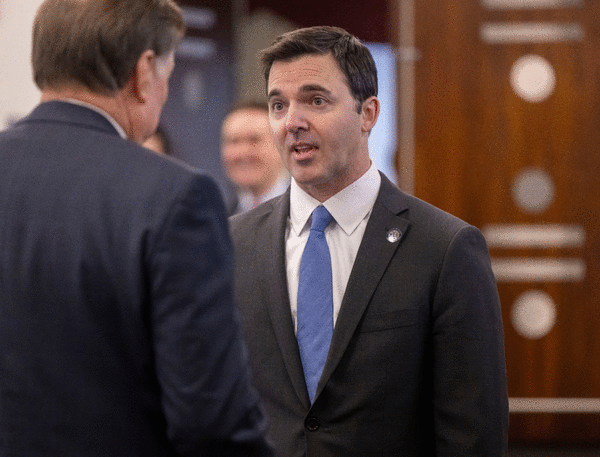
RALEIGH, N.C. — North Carolina Attorney General Jeff Jackson is suing the Trump administration over changes to work requirement exemptions for medically frail individuals, which he contends could jeopardize the coverage of tens of thousands of North Carolinians with severe illnesses.
Jackson, a Democrat, and the other officials bringing the lawsuit allege that the Centers for Medicare and Medicaid Services, or CMS, and the federal Department of Health and Human Services violated congressionally passed protections that exempt certain individuals with severe illnesses who access Medicaid from meeting new federal work requirements.
The One Big Beautiful Bill Act, passed in July 2025, established an 80-hour monthly work requirement for individuals who access Medicaid through expansion. The bill created an exemption for those who are considered medically frail — or those who have a serious physical, intellectual or developmental condition. But Jackson alleges that modified requirements released by CMS in June, which make it more difficult for states to prove someone’s medical frailty, are “sloppy and haphazard” and violate the law.
“(CMS) led the entire country to believe that they were going to follow the law as Congress wrote it when it comes to the most seriously ill people who are on Medicaid,” Jackson told The News & Observer in a phone interview. “And pretty much at the last minute, they changed their minds, and they decided to create their own test for whether someone is going to continue receiving Medicaid even while they’re actively being treated for one of the most serious illnesses you can have.”
Medicaid is jointly funded by the federal government and states. More than 730,000 North Carolinians have enrolled in Medicaid since the state expanded the program in 2023, pushing the total number of enrollees to more than 3 million.
Jackson said that the new rules from CMS create “a whole new bureaucracy” without clear guidance, leading states and counties to “scramble.” He also said that the new requirement puts patients with serious illnesses at risk, and that the increased amount of paperwork and medical records needed to prove their inability to work would be overwhelming.
“The consequences for the most seriously ill people in our state could be dire,” Jackson told The N&O. “Obviously, we’re talking about people who require active medical treatment, and if that gets pulled away from them, there’s no overstating how bad the consequences could be.”
Jackson said that rural communities will be hit the hardest by the new CMS rules. According to the North Carolina Department of Health and Human Services, rural residents make up nearly 37% of total Medicaid recipients in the state and the program provides healthcare coverage for more than half of the residents in seven counties.
If Medicaid enrollees lose their coverage and become eligible later, they would likely return in a worsened condition, Jackson said, which would require treatments that would be more expensive for the state to cover. He said that he’s currently calculating estimates on taxpayer cost to use in the lawsuit.
“Our priority is to ensure eligible North Carolinians get and keep vital health care coverage they need to live healthy, productive lives,” Dev Sangvai, the state Health and Human Services secretary, said in a press release. “The current guidance from our federal partners creates a barrier to care for some of the most vulnerable people in our state. We are grateful for the partnership with the North Carolina Department of Justice who shares our goal of protecting the life-saving care so many of our friends and neighbors depend on.”
The lawsuit was filed with the attorneys general of another 22 states and the District of Columbia and the governors of Kentucky and Pennsylvania. North Carolina is one of four Southern states in the lawsuit.
All the attorneys general and governors involved in the lawsuit are Democrats. But Jackson said that he senses that both Democrats and Republicans understand the consequences of this new guidance if states don’t take action.
“I think when an agency clearly disregards congressional intent, that gives you very strong evidence that the law was broken,” Jackson said.
Jackson said that he’s spoken to many organizations who say that Medicaid enrollees’ are “desperate” for the state’s help in this lawsuit.
Burden on state health departments
The One Big Beautiful Bill requires state Medicaid services to create new mechanisms to assess whether medically frail enrollees will have to work. This original mandate alone was expected to cost North Carolina tens of millions of dollars to implement.
Melanie Bush, deputy secretary for North Carolina Medicaid, previously told The N&O that the new rules have put a pause on some of the progress that the state Department of Health and Human Services had made toward the previous requirements laid out in the One Big Beautiful Bill Act.
Jackson told The N&O that NCDHHS was once confident that they could meet federal compliance by the Jan. 1 deadline. But now, officials have told him that they’re unsure.
Jackson also said that he worries that the money spent creating systems to implement Congress’ original work requirements will go to waste if states are forced to comply with the new CMS rules.
“Congress included the medical frailty protections to prevent individuals with serious health conditions from losing the healthcare coverage they need,” Rhaegan Jackson, director of health access for the North Carolina Alliance for Health, said in a press release. “Rather than advancing that goal, the additional documentation and verification requirements in (CMS rules) create new administrative burdens for providers, patients, and state agencies, making it more difficult for medically vulnerable North Carolinians to maintain coverage, even when their health needs and eligibility have not changed.”
President Donald Trump said last year before the One Big Beautiful Bill Act passed that it was “not touching” Medicaid, but would eliminate “waste, fraud and abuse.”
Jackson said that his agency’s Medicaid Investigations Division has returned millions of dollars tied to Medicaid fraud this year.
_____
©2026 The News & Observer. Visit at newsobserver.com. Distributed at Tribune Content Agency, LLC.






Comments