Trump's troop withdrawal leaves Germany's base towns in limbo
Published in News & Features
In Wiesbaden’s leafy Neroberg neighborhood, a steady stream of Americans rented Birgit Bug’s apartment with underfloor heating and a balcony. The tenants typically stayed for two to three years while being deployed at the nearby U.S. Army command post in the German city.
The situation worked seamlessly for a decade, but after the former occupants returned to Utah in October, the spacious flat remained empty for five months. The extended vacancy is emblematic of how Donald Trump’s threats to withdraw troops from Germany are already rippling across towns that have hosted the American military for decades.
“After the last tenants moved out, it was clear to us that there’s uncertainty among potential renters from the U.S,” said Bug, a 61-year-old flight attendant. “As long as Trump’s in office, everything is possible.”
While vastly diminished after the fall of the Berlin Wall in 1989, the presence of the U.S. military has been a constant in Germany since the end of World War II. Troops, weapons and command centers represent a tangible link in the transatlantic alliance and are still a critical support for communities in the heart of Europe.
About 37,000 soldiers are still permanently stationed in Germany, the U.S. army’s second-largest overseas deployment after Japan. Facilities include the giant Ramstein Air Base, the largest military medical facility outside of the U.S., a garrison in Bavaria and the army’s European and African headquarters in Wiesbaden.
Now, the threat of a further drawdown collides with Germany’s stubborn economic malaise, linked to energy costs that have surged in the fallout from U.S.-led attacks on Iran and Russia’s invasion of Ukraine.
Trump’s antagonistic relationship with Europe — and Germany in particular — is regularly on display, stoking anxiety in communities that rely on American defense spending. In a bid to smooth tensions at the G7 summit in France this month, Chancellor Friedrich Merz gave Trump a jersey of the Germany national soccer team with the president’s name on the back.
The gift was in some ways a response to the German conservative criticizing the U.S. in April for getting “humiliated” in ceasefire negotiations with Iran. Trump responded with a social media post about troop withdrawals, in what appeared to be “a form of petty retribution,” according to Ben Hodges, a former commanding general for the U.S. Army in Europe.
“My frustration was tied to the absence of any kind of explanation,” said Hodges, who lives in Frankfurt. “What’s the strategy here other than punishing the chancellor?”
The U.S. Defense Department did not respond to a request for comment.
Hodges embodies past relations between Germany and the U.S. military. After starting his overseas career near the port city of Bremen in 1981, he concluded his active service in Wiesbaden in 2017 and decided to stay in Germany.
From his home in Frankfurt’s Westend neighborhood, the retired general can see the historic IG Farben building, a symbol of the countries’ shared history. The former headquarters of the chemical giant that created poison for Nazi death camps served as a post for the U.S. military until the 1990s.
As part of the peace dividend from the end of the Cold War, the complex was returned to Germany and has become a campus for university students learning about philosophy, history and theology.
The back and forth over U.S. troops comes as Germany invests to create Europe’s strongest conventional army and lays the groundwork for reviving conscription, a controversial subject for a country that has embraced pacifism in the aftermath of World War II. Uncertainty about the country’s changing defense landscape can be felt especially in Vilseck.
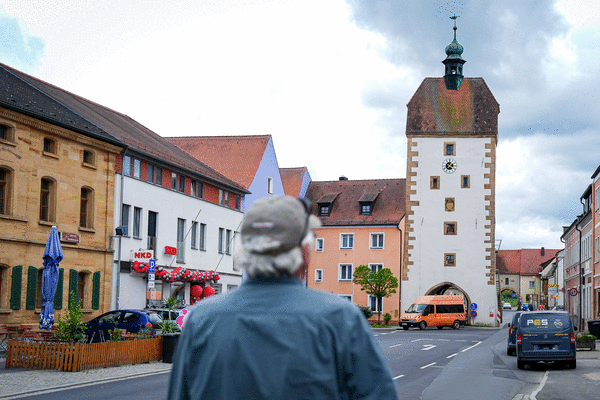
The small town in northern Bavaria — close to the Czech border and the former Iron Curtain — hosts a regiment with almost 5,000 soldiers ready to defend NATO, if necessary. The force trains with conventional weapons including combat vehicles and has been at the forefront of testing drones. Should the U.S. reduce or redeploy troops in Europe, the municipality thinks it’s first in line.
The threat has hung over Vilseck Mayor Thorsten Grädler ever since his first day in office in early May. When he became aware of the issue through local media, he said he was “shocked.” With no official information to go on, he scours the web daily for news that could devastate the community.
Counting families, the broader region hosts roughly 30,000 Americans, more than a third of which could leave if the U.S. withdraws troops, Vilseck’s mayor estimates.
Given the town’s population of about 6,500, a withdrawal would mark “a dramatic blow to the entire economic and social life,” Grädler said.
The U.S. military has been in the region for over 80 years and is its largest employer today, helping support events like knight camps, a renaissance fair with falcon shows and merchants around the local castle. In terms of hard numbers, the economic contribution to the region is in the range of 650 million to 700 million euros ($800 million) a year, according to the mayor.
The potential long-term impact could mean about one full-time job lost for every two soldiers withdrawn, according to a study by the ZEW Leibniz Centre for European Economic Research and the University of Cologne.
The researchers evaluated the effect of troop reductions in the early 1990s, when geopolitical shifts after the Cold War led to the removal of roughly 200,000 U.S. soldiers from Germany in about five years. Municipal revenues declined about 9%, and the negative impacts on employment and public finances are still measurable today.
“We noticed that the effects of troop withdrawals are very similar to those of companies closing down in a region,” said Johannes Kochems, one of the co-authors. The study found the most pronounced impact was in rural locations that heavily depend on the bases — an ominous sign for Vilseck.
With Defense Secretary Pete Hegseth due to complete a review of the U.S.’s military presence in Europe towards the end of the year, the town isn’t waiting to find out if the worst-case scenario will arrive.
To develop an alternative job base, a new industrial park is opening this fall. While that’s a start, Mayor Grädler acknowledges that the region won’t be able to fully offset troop reductions, and attracting investment continues to be challenging as Germany faces a fourth consecutive year without significant growth.
In the wealthy outskirts of Frankfurt, the region around Wiesbaden hosts about 23,000 troop-affiliated Americans, including soldiers, civilian employees and family members, making it one of the larger U.S. military enclaves in Germany.
Several sites and housing areas in and around the capital of the state of Hesse are connected with their own shuttle-bus service. The largest site is the Wiesbaden Army Airfield, which includes sports facilities, restaurants, a chapel and a veterinary clinic.
Despite the concerns over the U.S. reducing its presence, others see opportunities. That was the case in 2013 when the U.S. army moved its headquarters from Heidelberg to Wiesbaden. Vacated sites in the picturesque university town and the nearby industrial city of Mannheim were turned into much-needed housing for tens of thousands of residents.
That could serve as a model for other densely populated areas. Carl-Michael Baum, who works as a U.S. military liaison officer for the city of Wiesbaden, has a backup plan in case withdrawals reach his city and open up space for residential and commercial renewal.
“We already have ideas about what we could develop there,” he said.
———
(With assistance from Jenny Leonard.)
©2026 Bloomberg L.P. Visit bloomberg.com. Distributed by Tribune Content Agency, LLC.






Comments