California revives $900 million homelessness program after Newsom reverses course
Published in News & Features
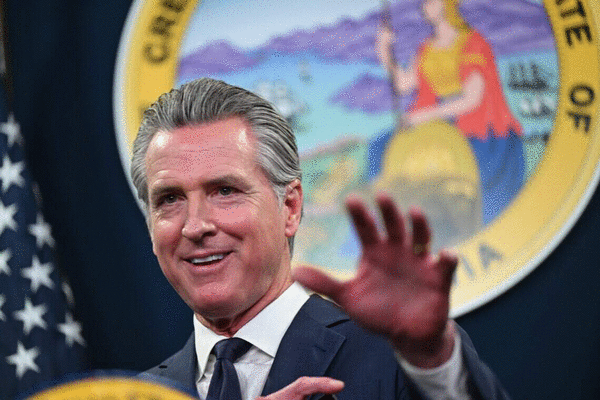
Nearly $1 billion in state homelessness funding will flow to California cities and counties after Gov. Gavin Newsom shifted his stance on limiting new spending on the state’s centerpiece program for shelters, services and permanent housing.
In a victory for cities, counties and advocates for homeless Californians, the 2026-27 budget agreement hammered out between Newsom and top Democrats in the state legislature includes $900 million for the state’s Homeless Housing, Assistance and Prevention grant program.
Since Newsom created the program in 2019, it has been the main way California funds services for homeless people, and is often credited for helping to shrink the state’s population of people without permanent homes or shelter. Through the program, more than 110,000 people statewide have been placed in permanent housing since January 2023, according to state data. Nearly 400,000 people have received services of some kind. Homelessness in the state declined 3% in 2025, according to federal data, the first drop since 2018.
Newsom opposed new funding for the program last year, saying he wanted better results from the counties and cities that operate local safety net systems. Officials in the Bay Area said the governor’s stance threatened fragile progress made on unsheltered homelessness in the region.
The agreement represents a compromise: lawmakers won a larger investment than Newsom had proposed, while cities and counties will have to meet new reporting requirements and put up more local money to qualify.
“That’s one of the battles we were picking to fight,” said South Bay state Sen. Dave Cortese, a Democrat. “We really didn’t want to back down on our side.”
In a statement, a spokesperson for the governor said the agreement “reflects Governor Newsom’s longstanding commitment to addressing homelessness.”
Cities and advocates celebrated the renewed investment on Monday. The funding is contained in an add-on to the state budget, known as a trailer bill, that lawmakers expect to pass this week.
“Cities are working every day to connect people experiencing homelessness with housing and services,” said Carolyn Coleman, CEO of the League of California Cities. The funding “recognizes this important work and helps build on the progress already underway,” she said.
The program has awarded more than $4 billion in grants since 2019, state data shows. The biggest portion — $525 million — subsidized the operations of nonprofit service providers that hold city and county contracts to deliver services directly to homeless people. About $410 million went toward interim housing, such as tiny homes or motels, and $323 million for permanent housing.
Local governments and groups in the nine-county Bay Area have been allocated $754 million. Housing officials have long said the funding is critical.
Earlier this year, Oakland closed two shelters in part because of lapses in state funding. Santa Clara County and San Jose have expanded a rental assistance program seen regionally as a model for preventing homelessness and doubled the number of shelter beds, in part with state funds.
Newsom and lawmakers poured billions of dollars into the program between 2021 and 2024. By that point, California’s population of unhoused people was still growing, but slower than the national pace. Newsom credited investments in homelessness services for its flat rate of unsheltered homelessness — people living not in shelters but in tents, cars or on the street.
The governor’s tone began to change after a blistering audit in 2024 found that agencies had failed to track at least $24 billion spent to combat homelessness between 2018 and 2023. Last winter, Newsom threatened to withhold funding from local governments that were not making progress on homelessness.
“At the end of the day, people want outcomes, and they want results for their money spent,” Newsom said then in a press conference.
At the governor’s behest, last summer’s state budget agreement included no new funding for the homelessness program. Newsom’s office in January released a plan to invest $500 million more, with more “accountability” measures to ensure local governments were spending the money effectively. That kicked off months of negotiations with state lawmakers, which culminated in the budget agreement finalized this week.
“We needed more,” said Assemblymember Ash Kalra, a San Jose Democrat. “This program is incredibly important.”
As Newsom’s office agreed to spend $400 million more on the program, state lawmakers agreed to some tighter restrictions for cities and counties that receive the funding. To be eligible for the next round of spending, they will have to track the demographics of program recipients and report a list of encampments — and plans to tackle them — to state officials.
California’s largest cities and counties — 11 counties and 14 cities — will be required to show they can match 70% of the state funds with their own investments.
That shouldn’t be a barrier for most local governments, said Sharon Rapport, director of California policy for the Corporation for Supportive Housing.
“Most of them are investing in solutions to homelessness,” she said.
Rapport said she was “thrilled” with the new spending, but it’s far short of the investment needed to solve homelessness in California, she said. According to the Corporation for Supportive Housing, that would take about $6 billion more each year, from state coffers or other funding sources.
“What the state is spending now is a lot more than what the state has ever spent on homelessness,” Rapport said. “We don’t expect the state to like, all of the sudden, go from zero to 6 billion.”
_____
©2026 MediaNews Group, Inc. Visit at mercurynews.com. Distributed by Tribune Content Agency, LLC.






Comments