Venezuela quake death toll hits 1,719 as anger at government grows
Published in News & Features
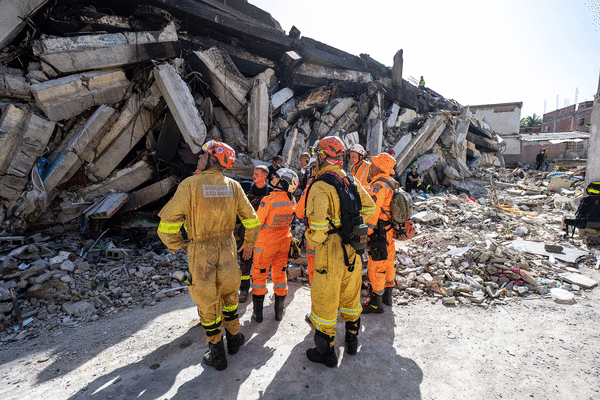
Venezuela’s earthquake catastrophe entered its fifth day Monday with rescue crews still combing through mountains of rubble for survivors, even as mounting anger over the government’s handling of the disaster threatened to open a new political front for the country’s embattled socialist leadership.
Authorities said the official death toll has now risen to at least 1,719, with 5,034 injured, 15,866 displaced from their homes and 22,619 people officially classified as affected, according to updated figures released Monday by National Assembly President Jorge Rodríguez. The latest toll marks another sharp increase in casualties from the twin 7.2 and 7.5 magnitude earthquakes that struck Venezuela on June 24 just 39 seconds apart, though many analysts warn the final death toll could climb significantly higher.
The humanitarian emergency remains most severe in La Guaira, Caracas and surrounding central states, where hundreds of aftershocks continue to rattle already weakened structures, complicating rescue efforts and keeping many residents too fearful to return home.
Rodríguez said the country has now recorded 611 seismic events since the disaster began, including the two main earthquakes and 609 aftershocks, underscoring the persistent instability of the affected region. He said a 4.2 magnitude aftershock struck Monday morning, triggering renewed concern among residents but causing no additional structural damage or casualties.
As the rescue effort stretched into a fifth day, frustration is growing among survivors and volunteers who accuse authorities of slowing aid deliveries, restricting civilian rescue efforts and understating the true scale of the tragedy.
That frustration is increasingly becoming a political problem for the interim government of Delcy Rodríguez, which took power in January after a U.S. operation captured former leader Nicolás Maduro.
For many Venezuelans, the disaster is exposing institutional weaknesses that long predated the earthquakes.
“Emotionally, the country is deeply shaken,” said Venezuelan pollster Rubén Chirinos, president of Meganalisis, after conducting informal field soundings in multiple states. “But the anger toward the government’s response is on another level.”
According to Chirinos, public outrage is especially intense toward the armed forces, police and senior Chavista officials, including Delcy Rodríguez, Interior Minister Diosdado Cabello and National Assembly President Jorge Rodríguez.
He said one of the biggest grievances centers on allegations that authorities obstructed humanitarian aid collected by civilians during the critical first hours after the disaster.
“The two biggest sources of anger are clear,” Chirinos said. “First, the obstruction of aid organized by ordinary citizens. Second, the inaction — or worse — of the armed forces.”
Videos circulating on social media over the weekend showed residents confronting military personnel, accusing them of standing by while civilians carried out rescue operations with little official assistance.
In some videos, survivors accused soldiers of looting apartments and confiscating donated supplies — claims that remain difficult to independently verify but have fueled widespread outrage.
The armed forces, already burdened by years of public distrust, now face what analysts say could be a near-total collapse in legitimacy.
Chirinos said previous polling already showed military disapproval above 70%, and he believes the earthquake response may have pushed public sentiment beyond repair.
“This was their chance to rehabilitate their image,” he said. “Instead, many Venezuelans feel they became spectators to the tragedy.”
Public skepticism has also intensified over the government’s casualty figures.
Although the official death toll now stands above 1,700, many Venezuelans believe the true number of victims is far higher.
Online missing-person registries contain tens of thousands of names submitted by families searching for loved ones, though not all entries necessarily represent confirmed missing persons, as communications outages and transport disruptions continue to hamper reunification efforts.
Chirinos compared the government’s handling of casualty data to the information management seen during COVID-19, when many Venezuelans accused authorities of minimizing deaths and infections.
“The government’s figures do not reflect what people believe they are seeing,” he said.
He argued that the widening gap between official statistics and public perception may be becoming almost as politically damaging as the disaster itself.
New official assessments also point to enormous structural destruction.
Rodríguez said 855 buildings have been affected, including 189 that collapsed completely and 666 that suffered partial collapse or severe structural damage. The damaged structures include residential towers, apartment blocks, schools, commercial buildings and public facilities, complicating rescue and recovery operations.
Independent satellite-based damage assessments from NASA suggest the destruction could be even more extensive.
According to a rapid preliminary assessment using satellite radar imagery, the twin earthquakes may have damaged or destroyed as many as 58,870 buildings across the affected region, pointing to destruction on a scale far beyond what authorities have publicly detailed.
NASA said the estimate was generated using data from the Sentinel-1 radar satellite, part of the European Union’s Copernicus Earth observation program, stressing that the analysis remains preliminary and has not yet been fully validated.
The assessment compared radar imagery collected on June 24 and June 25 with reference images captured over the previous year to detect structural anomalies consistent with building damage or collapse. The affected zone stretches from Caracas to Puerto Cabello, roughly 130 miles west of the capital, encompassing some of Venezuela’s most densely populated urban corridors.
The European Space Agency is also using Sentinel-1 data to map ground deformation caused by the earthquakes. Preliminary analysis shows measurable terrain shifts across broad sections of Venezuela’s central coast, underscoring the extraordinary tectonic force unleashed by the back-to-back 7.2 and 7.5 magnitude quakes.
As the crisis deepens, the United Nations has taken a central role in coordinating the international rescue effort in collaboration with the Rodríguez government.
According to the latest official figures, 3,319 foreign rescuers from 45 international delegations are now operating in Venezuela, supported by 140 rescue dogs, 49 support vehicles, and 707,063 humanitarian aid items.
Gianluca Rampolla, the U.N.’s resident and humanitarian coordinator for Venezuela, said Monday that the international operation remains focused primarily on locating survivors trapped beneath collapsed structures.
Although the critical first 72 hours after a major earthquake — typically considered the most important window for finding survivors alive — have already passed, Rampolla said search-and-rescue efforts remain the immediate priority.
“We are coordinating efforts to provide emergency health assistance, shelter, food aid, water and sanitation, logistical support, and to ensure not only the storage but also the distribution of all supplies arriving in the country,” Rampolla said during a videoconference briefing.
Rampolla defended the U.N.’s close coordination with Venezuelan authorities, saying cooperation with the Rodríguez government was necessary to ensure “the best possible use and maximum impact of the resources” being deployed.
He also highlighted what he described as close cooperation with U.S. rescue teams, noting Washington was among the first governments to commit emergency funding after the disaster. His remarks underscored the unusual level of coordination between Venezuelan authorities, the United Nations and American responders despite years of political tensions.
Rodríguez said the humanitarian response has expanded significantly. Authorities have provided medical care to 12,402 people, assisted 75,238 families, distributed 7,237,000 kilograms of food, and delivered 22,478 food bags across La Guaira and other affected states. Officials also reported the distribution of 754,038 liters of water and said 90% of electrical service in La Guaira has been restored.
Rodríguez also announced two specialized commissions appointed by President Rodríguez. One is tasked with assessing whether damaged buildings remain habitable, while the second is focused on establishing temporary shelter infrastructure.
Authorities said 15 major shelters have been established in La Guaira, along with 50 provisional camps in Greater Caracas.
Volunteer mobilization has also surged. Rodríguez said 10,834 volunteers have now registered through the Poliedro de Caracas, where they are being assigned to rescue operations, logistics, food distribution, medical support and security assistance.
Jorge Rodríguez has repeatedly urged citizens to channel donations through official networks and avoid self-deploying to disaster zones. Authorities have also warned against misinformation circulating online, including false claims about infrastructure failures and casualty figures.
Still, criticism continues to grow.
In affected neighborhoods, survivors increasingly describe a stark contrast between the speed of citizen-led relief and the slower, more bureaucratic state response.
For more than two decades, Chavismo built much of its legitimacy around the promise of a strong state capable of protecting ordinary Venezuelans during times of crisis.
Critics say the earthquake has severely damaged that narrative.
Chirinos described the situation as a contrast between “two Venezuelas.”
“One Venezuela is solidarity, sacrifice and ordinary people helping each other,” he said. “The other is bureaucracy, obstruction and indifference.”
For now, large-scale unrest remains unlikely, as most Venezuelans remain focused on survival—searching for medicine, shelter, food and missing relatives.
But analysts warn that could change once the immediate emergency subsides.
“The only thing containing the anger right now is the emergency itself,” Chirinos said.
“People are too busy surviving.”
©2026 Miami Herald. Visit at miamiherald.com. Distributed by Tribune Content Agency, LLC.




Comments