Colorado Supreme Court rejects congressional redistricting ballot measures in blow to Democrats' 2028 plans
Published in News & Features
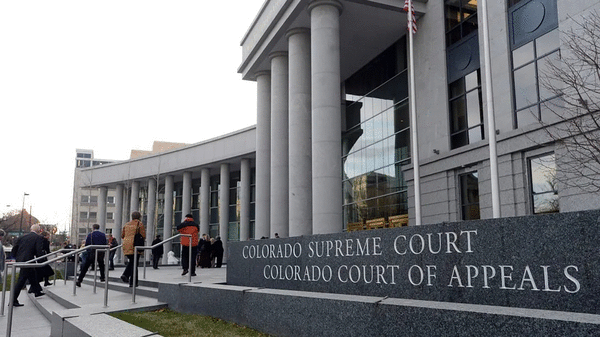
DENVER — The Colorado Supreme Court rejected multiple proposed ballot measures Monday that would have asked voters to redraw the state’s electoral maps for the 2028 election to give Democrats an advantage in seven of eight congressional districts.
For now, the two unanimous rulings knock Colorado out of the nationwide partisan redistricting wars kicked off by President Donald Trump as Republican- and Democratic-led states have jockeyed for an advantage by adopting new congressional maps.
The state Supreme Court concluded that the ballot measures violated the state’s requirement that ballot proposals encompass only a single subject, rejecting claims by proponents that the proposals “point in the same direction.” Three of the rejected ballot measures were backed by Democrats seeking to grow their congressional power in the state, while two more were backed by conservatives with similar aims for Republican candidates.
“Changing long-settled law by modifying the timing, frequency, criteria, and entity responsible for congressional redistricting represents a significant change beyond the proponents’ stated central purposes (of) ... congressional redistricting by adopting a new temporary map,” Chief Justice Monica Márquez wrote in one of the opinions.
In Colorado, Democrats initially sought to redraw the state’s maps ahead of the 2028 election — the soonest new boundaries could take effect here — prompting retaliatory proposals from Republicans. But given Colorado’s distinctly Democratic voter base, the liberal push was likely to find more fertile ground here, had one of the Democrats’ measures reached the ballot box.
Democrats and Republicans currently have a 4-4 split in representation in Colorado’s U.S. House districts, with one of those considered a swing district. Colorado’s congressional and state legislative districts are drawn by an independent redistricting commission, which was created through separate ballot measures and first produced maps in 2022, after the 2020 census.
Had the Democrat-backed proposals advanced and passed this November, liberal candidates would’ve had a distinct advantage in as many as seven of the state’s seats for the 2028 and 2030 elections.
In her opinion rejecting two of the ballot measures, Márquez wrote that each proposal “represents a seismic shift to Colorado’s longstanding redistricting process enshrined in the state constitution.” The other opinion was authored by Justice Richard L. Gabriel.
The defeat scuttles Democrats’ efforts to expand the redistricting wars, which kicked off last year after Texas Republicans altered their maps. That was followed by a spree of map-redrawing across the country.
The campaign behind the Democratic redistricting proposals has already raised $2.3 million and has spent more than $2 million of it, in large part to gather signatures for the ballot. Much of that money has come from the Fairness Project, which has backed liberal ballot measures elsewhere, and American Opportunity Action, a relatively new, Democrat-aligned dark money outfit.
The campaign also received $150,000 from a political action committee tied to the Democratic caucus in the U.S. House.
_____
©2026 MediaNews Group, Inc. Visit at denverpost.com. Distributed by Tribune Content Agency, LLC.






Comments