NY prosecutors dismiss rape count against Harvey Weinstein as victim says she can't handle another trial
Published in News & Features
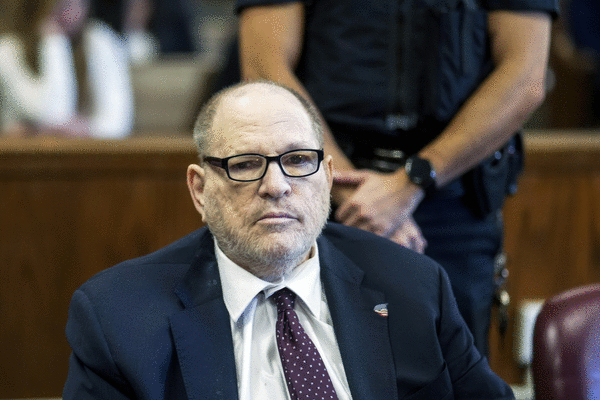
NEW YORK — Manhattan prosecutors moved to dismiss their rape case against Harvey Weinstein on Thursday after Jessica Mann — among the first women to come forward against the once-powerful Hollywood producer — said she could not bear the brutality of taking the stand a fourth time.
The move announced at a Manhattan Supreme Court hearing came after jurors last month could not agree about whether Weinstein was guilty of raping Mann inside a Midtown hotel room in March 2013. The outcome was a repeat of the disgraced producer’s 2025 prosecution that ended in a partial mistrial.
The Miramax founder, 74, was found guilty of raping Mann at his first trial in 2020 — in addition to sexually assaulting Miriam Haley, a former “Project Runway” assistant — but that conviction was overturned by the Court of Appeals in 2024 after New York’s highest court determined in a split decision that the jury shouldn’t have heard sexual assault allegations from other women that didn’t make up part of the charges.
In a statement read aloud by Assistant District Attorney Nicole Blumberg, Mann said her participation in Weinstein’s prosecutions had stolen a decade of her life and left her feeling “fragmented, silenced, defamed and traumatized.”
“Living with sexual abuse trauma is one aspect of surviving a crime — and it is wholly another infliction to go to court and face the man who raped you,” Mann said. “I warn earnestly, nothing could have prepared me for the deeper re-traumatization and additional trauma taking the stand induces.”
Manhattan District Attorney Alvin Bragg said the decision not to retry the case had nothing to do with the strength of Mann’s accusations.
“To be clear, we believe Ms. Mann’s account and her credibility as a witness,” Bragg said in a statement. “This has been an extraordinarily taxing ordeal for her, and she has never wavered while testifying in front of two grand juries and three trial juries over the course of eight years.”
Outside the courthouse, Weinstein’s attorney, Marc Agnifilo, counted the dismissal as tantamount to a victory. The attorney said he was intent on freeing the notorious sexual predator whose downfall spurred the global #MeToo campaign against sexual abuse fueled by power dynamics.
“There’s a lot that is going to have to be unraveled,” Agnifilo said. “I think there are problems with each of the convictions.”
While jurors couldn’t agree on Mann in 2025, Weinstein was convicted anew of assaulting Haley. Manhattan Supreme Court Justice Curtis Farber on Thursday said he would sentence Weinstein for that conviction on Sept. 23. Bragg said his office would seek a 20-year term.
Once he’s sentenced, Weinstein is headed back to Los Angeles to begin serving a 16-year prison term for his 2022 conviction in California for raping and sexually assaulting Evgeniya Chernyshova in early 2013, weeks before the attack alleged by Mann. Jurors did not hear about that conviction, which Weinstein is appealing.
Mann, 40, faced a grueling cross-examination about her relationship with Weinstein and her reasons for staying in touch with him in the years after the alleged violent assault at the DoubleTree hotel, in which she said Weinstein trapped her inside a room after turning up early for a breakfast she had invited him to with friends she was vacationing with in the city.
The jury heard Mann was financially strapped and without connections when she arrived in Hollywood looking to make it as an actor, following a particularly difficult childhood in poverty in rural Washington and a history of being sexually abused in her teens. She testified that she felt like she’d caught a break when she met Weinstein at a party, and he committed to taking her on as a quasi-acting protégé.
“I thought I just got discovered,” Mann told the court.
The jury heard how, as the two started getting to know one another, Weinstein, 34 years Mann’s senior, took particular interest in her background and lack of a father figure growing up.
Mann acknowledged at all of the trials that the relationship was complex and included several consensual sexual encounters. She testified that, while genuine mutual affection had sometimes existed, it didn’t change the fact that she did not consent to the incident at the DoubleTree and another she alleged occurred in California.
Mann on Thursday said the dissection of her background during the cumulative dozens of hours on the stand made her feel as though she’d been the one facing charges. She criticized the restriction of evidence about scores of sexual assault allegations Weinstein has faced.
“In all of this ordeal, I was treated as though I was the person on trial,” she said. “By coming forward about being raped, I have been treated by some as if I was defiling the sacred sexuality of a man. Yet I was the one who had my sexuality defiled.”
“When a convicted rapist is awarded privileges to continue to shield a jury from past settlements, nondisclosure agreements, prior convictions or other abuse, there is no true justice for a victim of sexual assault.”
Weinstein’s lawyers sought to convince the jury that Mann had been in love with him and that she came forward years later either for attention or so people in her life wouldn’t assume she’d slept with him to get ahead.
Mann rejected the narrative and emphasized how she had long shunned the spotlight — waiving multiple opportunities to file a lawsuit against Weinstein, turning down free representation with the Time’s Up PR company and a Vanity Fair profile, and skipping the premiere for “She Said,” the 2022 blockbuster about Weinstein’s downfall. She has never once spoken outside the courthouse.
“If I wanted ‘fame’ as a victim, I certainly left a magnitude of opportunity on the table,” she said.
_____
©2026 New York Daily News. Visit at nydailynews.com. Distributed by Tribune Content Agency, LLC.





Comments