Rubio rejects Hormuz tolls after touring wary Gulf nations
Published in News & Features
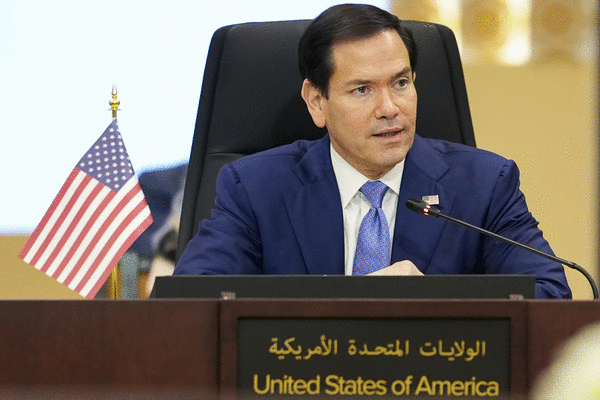
WASHINGTON — The United States wants to reach a deal with Iran to end the war but won’t do so “at any price,” Secretary of State Marco Rubio said Thursday, as he reiterated that tolls in the Strait of Hormuz were unacceptable.
“You can call it a toll, you can call it a fee, whatever you want to call it — it’s a game of semantics,” Rubio said Thursday in Bahrain, as he finished a whirlwind tour of the Persian Gulf. “That will never be an acceptable condition of any deal.”
The top U.S. diplomat told a meeting of the six-member Gulf Cooperation Council on Thursday that if Iran were to charge for the crossing of the strait there would be nothing to stop every country in the world near a waterway from following suit “and then we’re going to have chaos.”
Despite U.S. officials insisting the Strait of Hormuz was open, there appeared to be confusion in the vital route for oil and gas flows Thursday. A U.K. naval group said it received a report that a vessel was hit by an unknown projectile in strait, hours after several freighters turned around while attempting to cross the waterway.
Rubio’s comments Thursday came after Iran and Oman said earlier in the week that they were working toward an agreement to jointly administer the Strait of Hormuz.
A joint statement from the two countries, which border the narrow access point to the oil-rich Persian Gulf, mentioned the costs of managing maritime traffic. That once again raised concerns about Iran potentially charging fees or tolls in the strategic waterway, an idea that officials from the U.S., Saudi Arabia, the United Arab Emirates and Qatar have rejected.
On Wednesday, President Donald Trump said he would reject any final deal with Iran if it included service or shipping fees. “It would be unacceptable to me,” he said. “It would be a game changer.”
According to Rubio, Oman said during the meeting it does not favor tolls. “They signed on to the statement that said that there isn’t going to be any fees or tolls, and so I think that’s good news,” Rubio said, referring to a joint statement between the U.S. and the Gulf Cooperation Council that says the parties “rejected any tolls, fees, or attempts to assert control over the Strait.”
An earlier GCC statement did not explicitly mention tolls or fees, but did say the regional grouping welcomed diplomatic efforts to “ensure the security of maritime corridors — including the Strait of Hormuz — freedom of navigation, and respect for the rules of international law.”
Bahrain was the final leg of Rubio’s three-day tour of the Persian Gulf, his first since the U.S. signed an interim peace deal with Iran. The top U.S. diplomat hoped to reassure allies in the region that their security interests will be factored into negotiations with Tehran and that, if a deal is reached, it will be “a good one.”
Arab Gulf nations worry that an agreement will fail to address issues such as Iran’s ballistic missile program and support for proxies in the region, leaving an emboldened foe on their doorstep.
Rubio said Gulf states, which were at the forefront of Tehran’s retaliation against U.S.-Israeli attacks in late February, also raised the issue of compensation for damages, but that no details were discussed. It’s something “we’re going to have to address at some point.”
An initial round of discussions between Washington and Tehran has been completed and further talks are set to take place in Switzerland next week.
The interim agreement caused oil prices to shed wartime gains, as flows through Hormuz ramped up after months of disruption. Brent crude dropped below $72.48 a barrel — its prewar closing price — before fluctuating around that level. West Texas Intermediate hovered around $70.
Trump is under pressure at home to wrap up the increasingly unpopular war in Iran, which drove up U.S. gasoline prices and overall costs and threatens to harm Republican candidates in upcoming midterm elections.
The president has defended the preliminary agreement from criticism, including from defense hawks in his own party. Some worry the Islamic Republic will be allowed to rebuild its military and support proxy militant groups such as Hezbollah in Lebanon and Hamas.
Iran is set to receive broad financial incentives as part of the deal, including tapping a $300 billion development fund and eventually getting access to billions of frozen assets.
Rubio said the reconstruction fund was not discussed with Gulf partners, which the White House has suggested would pay for the Iranian reconstruction fund.
Both Trump and Vice President JD Vance have said any frozen funds released will need to be used on agricultural products and medicine purchases from the U.S., something Iran has rebutted. The details of how the funds will be dealt with, and how much will be made available, have yet to be clarified.
On Thursday, Iran’s main negotiator Mohammad Bagher Ghalibaf shot down that idea as false.
“The only crop we’re harvesting is what you planted: decades of mistrust,” he wrote on X. “It’s organic, abundant, and homegrown. But apparently the U.S. only exports GMO soybeans, broken promises and trash talks.”
It’s one of a number of outstanding issues, which include Israel’s war with Hezbollah in Lebanon and, crucially, the Islamic Republic’s nuclear program. This will be one of the main points in this round of negotiations, likely also one of the thorniest.
“It is going to be exceedingly difficult to get the Iranians to give up all that they had in a prior agreement,” former Secretary of State John Kerry told Bloomberg Television, referring to the 2015 nuclear deal signed with Iran during President Barack Obama’s administration.
©2026 Bloomberg L.P. Visit bloomberg.com. Distributed by Tribune Content Agency, LLC.





Comments