Scientists make prediction for summer's Lake Erie algae bloom
Published in News & Features
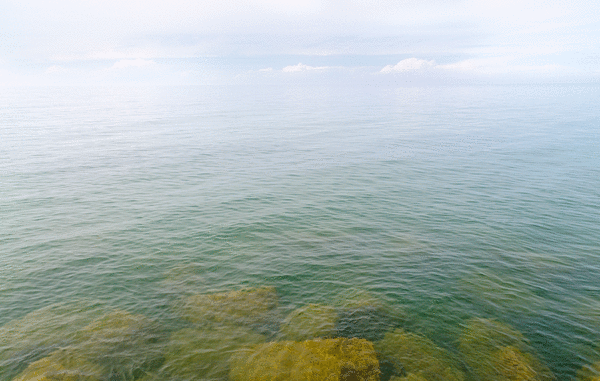
DETROIT — The harmful algae bloom on Lake Erie will be moderate this year, similar to levels seen in 2022 and 2024, water quality scientists predicted Thursday.
Scientists from federal, Michigan and Ohio university labs presented their forecast for this summer's harmful algae bloom on Lake Erie from The Ohio State University's Stone Lab in Put-In-Bay, Ohio.
This year's bloom is expected to start in July and intensify in August, the scientists said.
They expect it to continue into September depending on the weather, although "the duration very much depends on the weather fronts," said Rick Stumpf, a National Oceanic and Atmospheric Administration harmful algae bloom expert. "That is quite variable."
The harmful algae bloom in western Lake Erie is now an annual event in which a bright green scum forms on the lake because of farm runoff that flows into the lake's shallow western basin. The western basin is a great breeding ground for the algae because it is warm and shallow and loaded with farm runoff.
The algae behind the blooms is actually a bacteria called cyanobacteria. Cyanobacteria can release toxins that are dangerous to people and pets, which makes the annual bloom a "really pernicious societal challenge" that impacts the environment and economy, said Steve Thur, acting NOAA chief scientist.
Climate change stands to exacerbate the algae blooms by warming the lake and intensifying storms that send more nutrients into waterways.
Scientists monitor algae bloom
Scientists from the Great Lakes region monitor things like weather forecasts and the amount of phosphorus flowing into the lake during the spring to make predictions about the bloom. In the summer, they take water samples looking for toxins and review satellite images to monitor the bloom's course.
That's part of a huge concerted effort to research and ultimately limit the annual bloom, said Chris Winslow, Ohio Sea Grant Director at The Ohio State University. He said the region is making progress, but has not met the goal outlined by the U.S. and Canada, which agreed to reduce phosphorus runoff into the lake by 40% over 2008 levels.
"We have not won this," Winslow said. "We have not gotten to our 40% target, but we have learned a lot... It is truly all hands on deck."
The projection for this year's bloom highlights the inadequate actions taken by the state and federal governments, said Joel Brammier, president and CEO of Alliance for the Great Lakes, a Chicago nonprofit that advocates for Great Lakes issues. The states heavily rely on voluntary programs to get farmers to reduce runoff, he said, calling on them to take stronger action.
"We simply cannot accept harmful algal blooms as the new normal in Lake Erie," Brammier said. "As states fail to meet their target year after year, residents are paying higher water bills to protect their drinking water, fishing industries and the jobs they support are impacted, beaches are being closed, and people experience respiratory problems."
April rainstorm sent farm runoff into Lake Erie
The Lake Erie harmful algae blooms vary each season depending on factors like spring rainfall, summer temperatures and wind.
Rainstorms send a deluge of phosphorus and nitrogen from farmfields into the Maumee River, which delivers a concentrated load of nutrients into western Lake Erie that feed the cyanobacteria.
There was one big storm in April this year, said Nathan Manning, a Heidelberg University research scientist who presented Thursday. Heidelberg has monitored nutrient loading into Lake Erie from 16 locations around the basin, with a focus on the Maumee River, since 1975.
"The Maumee provides somewhere between 5-10% of the water that enters Lake Erie but about half of the phosphorus loading that enters the lake," Manning said. "It's a really prime driver. Essentially, what's coming out of the Maumee determines what we see in the (harmful algae blooms) in the western basin of Lake Erie."
"The last several years have been very similar to each other" in terms of nutrient loading into western Lake Erie, Manning said. "2026 looks a lot like 2024 in terms of where it's going to end up."
When Lake Erie algae bloom will start
The location of this year's bloom will depend on wind direction. A north wind would push the bloom south to Ohio, while a southeast wind would push it into Michigan.
That will leave some areas bloom-free, said Stumpf. He said people should "enjoy the lake," but cautioned against going near scum.
"Keep your kids, your pets, your dogs out of scum please," Stumpf said. "People think their dogs are indestructible, (but) they do die from this. I can't emphasize this enough."
Scientists on Thursday predicted the severity of this year's bloom to be 3.5, which is considered moderate.
Blooms above 7.5 are considered severe. The largest harmful algae blooms occurred in 2011, when it hit a severity index of 10, and in 2015, when it had a severity index of 10.5.
The most damaging bloom arguably took place in 2014, when it concentrated around Toledo's drinking water intake system and produced toxins that got into the city's finished drinking water. More than 400,000 people were without drinkable water for more than two days.
_____
©2026 www.detroitnews.com. Visit at detroitnews.com. Distributed by Tribune Content Agency, LLC.






Comments