Why did Sacramento residents receive an alert for the Northern California quake?
Published in News & Features
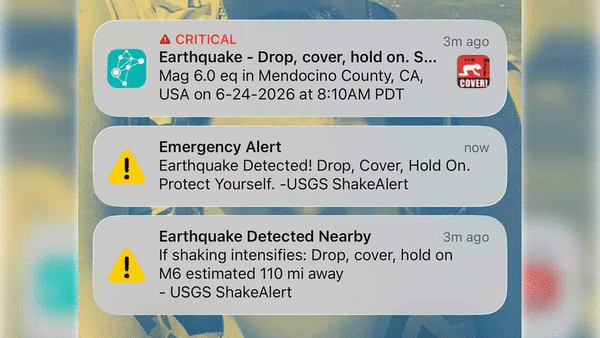
Sacramento residents received an emergency earthquake alert Wednesday morning but felt little or no shaking after a magnitude 5.6 earthquake struck Mendocino County — an outcome seismologists said shows California’s early warning system worked as intended.
The quake struck at 8:10 a.m. near a small Mendocino County community on the Maacama Fault. About a minute later, Sacramento residents 100 miles southeast of the epicenter received MyShake and ShakeAlert notifications warning them to “Drop, Cover, Hold On” and “Protect Yourself.”
While some residents reported swaying light fixtures or other suspended objects, many in the capital region noticed little shaking. That’s because Sacramento sat on the fringe of the area expected to experience light tremors, said Dr. Angie Lux, a seismologist with the Berkeley Seismology Laboratory.
“The earthquake early warning system is a very fast system,” Lux said. “It only uses a couple of seconds of data to estimate the magnitude and the location of the earthquake.”
Using those first few seconds of data, seismologists estimate an earthquake’s location, magnitude and the area most likely to experience shaking. Because Sacramento was near the edge of Wednesday’s projected shaking zone, residents could receive an alert even if they felt only weak tremors — or none at all.
The system is designed to alert “as many people who may feel shaking as possible,” Lux said.
Residents in Reno and Truckee also reported receiving alerts Wednesday morning. According to Lux, communities as far away as Reno, Nevada and Medford, Oregon, were within the alert’s range for light shaking.
How do experts anticipate quakes?
Seismologists receive a constant stream of data from a network of seismometers and GPS instruments stretching from Mexico to Canada along the West Coast, according to Lux.
Three computer algorithms analyze the quake’s first seismic signals to estimate its location and magnitude, then calculate how far shaking is expected to spread. The system also estimates where “light” shaking — the fourth-lowest level on the Modified Mercalli Intensity, or MMI, scale — is likely to occur, Lux said.
The MMI scale is made up of 10 stages, from “Not Felt” to “Extreme.”
People in areas expected to experience “light” shaking would primarily feel it indoors and could notice windows, doors and dishes rattling. Walls may creak, standing vehicles may rock noticeably, and some people may experience a sensation similar to a heavy truck striking a building, according to the U.S. Geological Survey.
Once those calculations are complete, earthquake alerts are sent through MyShake, Android’s earthquake alert system and other participating platforms.
Was Wednesday’s quake cause for alarm?
Lux encouraged residents to check the U.S. Geological Survey’s website for forecasts of additional aftershocks, which are common after a magnitude 5.6 earthquake.
There is a “very, very, very small chance” Wednesday’s earthquake was a foreshock to a larger event, Lux said, but seismologists won’t know whether that’s the case until later.
“We live here in California, so we definitely anticipate earthquakes,” Lux said. “We should use these earthquakes as a reminder, even for people in Sacramento, to use these as a reminder that we live in earthquake country, and to be prepared for the next big earthquake, which may be closer.”
____
©2026 The Sacramento Bee. Visit at sacbee.com. Distributed by Tribune Content Agency, LLC.






Comments