Who's behind Havana syndrome? A decade after, US investigation is in disarray
Published in News & Features
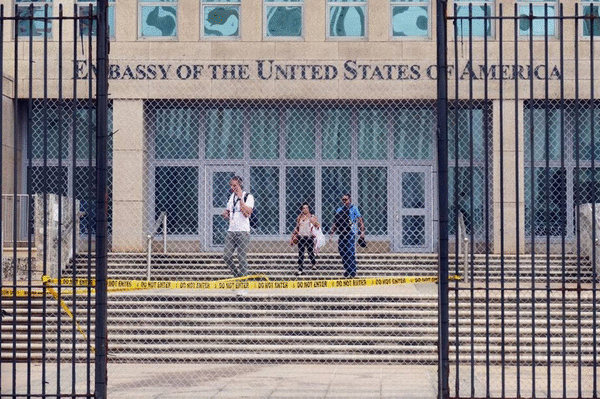
Years into multiple investigations of the so-called Havana syndrome, a definitive answer remains elusive after the recently departed director of national intelligence, Tulsi Gabbard, retracted two intelligence assessments that concluded no foreign power was behind it.
In a memo sent to Congress before leaving office last week, Gabbard said the assessments deliberately limited intelligence collection, failed to include relevant intelligence, and selectively excluded evidence that contradicted their conclusions. The investigators also mischaracterized sources “to suppress alternative analyses” and omitted information necessary to understand the sources’ reliability and quality, according to the memo.
Gabbard said that the recall was necessary due to concerns about “analytic bias negatively impacting the objectivity and soundness of analytic judgments.”
The reports’ retraction comes after media coverage has linked some of the incidents with agents in the Russian military intelligence services and uncovered that the U.S. government had purchased a device that could be linked to the Havana syndrome.
The decision brings a moment of vindication for victims of the irregular health problems who were first dismissed and denied medical treatment and had lobbied the Biden and Trump administrations to look into the incidents.
“We, of course, welcome that Gabbard rescinded the two intelligence community assessments, and for all the reasons that she cited, this is something the victims both wanted, and she had promised repeatedly in congressional testimony,” said Marc Polymeropoulos, a former senior CIA official who suffered from the illness while he was in Russia. “The next step should be, of course, that the intelligence community conducts a new assessment.”
But he expressed doubts that it would happen.
“The Trump administration is fully aware of this issue, but they seem to be choosing not to do anything about it, and it’s very upsetting for the victims who just want to see some accountability for how we were treated, and also attribution, meaning that the Russians and certainly some elements of the Cuban government were involved,” he said.
After a decade of contested scientific studies and serious lapses in care for the victims, the recall and Gabbard’s departure last week once again leave the question of who or what is behind these incidents up in the air.
An official at the Office of the Director of National Intelligence told the Miami Herald that before her departure, Gabbard had directed the intelligence community “to take further action in the coming months to review this topic, ensure analytic integrity, and bring the truth to the American people.”
But some of the people who led the inquiry and produced those reports within U.S. intelligence agencies remain influential. And members of Congress have expressed concern about the future of the investigation into these incidents after a Pentagon reshuffling of the team tasked with researching them and providing care for the victims.
The syndrome, which took its name from reported incidents in Havana in late 2016, has affected many U.S. diplomats, intelligence officers and their relatives, leaving many with disabilities and chronic conditions. Several of the ill people, who also include Canadian diplomats, reported vertigo, tinnitus, headaches, cognitive impairmen, and other issues after feeling intense pressure or hearing strange sounds coming from one direction in incidents that happened in several countries.
Early medical studies by the first doctors who had access to and treated the victims at the University of Miami and the University of Pennsylvania found they had real, significant ailments, including brain changes similar to those caused by a concussion. A study commissioned by the U.S. government found there were readily available devices — known as directional loudspeakers or acoustic lasers — that could cause such symptoms using radio frequency or ultrasound.
At least 334 former and active government employees, military officers and relatives, including 15 children, qualified to get treatment for Havana syndrome in specialized military health facilities, according to a report by the U.S. Government Accountability Office. To be eligible for treatment in the military health system, a doctor must certify a brain injury or other significant symptoms that a known cause or a pre-existing condition cannot explain.
Still, a March 2023 intelligence assessment by seven unnamed agencies concluded, with different degrees of confidence, that “there is no credible evidence that a foreign adversary has a weapon or collection device that is causing” Havana syndrome, and that symptoms reported by those affected were likely the result of preexisting conditions, conventional illnesses and environmental factors.
An updated assessment released in January 2025 maintained the conclusions but acknowledged that one agency believed there was an even chance that a foreign actor had used a novel device to attack U.S. government officers in a “small, undetermined” subset of reported cases.
The House Permanent Select Committee on Intelligence has been battling U.S. intelligence agencies on the issue, and sent criminal referrals to the Department of Justice last year after identifying “alleged illegal activities” in the handling of the investigation and treatment of the victims.
A committee spokesperson declined to comment on the referrals, citing a desire to “protect the integrity of DOJ’s potential prosecutions and to give the best possible chance of pursuing real accountability.”
U.S. Rep Rick Crawford, an Arkansas Republican and the House intelligence committee’s chairman, welcomed the reports’ retraction.
“These flawed, fraudulent, and manufactured Intelligence Community Assessments (ICA) have caused significant harm to some of our nation’s bravest,” he said. “The assessment was deliberately manufactured and used to discredit some of our nation’s bravest and impede their access to medical care. As was the case with other high-visibility intelligence assessments, it fell far short of analytic integrity standards.”
The memo Gabbard sent to Congress also says the recalled assessments relied on a “flawed medical study without noting methodological critiques,” a reference to a controversial study by the National Institutes of Health that dismissed earlier medical evidence that the victims suffered brain injuries. The study was later shut down after an internal review confirmed that patients were coerced into participating.
Jay Bhattacharya, the director of the National Institutes of Health, commended the retraction of the intelligence reports and said they “mischaracterized the NIH study on anomalous health incidents (AHIs). Our research was not complete at the time of this report. Nor was our study designed to determine whether a foreign adversary or external mechanism caused these health effects.”
Victims, lawyers and former U.S. government officials involved in the investigation of Havana syndrome have accused the U.S. government, its intelligence agencies, and, in particular, the CIA, which led the inquiry, of a coverup out of fear of confronting who they believe is the culprit: Vladimir Putin’s Russia.
While they welcome Gabbard’s latest action, some of those former intelligence officers affected also fear the investigation is stalled. They have expressed concern that the official leading a task force put together by the CIA to investigate the incidents, which found no evidence of a foreign adversary or weapon behind the AHIs, has been promoted, which they see as a sign that the agency is not interested in accountability.
“Director Gabbard followed through with what she said in her confirmation hearings. She brought the truth to light. We are forever indebted to her for being a person of her word,” said Patient Zero, a retired U.S. intelligence officer who was the first to report one of these incidents in Havana and asked not to be identified due to security concerns.
“Now DNI Gabbard has brought to light the truth of this coverup, maybe the CIA and Director [John] Radcliffe will stop trying to block the public release of the House Permanent Select Committee on Intelligence report showing the same thing,” he added.
Rep. Crawford remains “committed to releasing the interim report on the intelligence community’s mishandling” of the anomalous health incidents, a committee spokesperson said. The spokesperson said the investigations team continues to gather information, conduct interviews and receive documents as part of the inquiry.
“The Committee is focused on making sure the report clearly and strongly lays out the findings of our investigation,” the spokesperson said, “and continues to work through classification challenges as we prepare to release our next interim report.”
The CIA did not say whether its task force has continued investigating these incidents, nor did it respond to questions about the official’s promotion or the House report. A CIA spokesperson said, “Director [John] Ratcliffe supports the IC’s efforts to deepen our understanding of the AHI issue. The health and security of CIA personnel is of the utmost importance to the director.”
Polymeropoulos also called on Ratcliffe and Secretary of State Marco Rubio, both of whom head agencies whose personnel were affected by the Havana syndrome, to press the Cuban government for answers. Rubio, he said, was a “champion” of the officers and diplomats affected when he was in the Senate.
“We all testified in front of him numerous times when he was the vice chairman of the Senate Select Committee on Intelligence, but sadly, he has been silent on this,” the former senior CIA operative said. “I just don’t understand why, in particular, when we are in negotiations in some form with the Cuban government. It would seem to me that this issue should be front and center because there’s no doubt in any of our minds that elements of Cuban intelligence were involved in this.”
The CIA and the State Department did not say whether their officials had raised the issue in talks with Cuba. Ratcliffe recently traveled to Havana to meet Cuban officials.
“Radcliffe was at the U.S. embassy in Havana,” Polymeropoulos said. “There is some irony if he does not raise this, because his officers are the ones who were critically hurt. If the CIA is going to live up to their slogan, ‘mission first, people always,’ they have to raise this, and failure to raise is a betrayal of their officers.”
©2026 Miami Herald. Visit at miamiherald.com. Distributed by Tribune Content Agency, LLC.

Comments