After weeks of drama, Boston City Council passes on override, accepts $4.9 billion budget to avoid layoffs
Published in News & Features
BOSTON — After weeks of drama, the Boston City Council accepted Mayor Michelle Wu’s returned $4.9 billion budget, by passing on its authority to override Wu’s decision to reverse a $1.4 million transportation department cut to avoid layoffs.
Wu last week informed the Council of her decision to accept, rather than veto, most of its $11.5 million amendment package to her proposed budget, with one modification that moved the Council’s approved $1.4 million cut from the personnel line item to the contractual services line item within the transportation department.
The change would allow the city to avoid layoffs “across multiple divisions” in that department, Wu told the City Council, which opted to accept her decision without an override challenge on Wednesday.
“As the chair of the Committee on Ways and Means, I’m not recommending any further action,” Councilor Ben Weber said at the meeting.
While a formal vote was not held, thereby allowing the budget to go into effect for next fiscal year that begins July 1, the councilor behind the rejected transportation department cut indicated that he was blindsided by the mayor’s partial veto.
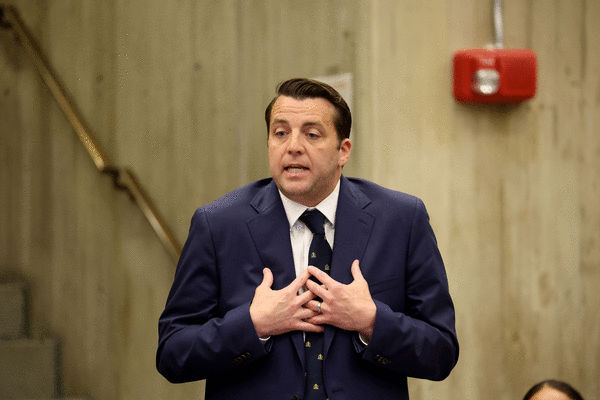
Councilor John FitzGerald said his proposed amendment package, which included the $1.4 million reduction, was born out of conversations with the Wu administration, which he said resulted in “a number that was given to us so that we could absorb this cut.”
“So I was rather surprised last week when it came back with the modification, having thought we’d worked out an agreement with the administration,” FitzGerald said.
The councilor said he was told there was an “internal miscalculation,” or faulty math on the administration’s part, that changed the outcome of his amendment in a way that made it result in potential layoffs.
“That was never our original intent,” FitzGerald said. “I think we actually originally proposed taking it from contractual, and were told that this could be a better one to take from, so with that, I just want to say our intent was always in the way of keeping as many jobs as possible for our city workers.
“I know we’ve got some colorful emails and phone calls in the office from certain departments in the last week or two, but I just wanted to clarify that miscalculation on the administration’s part to put us in this position,” FitzGerald added.
Aside from FitzGerald’s gripe, the day’s budget action was a relatively benign way to cap a tumultuous budget process, that was reflected two weeks ago by a demonstration from activists protesting city budget cuts that shut down the City Council meeting for two hours and led to eight arrests.
The Council ultimately approved the FY27 budget at that meeting, by a 12-1 vote, with Julia Mejia, who cheered on the protesters, casting the lone dissenting vote.
Weeks earlier, the Council had deadlocked, 6-6, on a motion to reject the budget, a move that was aimed at seeking additional funding from the mayor, which Wu had dismissed as “fiscally irresponsible.”
“This budget restores cuts, maybe not at the level I would have liked to see them, but it does restore cuts that never should have been cut in the first place,” Councilor Miniard Culpepper said. “We made it clear that those cuts were unacceptable, and as a result, the budget is stronger today than the version that was first presented to us in April.”
Weber copped to working with the Wu administration to craft his $8-9 million amendment package, which Wu’s chief financial officer urged the Council to accept without additional amendments to avoid layoffs and loss of revenue. FitzGerald put forward two more amendments that were approved by the Council.
Councilor Ed Flynn contends that private negotiations between councilors and the mayor’s office were taking place during a break in the Council meeting two weeks ago, ahead of the vote, which he says is a violation of the state’s open meeting law. The vote was nearly unanimous, compared to a deadlocked vote weeks earlier.
Gregory Maynard, executive director of the Boston Policy Institute, a City Hall watchdog, said the coordination between the Council and mayor’s office points to the Council’s fundamental inability to carry out its budget amendment authority, which was granted by voters in a 2021 ballot referendum.
“This year’s budget debate has seen councilors be much more open about the behind-the-scenes negotiations that take place between the body and the mayoral administration to create Boston’s annual budget,” Maynard said. “That openness has highlighted how little technical support councilors have when it comes to the budget.”
Maynard added, “In his speech today, FitzGerald blamed Wu’s veto of the FY27 budget on ‘internal miscalculations’ by mayoral staff, upon whom the Council was relying on for budget numbers.”
The mayor’s office thanked the City Council “for their due diligence and action to approve the budget for the next fiscal year.”
“In challenging economic times, we continue to prioritize city services for the highest quality of life in every neighborhood and protect the city’s financial health through sound fiscal management,” city spokesperson Marcela Dwork said in a statement. “Now that the budget is in place, we look forward to delivering on these programs and investments over the next year and continuing our work to make Boston a home for everyone.”
_____
©2026 MediaNews Group, Inc. Visit at bostonherald.com. Distributed by Tribune Content Agency, LLC.






Comments