Delcy Rodríguez is campaigning even before Venezuela calls for vote
Published in News & Features
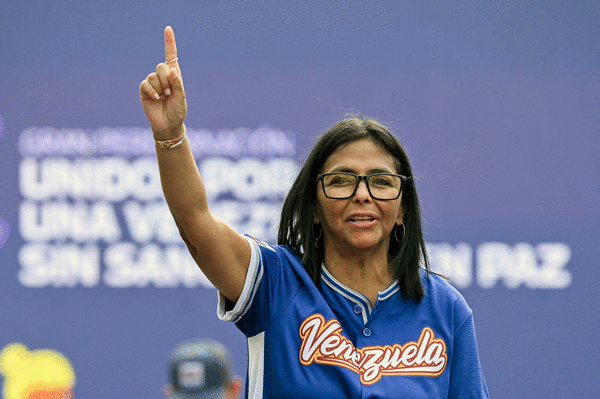
For months, Delcy Rodríguez has been crisscrossing Venezuela atop a truck in what she describes as a pilgrimage. Motorcycles and cars follow her caravan in a scene that looks remarkably like the presidential campaign that opposition leader María Corina Machado ran less than two years ago.
It’s a carefully choreographed spectacle by Venezuela’s unlikely acting president as she attempts to shed the baggage of a deeply unpopular government and position herself as its standard-bearer since Nicolás Maduro’s ouster. Rodríguez’s face now adorns blue banners and posters across the country, replacing the bright red that long defined Chavismo, Venezuela’s homegrown brand of socialism. A new jingle urges citizens to place their trust in her.
Though the performance has all the trappings of a presidential campaign, authorities have yet to set a date for the vote. And at least for now, the US, which has had a critical hand in Venezuelan policy since its forces removed Maduro, is prioritizing economic recovery. But now is a critical moment for Rodríguez to rally support: The ever-popular Machado is readying her return to Venezuela and says she intends to run for the nation’s top job.
A recent Meganálisis poll found that 82.6% of Venezuelans said they would vote for Machado in a presidential race, compared to 4.5% who said they would back Rodríguez. The survey, conducted between May 20 and 27, also found that 94% of respondents opposed Rodríguez leading the country’s transition process.
“What Delcy Rodríguez is trying to do is reposition a new version of Chavismo,” said Luis Rendueles, a political scientist and director of consulting firm Conversa Consultores. “But it’s very difficult to reinvent a politician who is already widely known and deeply unpopular. The data shows the strategy is not working.”
Rodríguez is hardly a newcomer to power. She briefly held a cabinet post under the late Hugo Chávez, but her rise came over the last decade under Maduro. She became one of the former president’s closest allies and played a key role in budget planning and diplomacy while maintaining ties with partners, including China and Russia.
The ruling party views her as a viable candidate in elections it wants to win legitimately, said a person familiar with the government’s thinking who wasn’t allowed to speak publicly. However, it could take as long as two years for an economic recovery and for Rodríguez to reap the political benefits, the person said. Others believe that although Rodríguez is seen as a reformist, she is a figure of continuity rather than a break with the current system.
The ruling party has not formally nominated Rodríguez as their candidate for an upcoming election. Venezuela’s Information Ministry didn’t respond to a request for comment.
There are some differences between Rodríguez and the more typical Chavista politician: She is often described as pragmatic and tends to favor shorter, more direct speeches, a style that contrasts with the Venezuelan socialist movement’s historically ideological and often lengthy rhetoric.
Still, she has embraced the religious undertones that have become increasingly common in Venezuela and began her national “pilgrimage” in mid-April. One day she is crossing a desert with authorities and business leaders; the next, she is meeting producers in a coastal town.
Her two most important allies — her brother and National Assembly head Jorge Rodríguez and hardline Chavista Diosdado Cabello — have been dispatched to other regions in a tour they say is aimed at securing a permanent end to sanctions and achieving full economic freedom for Venezuela.
“We will continue fighting for a Venezuela free of sanctions,” Rodríguez said in late May, during a community gathering in the western Venezuelan state of Portuguesa. “Those who called for blockades, sanctions and even military intervention will simply find themselves isolated from the sentiment of our people.”
At the same time, Maduro has largely disappeared from official messaging. For the first time, Venezuelan government figures openly acknowledge failures under his rule. Supporters are being asked not to defend the past, but to move beyond it.
Rodríguez, who served as Maduro’s vice president, was appointed acting president in early January through a court ruling that cited Maduro’s “forced” temporary absence. Under Venezuela’s Constitution, such an arrangement can only be extended twice, for 90-day periods. After that, the National Assembly must declare Maduro’s absence permanent and call elections within 30 days, a timeline that would have put the vote this summer.
But the court never ruled on an extension of Rodríguez’s term, leaving the country in a political limbo with no clear endpoint to her tenure and ample room for authorities — or Washington — to determine when the vote takes place.
The opposition, meanwhile, is once again organizing around Machado. The Unitary Platform, made up of the country’s main opposition parties, has already named her its candidate for the upcoming election.
Machado still has to return to Venezuela, though she remains barred from holding public office. Removing that ban is one of several conditions still needed for a free and fair vote. Another is adding independent and opposition voices to the National Electoral Council’s board, which would be responsible for setting an election date. Last week, Dinorah Figuera, who leads an opposition-led National Assembly that was formed in 2015, met with Jorge Rodríguez in Caracas and the two agreed to create a joint working force to discuss reforms.
Meanwhile, resistance is emerging from inside Rodríguez’s party. During a recent episode of Cabello’s weekly television program, an audience member complained that the government had not done enough to campaign for the return of Maduro and his wife Cilia Flores.
“The gravity of what happened on Jan. 3 has been forgotten,” the man said, referring to their capture by US forces.
Cabello pushed back.
“We are still campaigning,” he said. “Some may choose to normalize what happened on Jan. 3, but we will not.”
____
—With assistance from Nicolle Yapur.
©2026 Bloomberg News. Visit at bloomberg.com. Distributed by Tribune Content Agency, LLC.






Comments