California Democrats announce budget plan, push back on Newsom healthcare cuts
Published in News & Features
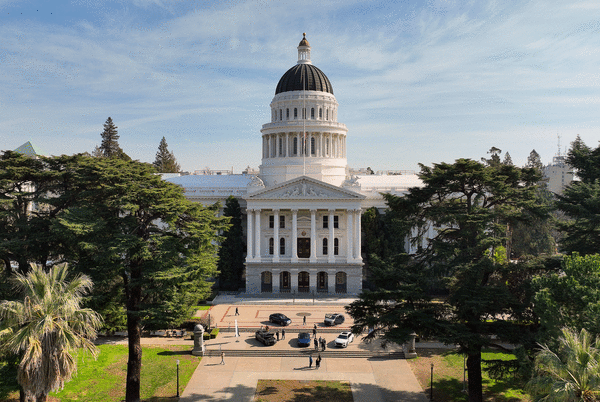
SACRAMENTO, Calif. — Democratic leaders in the Assembly and Senate announced an agreement Thursday on a budget for the upcoming fiscal year that rejected or delayed many of the healthcare cuts proposed by Gov. Gavin Newsom.
The step does not mark an end to budget negotiations, but instead brings the two chambers in line on their proposals to craft a final agreement with Newsom.
The deal leaves the Senate’s suggestion of a tax on corporations who leave their employees reliant on the state’s Medicaid system, called Medi-Cal, by the wayside for this year. Instead, the agreement leans on a Newsom-proposed tax on commercial health insurance plans to raise more revenue, which is expected to increase the cost of many working Californians’ monthly premiums.
Officials with Senate leadership said without their advocacy for revenue increases in this compromise, Newsom might not have included any tax measures in his budget proposal at all. Although the governor and Assembly leaders did not adopt the tax mechanisms senators wanted, the agreement includes language requiring the next governor to put forward a proposal for a tax on corporations who leave their employees to rely on Medi-Cal.
“The Legislature looks to stop drastic cuts to safety net programs that millions of Californians rely on to make ends meet,” said Senate President Pro Tem Monique Limón, a Democrat, in a statement. “The Legislature also continues to make responsible budget decisions for the future by laying the groundwork for the Fair Share from Big Corporations Act.”
Senators had proposed a fee per employee enrolled in Medi-Cal which would apply only to corporations that employ more than 100,000 people.
It’s unclear how the next governor, which will either be Democrat Xavier Becerra or Republican Steve Hilton, will feel about budget language that forces them to, at the very least, craft a tax on such powerful business interests.
The deal delays another politically loaded decision on whether to increase premiums on undocumented immigrants using Medi-Cal. Assembly leaders had previously accepted Newsom’s proposal to increase a monthly premium for many undocumented immigrants using Medi-Cal from $30 to $50. Senate budget leaders had flatly rejected the premium increase.
The agreement would also leave that decision for the next governor to hash out with lawmakers.
That was one of several areas where lawmakers either rejected Newsom’s healthcare cuts or delayed them until after he leaves office — giving the next Legislature a chance to undo them once he’s out of Sacramento.
Lawmakers delayed an imposition of asset limits on Medi-Cal that Newsom had proposed setting at $2,000, which would have affected elderly low-income Californians. Notably, the Legislature would also protect 200,000 humanitarian immigrants who are lawfully present in the country as asylees from losing full-scope Medi-Cal this year. The chambers’ compromise pushes that change into next year’s budget as well.
Cuts Newsom proposed to Medi-Cal’s dental care would also be delayed under the Legislature’s plan.
In social services, the Legislature is rejecting a cut by the governor to popular in-home supportive service care funding for Californians with disabilities — including older adults and children. Lawmakers also propose a substantive, $80 million investment in legal aid for immigrants swept up in the Trump administration’s deportation crackdown.
The agreement calls for the state to close another prison to cut costs and provide $900 million in homeless-related money for local governments and regional organizations — $400 million more than Newsom had proposed. But the compromise left unresolved questions about how the state will respond to reduced funding for greenhouse gas reduction efforts.
The Legislature is required to pass a budget by Monday or go without pay until they do so. The agreement comes about a month after Newsom announced a revised budget plan, which was designed to leave the state without a deficit for the next two fiscal years.
That was made easier this year as enthusiasm around artificial intelligence has flooded the state with higher-than-expected tax revenues. California’s budget can rise and fall sharply based on gains in the stock market, which puts the state in good financial position during booms and vulnerable during busts.
The Legislative Analyst’s Office, which advises the Legislature on fiscal and policy matters, warned that the state could face deep deficits if the stock market drops sharply because the dramatic rise in revenue has still not been enough to cover the state’s ongoing spending.
Thursday’s deal calls for constitutional amendment to allow the state to increase the amount of money that can be put into the state’s Budget Stabilization Account, known as the “rainy day fund,” during strong financial years.
“Our legislative budget agreement prioritizes health care, housing, affordability, and critical safety net programs that our most vulnerable communities rely on,” said Democrat Assembly Budget Chair Jesse Gabriel. “At the same time, we are also committed to fiscal discipline and preparing California to weather future challenges.”
©2026 The Sacramento Bee. Visit sacbee.com. Distributed by Tribune Content Agency, LLC.





Comments