In a first, polyamorous people get bias protection in this Michigan city
Published in News & Features
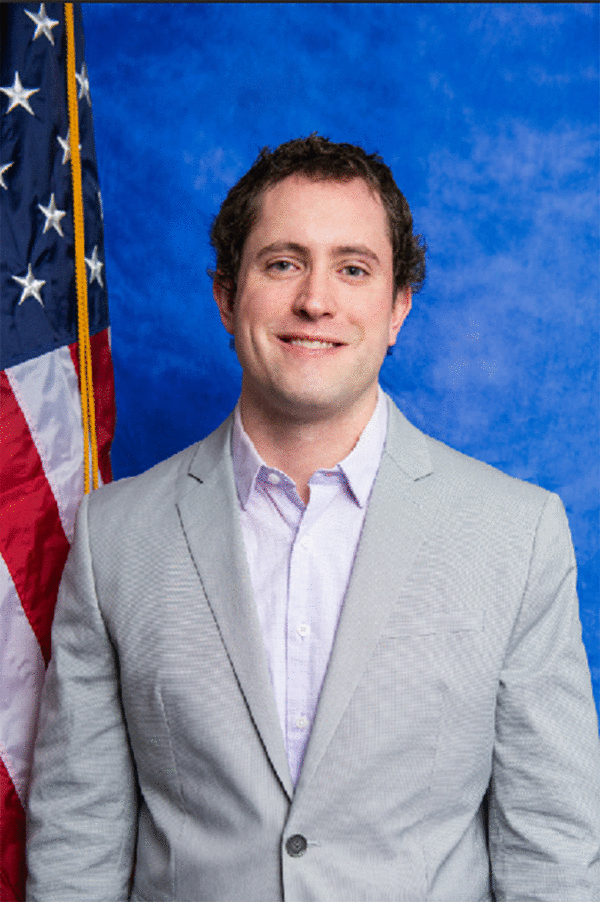
HAZEL PARK, Mich. — A local official contends Hazel Park is now the first community in Michigan to explicitly protect polyamorous people from discrimination, even though city officials said there have been no known explicit instances of such bias reported.
The Hazel Park City Council on Tuesday night unanimously approved an update to the city's human rights ordinance that protects people on the basis of "family or relationship structure." The ordinance directly applies to polyamorous people, who have multiple romantic or sexual partners at once, said Councilman Luke Londo.
Londo said Hazel Park is now the first city in the state and in the Midwest to pass such an ordinance. Nationally, it's the ninth city, he said.
"We’re seeing a lot of kind of pushback on traditional family or nuclear family language happening at the federal level, so to kind of get in front of that in Hazel Park, we kind of wanted to incorporate families that don’t necessarily look like that quote-unquote traditional family," Councilwoman Alissa Sullivan said after the vote.
Sullivan was referring to the administration of President Donald Trump, who has issued a series of executive actions targeting the rights of transgender individuals and asserted in a directive that the federal government will recognize only two sexes: male and female.
About one in 20 relationships is polyamorous, and about one in five people in the United States has had a non-monogamous relationship at some point in their lives, according to Psychology Today.
"At least the sheep are safe … for now," State Rep. Matt Maddock, R-Milford, said in a text message to The Detroit News.
Maddock, who has opposed books with LGBTQ themes in school districts in Metro Detroit, said his text message was all he had to say about the subject when asked for further comment.
How Hazel Park official got idea for ordinance update
Londo, who was absent from the Tuesday night meeting for vacation, said the update to the city's human rights ordinance was originally his idea. He said he got the idea after the city of Olympia, Washington, passed a similar ordinance.
“I discovered there was nothing protecting diverse family structures" in Hazel Park, said Londo, who chairs the Michigan Civil Rights Commission.
Londo said he worked with the Organization for Polyamory and Ethical Non-Monogamy (OPEN) to draft language for the ordinance. He said OPEN led the efforts to pass similar ordinances in the eight cities before Hazel Park.
“In my discussions with landlords, business owners, residents and other relevant stakeholders, this ordinance received absolutely zero opposition, which I think speaks to how inclusive Hazel Park is," said Londo, who once worked for two Republican elected officials.
While Londo said he hasn't seen any examples of explicit discrimination against polyamorous people in Hazel Park, he said this type of discrimination is often insidious by nature. Londo said people "can expect that they're treated a certain way based on how their relationship structure is." He said this especially applies to polyamorous people when they are looking for housing.
Sullivan said the ordinance can also be more broadly applied to the LGBTQ community in Hazel Park.
“Often times, people and members of the LGBTQIA+ community find themselves with their chosen family, or they may seek out a different kind of family structure. And so we wanted to make sure that our ordinance speaks to that nuance and speaks to the lived reality in our community, or people who want to join our community," Sullivan said.
Londo also said the ordinance can be applied to multigenerational housing because it speaks broadly to family and relationship structures.
But not every official in Oakland County was so happy with the new ordinance. Maddock opposed the ordinance when asked about it Wednesday.
State Sen. Jim Runestad, the state Republican Party chairman and lawmaker from White Lake, said the ordinance was "overly broad."
"It's inserting the government in parental rights and religious liberties," Runestad said. "If they wanted it to pertain to a specific kind of contract, they should have written it more specifically."
But Londo argued that the protection for different family and relationship structures is "an unmet need in a lot of communities nationwide."
"I don't believe in performative legislation," he said.
_____
©2026 The Detroit News. Visit detroitnews.com. Distributed by Tribune Content Agency, LLC.





Comments