Federal court weighs DOJ demand for Maryland voter registration records
Published in News & Features
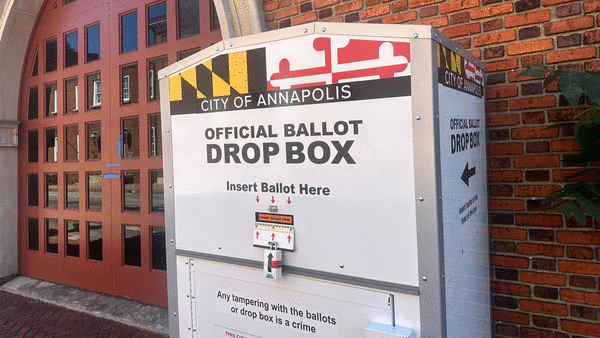
BALTIMORE — A federal judge on Wednesday repeatedly pressed U.S. Department of Justice attorneys to explain why they want access to sensitive personal information from more than 4 million Maryland voters, questioning how the federal government would use the data if the state is forced to turn it over.
The hearing in Baltimore’s U.S. District Court marked the first appearance in United States v. DeMarinis, a lawsuit challenging Maryland’s refusal to provide an unredacted voter file containing personal information on 4.2 million registered voters. It came a day before early voting begins Thursday for the state’s June 23 primary election and amid heightened scrutiny of the Maryland State Board of Elections following a separate ballot-printing error last month.
The lawsuit is part of a broader effort by the Trump administration to obtain unredacted voter registration databases from states across the country, suing 30 states and Washington, D.C., for not complying. Maryland already makes a version of its voter registration list available for purchase , including voters’ names, addresses, dates of birth, party affiliation and voting history. The dispute centers on information the state does not disclose, including driver’s license numbers, portions of Social Security numbers and voter registration application details.
Maryland officials argue federal law does not authorize the DOJ to access such information, while the department says the records are necessary to determine whether states are complying with federal election laws.
Arguing data use
During nearly 70 minutes of arguments, U.S. District Judge Stephanie Gallagher questioned both sides about whether the DOJ had provided sufficient justification for its request and whether provisions of the Civil Rights Act of 1960 apply to modern electronic voter registration databases.
The hearing’s sharpest exchange came during rebuttal arguments, when Gallagher questioned DOJ Senior Counsel William Mohrman about how the federal government would use the records.
Mohrman said the department could compare Maryland’s voter rolls with federal databases to identify potentially ineligible voters. “The attorney general is going to try to figure out whether or not there’s people on that list that are ineligible to vote,” he said, adding that the records could be compared with data maintained by the Social Security Administration and other federal agencies, but declined to provide specifics when pressed by Gallagher.
The judge then asked whether there were limits on how the information could be used once obtained. “So, in your view, once these documents are requested, there’s no constraints on what they could be used for?” Gallagher asked.
Mohrman said federal privacy laws would govern the department’s handling of the records. “There’s a lot of allegations here without any evidentiary support that the federal government isn’t going to respect those federal privacy laws,” he said.
Mohrman also said federal law requires election officials to preserve voting-related records and make them available to the attorney general upon request, adding that the department is seeking to determine whether Maryland is complying with federal election laws.
“From the perspective of the United States, this is not a complicated case,” Mohrman said, adding that Maryland could produce the electronic voter file quickly, and its reluctance has been “a little troubling.”
Gallagher noted that several courts, including those in California, Maine and Rhode Island, have considered similar arguments and rejected the government’s interpretation. Mohrman responded that the DOJ disagrees with those rulings and said many of the cases are being appealed, though he could not immediately identify which ones.
Maryland Assistant Attorney General Daniel Coburn countered that the DOJ is claiming an oversight role over state election systems that Congress never authorized. “If Congress of the United States intended the Department of Justice to be a federal auditor of voter registration databases, it would have said that,” he said.
Attorneys representing Common Cause Maryland, Out for Justice and the American Civil Liberties Union also urged Gallagher to dismiss the case, saying that the DOJ had not adequately justified its request.
After the hearing, Maryland State Administrator of Elections Jared DeMarinis told reporters the proceedings reinforced the state’s argument that the federal government has not clearly explained why it wants the records. He added that comments during the hearing suggested the federal government may be seeking the information to identify noncitizens or other potentially ineligible voters.
“They kind of alluded to the fact that they may want to start looking at it for purposes of finding illegal or non-citizens on our rolls,” he said. “Well, then state that purpose.“
State election officials maintain that Maryland already conducts routine voter list maintenance required under state and federal law, including removing voters who have died, moved out of state or otherwise become ineligible. However, the Republican National Committee and the Maryland GOP filed a December 2025 lawsuit, alleging “impossibly high” voter registration numbers and possible fraud.
Gallagher did not rule from the bench and said she would issue a written opinion at a later date.
________
©2026 The Baltimore Sun. Visit at baltimoresun.com. Distributed by Tribune Content Agency, LLC.





Comments