Illinois Democrats' single-party rule and diminished GOP may shield Springfield from Benton scandal reforms
Published in News & Features
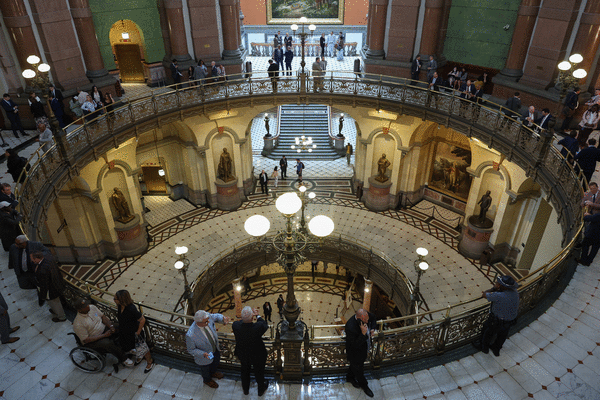
With only 100 days until the Nov. 3 general election, it would seem that questions surrounding Democratic House Speaker Emanuel “Chris” Welch’s handling of sexual harassment allegations against former state Rep. Harry Benton would be an issue ripe for Republicans looking to make gains in the chamber where they are a superminority.
But there are myriad reasons the issue is hard for Republicans to exploit, not least the fact that the GOP has increasingly bordered on irrelevancy in Illinois, its big-money donors evaporating as its former suburban power base has grown more ideologically, racially and ethnically diverse, and as it struggles to compete in Democratic-drawn gerrymandered districts.
Then there is one overriding factor in the current political climate — a GOP that pays fealty to a president with little support among residents in the state’s most populous counties.
Kent Redfield, a professor emeritus of politics at the University of Illinois Springfield, said things might be different “if this were a competitive state, that there was not an overwhelming fundraising differential, if there were incumbent officeholders of both parties in state constitutional offices.”
Instead, he said, “The Republican Party is in danger of becoming just kind of a regional, downstate conservative MAGA kind of organization,” using the acronym for President Donald Trump’s “Make America Great Again” slogan.
Redfield said Democrats could counter any Republican attempt to gain political advantage from the Benton situation by pointing to Trump — and the $5.6 million he paid writer E. Jean Carroll after a civil jury found him liable for sexually abusing her in the 1990s and then defaming her — “as the poster boy for the issue of sex and politics.”
“The Democrats are in a strong position to hide behind Trump and to raise the specter of Trump and to use it as (a) ‘whataboutism’ diversion,” he said.
Redfield said the powerful position of Democrats in a one-party state “provides license and cover, and it allows them to deflect because the opposition is so weak.” Some Republican lawmakers, he added, could fear riling Welch and becoming a target of a well-funded Democratic opponent in the future.
Redfield’s comments came after the state Legislative Ethics Commission, a group of four Democratic and four Republican lawmakers, voted 8-0 on Thursday to release Inspector General Michael McCuskey’s investigatory report on Benton, who quit his legislative seat on July 3. But the report is unlikely to be made public until the end of the month, since state law gives Benton time to respond to the inspector general’s findings and the commission redacts personal information out of privacy concerns.
But a monthslong Tribune investigation into Benton found that Welch’s office first knew about highly questionable behavior by the lawmaker in 2023. That’s when a young Benton staffer filed a lengthy list of harassment allegations, many of them of a sexual nature, with Welch’s then-chief of staff. But Welch’s office didn’t contact Benton until three months had lapsed and the staffer had quit her job over what she said was fear for her mental health.
In meetings with various House Democratic caucuses, Welch has said the staffer did not want his office to take any action until she had left her job — something she said she does not recall saying.
Welch also contended the staffer did not want to “pursue” action against Benton, but she said that was in reference to rejecting Welch’s office’s repeated push for her to file a complaint with the legislative inspector general’s office. The former staffer had made clear to Welch’s office that she did not want Benton acting the same way toward women in the future and thought the speaker’s office could handle her complaint internally.
The former staffer said nothing was done to discipline Benton at the time. Welch went on to support Benton’s narrow 2024 reelection victory with $1.4 million in campaign cash.
Benton ultimately faced no discipline until this year, after a female lobbyist had an interaction with him this winter at a bar in Chicago’s River North, where the lawmaker used his phone to show her pictures of women he claimed to have slept with and made lewd comments toward her, the Tribune investigation found. The lobbyist’s complaints about Benton’s behavior reached Welch’s office, and the inspector general was asked to investigate.
McCuskey, a former federal judge in Champaign, appeared Friday on WDWS radio there, and without releasing details of the still-confidential report, vastly lowered expectations of any bombshell findings when he said, “If you read the Tribune, you’ll know more than I do.”
Welch has said the report will show that his office acted “properly” regarding the former Benton staffer’s report of sexual harassment. But because a one-year statute of limitations for the inspector general to issue findings has elapsed on incidents she described, it is unlikely McCuskey’s report will detail her 2023 complaints, let alone judge the appropriateness of Welch’s actions.
With Democratic Gov. JB Pritzker urging Welch to come clean with the public about his actions, the speaker — facing criticism from the House Democratic Women’s Caucus, which called his handling of the case “insufficient” — has not addressed several detailed questions posed by the Tribune.
There has been no confirmation that Welch himself spoke with Benton after the former staffer’s complaint. The speaker has not explained the propriety of funding Benton’s 2024 campaign while his office was aware of his conduct toward the former staffer, nor has he explained why he did not act three years ago to remove Benton from Democratic caucus membership and committee posts, as he had done to discipline other House members.
Democratic state Rep. Kelly Cassidy of Chicago, a member of the Legislative Ethics Commission, released a statement Friday saying “the allegations against Speaker Welch are deeply concerning, and to this point, have not been adequately explained.”
“I plan to speak fully to the conduct of Speaker Welch, Rep. Benton, and our broken system, and I won’t stop until Springfield is a safe place for every one of us,” Cassidy said, adding she was reserving further comment until the report is released.
But Redfield, citing Welch’s majority of 78 Democrats in the 118-member chamber, questioned whether the speakership is in jeopardy.
“If you’ve got a huge majority, you can count to 60 and you can lose 18 people and still get” to the votes needed for election as speaker, he said.
“I ought to be worried about the (sexual harassment) issue in general. I ought to be worried about defending and protecting and strengthening the institution,” Redfield said of the thinking among Democratic legislators who need Welch’s help and money for reelection. “But is this the hill I want to die on? Do I want to cut off Welch’s support? I’m going to have to go into the speaker’s office and ask for favors. I want to have access to power — and so you end up pulling your punches.”
Jessica Dixon Heitman, whom Democratic Party leaders last week selected to replace Benton through the end of his term and on the November ballot, said Friday that she would welcome Welch’s political backing for the upcoming election. In 2023, Heitman briefly worked with Benton and the former staffer who made the allegations in 2023 against him, and Heitman said last week that working for Benton was “not a great fit.”
“Based on what I know today, I would accept campaign support from Speaker Welch, the Democratic Party, and anyone who shares my commitment to making Illinois more affordable for hardworking families,” Heitman said in a statement. “I have not spoken to the Speaker directly about supporting the campaign, but as with all campaigns we are working to build momentum and support from the residents of the 97th District.”
As for calls for ethics reforms to strengthen the role of the legislative inspector general’s office, allow the public release of more investigatory reports, or change how sexual harassment issues are handled in the legislature, Alisa Kaplan, executive director of Reform for Illinois, sounded skeptical, given the lopsided Democratic majority.
“When you have supermajorities like this, when you have so many safe districts … it’s harder to hold representatives, it’s harder to hold the party leadership accountable,” Kaplan said.
“Certainly if there were (a) healthier balance and more real, meaningful competition between the parties, there would be more pressure on both of them to act … and right now that’s been lacking,” she said, pointing to an overall weakness in Illinois’ ethics laws compared with other states.
“We know that when lawmakers get together and really want to … affect change, they can do it,” she said. “We need more legislators who want to do the right thing and are courageous enough to step up and get it done.”
Redfield said he believed the way Welch has handled the case of the former Benton staffer “has been terrible.”
“There’s just no good outcomes from this woman, the staff person, being treated this way. It’s bad for her. It’s bad for Welch. It’s bad for the system,” Redfield said. “It just feeds the narratives that the legislature is corrupt or incompetent.”
_____
©2026 Chicago Tribune. Visit chicagotribune.com. Distributed by Tribune Content Agency, LLC.



Comments