A fragile return of medical care in Haiti after weeks of violence roil capital
Published in News & Features
The French medical charity Doctors Without Borders has reopened its hospital in Haiti’s Cité Soleil neighborhood three weeks after suspending operations because of intense fighting between armed groups.
The deadly surge in violence has forced 300,000 people to flee their homes across metropolitan Port-au-Prince, including 17,500 from the sprawling seaside slum since the latest round of fighting began on May 10, according to the United Nations.
This week the U.N. warned that the rising violence in Haiti, where nearly 1.5 million people were already displaced by gangs at the beginning of the year, continues to force more residents to leave their homes behind. On Wednesday, a police operation in the Martissant 7 neighborhood of Port-au-Prince highlighted the ongoing challenges Haiti’s security forces face even as they succeed in accessing areas once shut off by gangs.
An armored police vehicle was set ablaze in Martissant 7 after breaking down. Cameras captured not only the flames but the cheering by apparent gang members.
On the first day of the fighting in Cité Soleil, the medical charity, also known by its French name Médecins Sans Frontières, found itself overwhelmed with gunshot victims and fleeing residents. Medical teams treated more than 40 people with gunshot wounds in less than 12 hours, while a security guard was struck by a stray bullet inside the hospital’s compound, the charity reported.
Meanwhile, more than 800 people fleeing the violence also sought refuge at the facility as gunfire continued nearby. As the shootings intensified, however, the hospital had no choice but to suspend its operations the next day.
“The hospital was completely emptied, and several bullet holes are visible on the different buildings,” said Thomas Curbillon, the charity’s head of mission in Haiti. “At the outpatient department we usually see an average of 150 patients per day, and the bed occupancy rate of the inpatient department regularly exceeds 80 percent. This gives an idea of the consequences for the population when our activities are suspended for several weeks.”
For now, the hospital’s emergency department and services for survivors of sexual violence will be reopened. Other patients will continue to be referred to other facilities after initial treatment and stabilization as teams continue to assess security risks before resuming additional services. If conditions remain stable, outpatient and inpatient services are expected to resume in the coming days, the charity said.
This is the third time in three years that the medical charity has been forced to suspend operations at its hospital in Cité Soleil, Curbillon said. “We call on all parties to the conflict to respect the safety of civilians and health care workers, so that we can do our work: saving lives.”
Cité Soleil is home to about 300,000 people, many of whom have limited access to basic services and health care, the medical charity noted, adding that healthcare needs remain immense.
Stéphane Dujarric, spokesman for U.N. Secretary-General António Guterres, said that along with humanitarian partners, the global organization has distributed thousands of sleeping mats, mattresses, tarps and mosquito nets in the capital. More than 9,500 people in the area have also received food assistance, along with water, sanitation and hygiene care.
“Our partners have provided hundreds of medical consultations, including psychosocial support. They’ve also established child-friendly spaces,” Dujarric said.
Violence in the Artibonite
U.N. agencies have also been responding to the escalating violence in the country’s breadbasket, the nearby Lower Artibonite region.
Three police officers and a civilian were among the latest victims when a gang ambushed them last week. The officers had been attempting to clear a road to deliver oxygen to the nearby Hôpital Albert Schweitzer. The facility ultimately received the supply after it was flown in on helicopter by HERO Client Rescue, which operates emergency medical ambulance and medical evacuation services in the country. The company also flew in Haiti National Police reinforcements, retrieved the bodies and flew out six injured Haitian police officers.
Dujarric noted that since May 29, more than 1,800 people had been displaced from the area of Saint-Marc.
“The displaced families have taken refuge with host communities,” he said. “We and our partners have distributed food, cash and other essential items, but there are critical gaps in the areas of health, protection, education and nutrition.”
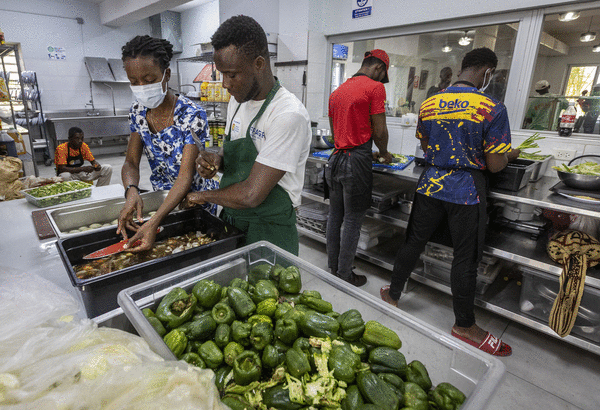
On Thursday, World Central Kitchen, which has provided meals to residents of the area, reported that the charity had reached “a sobering milestone.” More than 10 million meals had been served in the Artibonite region over the past year, said the charity, founded by Chef José Andrés in Haiti after the country’s 2010 earthquake.
“This week marks one year since WCK partnered with Hôpital Albert Schweitzer to support families displaced by violence in the region. Since then, approximately 450 Haitian team members working across 26 community kitchens have prepared and served roughly 40,000 meals every day, helping provide a measure of stability as food insecurity deepens and displacement continues to rise.,” the organization said.
World Food Program voices concerns
Speaking on Thursday to reporters during a U.N. briefing, Carl Skau, deputy executive director of the World Food Program, noted that despite the ongoing crisis and challenges the agency continues to operate “a very impressive operation” in Haiti.
“We’ve been able to reach these areas of Port-au-Prince controlled by gangs now for months and frankly years,” he said.
Parts of the country, he emphasized, are experiencing some of the highest levels of hunger in the Western Hemisphere.
“It’s hard to imagine,” he said, “on an island so close to New York.”
The World Food Program, which operates helicopters in and out of Port-au-Prince daily, continues to be the backbone of logistics operations, supporting humanitarian efforts.
Still, Skau warned of growing concerns as Haiti moves toward organizing long-overdue elections and a new U.N.-authorized Gang Suppression Force begins operations. Those efforts, he said, could trigger further violence and potentially restrict humanitarian access to vulnerable populations.
“We really need to watch this and make sure that those security efforts are happening In a way that still allows for humanitarian independence, neutrality and access in parallel,” he said.
Another concern is resources, which are already in short supply because of a drop in donor support worldwide. Skau warned that as attention turns toward ameliorating the security crisis, resources should not be taken away from addressing the surging humanitarian needs, which include more than 5 million people who do not have enough to eat.
“I can see a scenario where there is progress on security and on the political front without also making progress on the humanitarian and development front in Haiti,” he said. “And so that needs to go hand in hand. Often times, when focused on one thing, we drop focus on the other and I think that’s something that can’t happen if this is the moment and opportunity to turn a page in Haiti.”
©2026 Miami Herald. Visit miamiherald.com. Distributed by Tribune Content Agency, LLC.






Comments