Colorado appeals court overturns homicide convictions for 2 paramedics in Elijah McClain's death
Published in News & Features
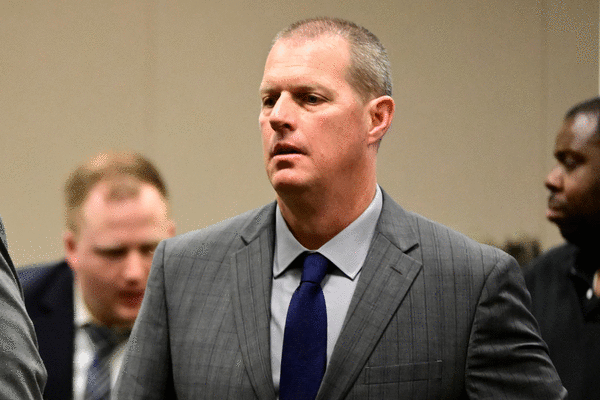
DENVER — Two former Aurora paramedics could get new trials after the Colorado Court of Appeals on Thursday reversed their homicide convictions in the 2019 death of Elijah McClain.
McClain, a 23-year-old Black man who was unarmed and not suspected of committing any crime, died after Aurora police put him in a neck hold and a paramedic injected him with an overdose of ketamine, a sedative.
Peter Cichuniec was supervising Jeremy Cooper, the paramedic who injected the drug, and both were convicted in 2023 of criminally negligent homicide in McClain’s death. Cichuniec was also convicted on one count of second-degree assault for unlawful administration of drugs.
Now, the Colorado Court of Appeals has ruled that the cases should be retried.
“We conclude that the district court erred by failing to properly instruct the jury on the standard of care applicable to the criminally negligent homicide charge and that the error wasn’t harmless,” Judge Jerry Jones wrote in the majority opinion reversing Cooper’s conviction.
Jones also authored the majority opinion that reversed Cichuniec’s homicide conviction, but upheld his second-degree assault by drugging conviction.
The jury was told that “a person acts ‘with criminal negligence’ when, through a gross deviation from the standard of care that a reasonable person would exercise, he fails to perceive a substantial and unjustifiable risk that a result will occur or that a circumstance exists,” Jones wrote.
But, when jurors asked for a definition or description of the “standard of care,” the court did not provide one, Jones wrote. When the jury doesn’t understand an element of the charged offense, “the court must clarify the matter concretely and unambiguously,” he wrote.
“The relevant circumstances in this case were that a medical professional provided medical treatment to a person needing medical attention while under law enforcement’s physical restraint,” Jones wrote. “The standard of care was therefore that which would apply in a civil case involving such a situation — one applicable to a reasonable paramedic in Aurora, Colorado, in 2019 treating a person in Mr. McClain’s condition.
“Indeed, it wouldn’t make any sense to apply an ordinary reasonable person standard in this context,” Jones continued.
Attorney General Phil Weiser said in a statement that bringing the cases to trial in 2023 was the right thing to do for justice and for McClain and the community.
“A jury convicted two paramedics for the death of Elijah McClain, an innocent Black man who did nothing wrong that tragic night seven years ago,” Weiser said. “The attorney general’s office is committed to defending these convictions through the appeals process. Justice demands it.”
McClain walked into a convenience store on Aug. 24, 2019, and bought a few cans of iced tea. The store security cameras showed him wearing a black ski mask and headphones, paying for his tea and dancing with his arms raised in the parking lot. Family members said that McClain often wore masks when outside because he got cold easily due to his anemia.
Soon after he left the store, a 911 caller reported a “sketchy” Black man walking fast down the street while wearing a black ski mask and waving his arms.
Aurora police officers confronted McClain shortly after 10 p.m. that night and tried to physically restrain him when he continued walking. One officer put McClain in a carotid control hold — applying pressure to the neck with the biceps and forearm — and McClain temporarily lost consciousness. When he regained consciousness, he told the officers he couldn’t breathe and vomited, prompting them to call for paramedics.
Based on the officers’ descriptions of McClain and his actions, Cooper and Cichuniec decided that McClain showed symptoms of “excited delirium” and agreed to inject him with ketamine. Critics say that the condition is unscientific and rooted in racism.
McClain went into cardiac arrest while in the ambulance and stopped breathing. Paramedics restored his pulse with CPR, but McClain was declared brain-dead at the hospital a few days later.
Cichuniec testified during his trial that he and Cooper overestimated McClain’s weight and gave McClain a too-high dose of ketamine. Cooper estimated McClain weighed 220 pounds, and Cichuniec estimated he weighed 187 pounds. McClain’s actual weight was only 143 pounds.
The 17th Judicial District Attorney’s Office initially declined to file charges against Cooper, Cichuniec or any of the police officers, but Gov. Jared Polis issued an executive order directing the Colorado attorney general to investigate and prosecute on the state’s behalf.
Cichuniec’s 5-year prison sentence was wiped away in September 2024 by Adams County District Court Judge Mark Warner, who converted the prison time into four years of probation. Warner had sentenced Cichuniec to the mandatory minimum required under Colorado law for an assault conviction, but reduced the sentence after Cichuniec argued that his case involved “unusual and exceptional” circumstances.
Cooper and former Aurora police officer Randy Roedema, who was also convicted of criminally negligent homicide in McClain’s death, were sentenced to 14 months of work-release. Two other Aurora police officers were indicted in McClain’s death, Jason Rosenblatt and Nathan Woodyard, but both were acquitted.
McClain’s death sparked statewide protests during the summer of 2020. Thousands joined the Colorado marches amid a national wave of protest movements and calls for police reform triggered by the Minneapolis police killing of George Floyd.
The city of Aurora also agreed to pay $15 million to McClain’s parents to settle a lawsuit over his death and entered into a consent decree to reform the police and fire departments.
©2026 MediaNews Group, Inc. Visit at denverpost.com. Distributed by Tribune Content Agency, LLC.





Comments