Trump administration and Philly clash in court over President's House slavery exhibit as 250th nears
Published in News & Features
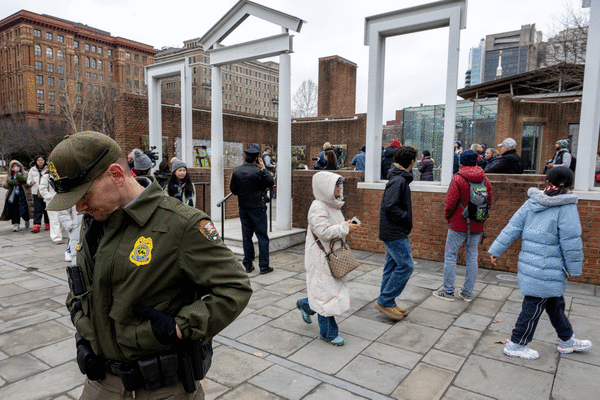
PHILADELPHIA — In just a month’s time, tourists are expected to flood Philadelphia’s Independence National Historical Park in anticipation of celebrations for the 250th birthday of the United States on July Fourth.
But it remains unclear which version of history visitors will see at the President’s House Site — one of the park’s highest-profile locations — as attorneys for the City of Philadelphia and President Donald Trump’s administration argued Tuesday before a federal appeals court over whether the federal government had the authority to dismantle the exhibit’s panels about slavery earlier this year.
The hearing before a three-judge panel of the U.S. Court of Appeals for the Third Circuit marked the latest twist in the legal saga that has transpired following the Trump administration’s desire to sanitize history at President George Washington’s Philadelphia home and the city and stakeholders’ ongoing quest to defend the site. The panel took the case under advisement and did not issue a ruling Tuesday.
Assistant U.S. Attorney Gregory in den Berken, arguing on behalf of the Trump administration, told panel a February court order requiring the National Park Service to restore the site should be reversed.
The order gives Philadelphia “veto rights” over federal property, in den Berken said, and the U.S. secretary of the interior has full discretion over the curation of exhibits in national historical parks.
Judge Thomas M. Hardiman, a President George W. Bush appointee, asked the Justice Department attorney if the federal government had the power to eliminate any reference to slavery at the President’s House.
“Yes,“ in den Berken said, because the federal government has unfettered discretion over which exhibits to display.
“I think it’s important to recognize that, given now that the new panels have been posted on the park service website, that that is not what’s happening here or what’s planned,” the attorney added.
Anne Taylor, an attorney with the Philadelphia Law Department, argued that the unilateral removal was unlawful because it did not consider the site’s stated purpose, or the decades the city and the federal government worked in collaboration to develop Independence National Historical Park.
The federal government’s attack on these exhibits has caused especially “acute” irreparable harm, Taylor said, as the city tries to tell its history ahead of next month’s 250th celebrations.
The city “expects 1.5 million visitors to come to Philadelphia. The President’s House is at the doorway to the Liberty Bell. That history is not being told to all the people who are expected to come here,” Taylor said.
The open-air exhibit at Sixth and Market Streets, just steps from where Tuesday’s hearing was held, memorializes the nine people enslaved by Washington in Philadelphia during the founding of the United States.
The exhibit has been scrutinized by the Trump administration for almost a year and culminated in the site abruptly being dismantled in January. Most of it was replaced in February per an injunction from a federal judge. An appeals judge issued a stay on further reinstallations pending the government’s appeal.
The city and federal government developed the President’s House exhibit in collaboration, pursuant to a series of cooperative agreements. But the city donated the President’s House to the National Park Service after the development of the site was completed.
“Please help me with this,” Hardiman said. “Is this a one-time permanent thing that could never change?”
The city gave up ownership of the site based on an understanding that the exhibit would be maintained, Taylor said. It believed that any change would take into account the 80 years of collaboration that preceded it.
“I think to the extent that the city wanted that,” in den Berken said, “it should have bargained for that” in the contract transferring the property.
The assistant U.S. attorney also said the federal government had no intention to remove mentions of slavery, pointing to digital renderings of new signs for the President’s House uploaded online by the National Park Service in April. The U.S. attorney said those signs had been manufactured and would be installed at the President’s House if given the legal green light.
Much of Tuesday’s hearing revolved around the legal question of whether the exhibit’s removal counted as an “agency action.”
The city brought its lawsuit under the Administrative Procedure Act, which gives federal court oversight on actions by government agencies. Mayor Cherelle L. Parker’s administration argued the removal was “arbitrary and capricious,” which the law prohibits.
Judge Peter J. Phipps, a Trump appointee, seemed skeptical of the argument. The removal was in accordance with a 2025 executive order, Phipps said, and the property the government removed was its own.
Trump’s 2025 executive order prohibited displays that “inappropriately disparage Americans past or living.”
As efforts to protect the President’s House have cycled through almost a full calendar year, the President’s House/Slavery Memorial Coalition — led by many of the same advocates who helped develop the exhibit in the early 2000s — has continued to gain momentum and support from a broad coalition.
The site was designated as endangered last month by the National Trust for Historic Preservation.
During a meeting Monday of Avenging the Ancestors Coalition, one of the leading groups in the alliance, attorney and founder Michael Coard said the group’s work builds upon those of its ancestors.
“You can give us all the credit, but we didn’t have to reinvent the wheel,” Coard said. “We simply took a page from the book of our ancestors. They taught us from the Civil Rights Movement in the late ’50s and early ’60s.”
Coard also lauded the backing his group has garnered from Republicans, including U.S. Sen. Dave McCormick — marking a rare moment of disagreement between the Pennsylvania lawmaker and the Trump administration.
“Senator McCormick believes it’s important to preserve and present our full history in these public spaces, this particularly to include 34 panels related to the history of slavery at the President’s House Site,” said Nate Gerace, McCormick’s Northeast regional director, who was delivering remarks on behalf of the senator, who was midflight at the time of the meeting.
The senator planned to monitor the outcome of Tuesday’s hearing and to stay in touch with Coard’s group.
Cara McClellan, a University of Pennsylvania law professor who represented Avenging the Ancestors as a party interested in the case, warned the judges about giving the president the power to unilaterally control parks and monuments.
“Just imagine if the government removed the Lincoln Memorial right before the Bicentennial,” McClellan said. “That’s the dangerous precedent that we must avoid here.”
_____
©2026 The Philadelphia Inquirer. Visit inquirer.com. Distributed by Tribune Content Agency, LLC.




Comments