Judge blocks moves to add Trump to Kennedy Center name
Published in News & Features
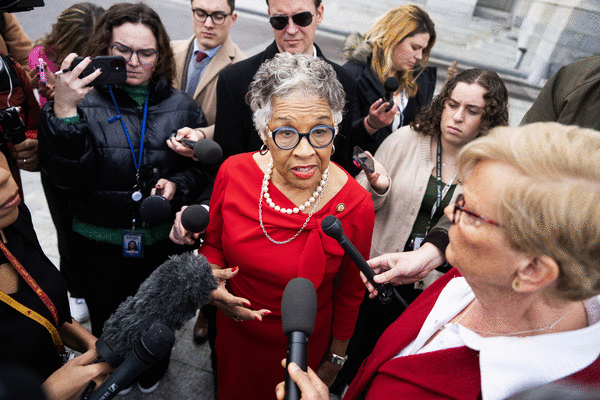
WASHINGTON — A federal judge in Washington on Friday blocked the Trump administration’s moves to rename the Kennedy Center after President Donald Trump and close the center for two years — and gave two weeks for removal of the changed signage on the building’s façade.
The opinion and order came in a lawsuit filed in December by Rep. Joyce Beatty, D-Ohio, a member of the center’s board, which argued the name change and subsequent closure of the center violated federal law.
Judge Christopher R. Cooper of the U.S. District Court for the District of Columbia wrote in Friday’s order that the name change, as well as board votes to close the center and strip ex officio members like Beatty of voting rights, violated the law.
“The Kennedy Center’s organic statute makes crystal clear that the Center is to be named for President Kennedy, and it cannot bear any other formal name or public memorial based on the Board’s unilateral say-so. Congress gave the Kennedy Center its name, and only Congress can change it,” Cooper wrote.
Cooper wrote that the renaming decision goes against the federal law establishing the Kennedy Center, which set its official name as “The John F. Kennedy Memorial Center for the Performing Arts” and did not give the board the power to change it.
In a separate order Friday, Cooper gave the administration two weeks to remove the changed signage on the building’s facade as well as any communications, websites and other materials that contain Trump’s name.
In December, the Kennedy Center’s board met to purportedly rename it as the “The Donald J. Trump and the John F. Kennedy Memorial Center for the Performing Arts,” which followed an earlier May 2025 decision to strip the voting rights of ex officio board members like Beatty.
Trump then announced in February that the center would close for two years for repairs to the “dilapidated” center.
The next month the board voted to ratify that decision, which Cooper said violated the law setting up the Kennedy Center requiring a continuously maintained living memorial to the late president.
Just because the center needs renovations does not mean that the board can unilaterally cease its operations for two years, Cooper wrote. “In other words, the Center may not sacrifice one statutory duty at the altar of another,” Cooper wrote.
Cooper’s opinion noted that the board could still reconvene at a future date and properly proceed with a closure of the center, if it also considers the consequences of such a decision.
Cooper wrote that the statute authorizing the creation of the center does not differentiate between the voting power of “general” members of the center’s board of trustees and ex officio ones like Beatty, who sits on the board through her position as a member of Congress.
The law “does not distinguish between general trustees and ex officio members in any way, other than to identify who they are, spell out how they are appointed, and specify the term length for general trustees,” Cooper wrote.
Republicans and Democrats have introduced dueling legislation over the name change. Rep. Bob Onder, R-Mo., proposed a bill last year to rename the Kennedy Center entirely to the “Donald J. Trump Center for the Performing Arts.”
On the other side, Rep. April McClain Delaney, D-Md., introduced a bill in December to reverse the board’s voted name change and require the government to remove the signage with Trump’s name.
_____
©2026 CQ-Roll Call, Inc., All Rights Reserved. Visit cqrollcall.com. Distributed by Tribune Content Agency, LLC.




Comments