West Altadena rescue came nearly 4 hours before Eaton fire evacuations ordered, 911 records show
Published in News & Features
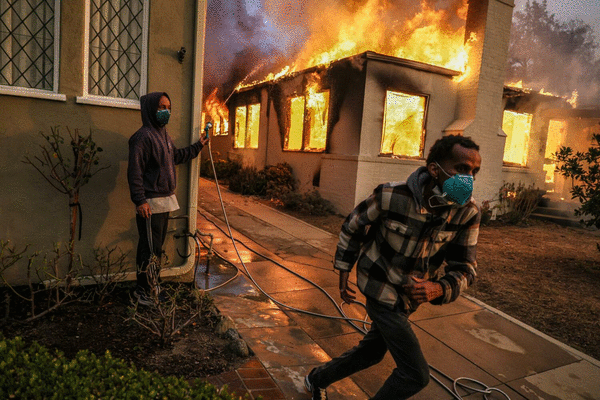
LOS ANGELES — Los Angeles County sheriff’s deputies evacuated a resident in west Altadena just after 11:30 p.m. the night the Eaton fire broke out, according to logs of 911 calls obtained by the Los Angeles Times, raising new questions about why it took nearly four more hours for authorities to issue widespread alerts for the rest of the community.
The records show this early evacuation was run up the chain of command, meaning officials handling the emergency should have been aware of it. It also came as fire crews reported an active fire in the same area.
The logs add to growing evidence that both fire and sheriff personnel on the ground during the first hours of the blaze knew it was threatening Altadena neighborhoods west of Lake Avenue well before the 3:25 a.m. evacuation order was issued.
In the end, all but one of the 19 people who died in the Eaton fire were found in west Altadena, where the fire damage was most concentrated. No evacuation warnings went out to that area before evacuations were ordered.
The new 911 records come a week after the L.A. County Fire Department released a report that concluded there was “no failure” or delay in how evacuations rolled out. County officials heralded the investigation for providing new details from the chaotic first hours of the firestorm, which highlighted incident commanders’ lack of situational awareness.
The Times first reported that many Altadena residents evacuated in dangerous conditions without any warnings or on-the-ground aid in January 2025. Some have blamed the late alerts for their loved ones’ deaths. Earlier this year, California Atty. Gen. Rob Bonta opened a civil rights investigation into the fire preparations and response, focusing on potential disparities in historically Black west Altadena. It’s unclear when that will be complete.
The county report published last week, conducted by a third-party consultant, said Eaton fire incident commanders were operating without a full picture of the situation, particularly after aircraft were grounded, nighttime fell and smoke and winds picked up, forcing officials to base their decisions on what limited information was flowing to them from the ground. The report found incident commanders weren’t aware of escalating danger in west Altadena until after 2 a.m.
This pre-midnight evacuation highlights concerns about missed opportunities to issue timely evacuation alerts for west Altadena and raises new questions about the Sheriff’s Department‘s role in informing incident commanders.
‘Staggering’ delay
There was “a staggering amount of time” between when incident commanders should have realized the fire was threatening west Altadena and when the official warning went out, said Thomas Cova, a professor at the University of Utah who studies wildfire evacuation analysis.
“How could they not be in the loop?” Cova said of the fire’s incident commanders. “How could they not know that these 911 calls were coming in? ... That’s their job, monitoring their radios or whatever they have with them.”
At 11:38 p.m., an L.A. County sheriff’s deputy responded to a fire-related 911 call from a home on Glenrose Avenue near Loma Alta Drive — deep in west Altadena — where a woman requested help evacuating, according to the records.
Within minutes, the deputy flagged her address to incident commanders — writing in the LASD call log that the address was “fwd’d to CP for evacuations,” a common abbreviation for command post — while a nearby L.A. County Fire battalion chief reported a structure on fire at the same intersection, according to last week’s county report.
LASD’s search and rescue team was dispatched to help the elderly woman evacuate, but the agency didn’t issue or appear to push for any wider alerts for her neighbors. It would be another three and a half hours before any section of west Altadena would receive a formal evacuation order.
Sheriff Robert Luna declined to be interviewed for this story, but the agency wrote in a statement that the evacuation of the woman from her home before midnight “involved an elderly resident who was understandably frightened and requested assistance,” but said her home didn’t burn down, and at the time of that call “her residence was not threatened by active fire conditions or impacted by fire progression.”
The nearby structure fire, a department official said, “was likely due to downed power lines or other factors related to the heavy winds that night,” as opposed to the official fire front. The statement cited FireGuard data — a satellite-based firetracking system used only by authorities after the fact— though that data does not pick up spot fires or ember cast, typical in wind-driven fires like the Eaton fire.
But even after this evacuation, the 911 call log and the new county report show sheriff’s deputies responded to an increasing number of spot fires and flare-ups that continued to creep farther west.
At 11:55 p.m., deputies responded to a call two blocks east of North Lake Avenue — the unofficial east-west divider of the unincorporated town — and reported back into the call log: “several structure fires in area. unable to proceed north.”
About an hour later, sheriff’s deputies requested assistance evacuating a home on East Sacramento Street and reported another on fire on East Las Flores Drive — both west of Lake Avenue, per the recent county report.
At 1:30 a.m., on Lake Avenue at East Palm Street, the dispatch log details a call about a “house, vehicle and tree on fire.”
Around 2:30 a.m., deputies responded to a call about a house fire on Concha Street and Santa Anita Avenue, deep in west Altadena. Minutes later at 2:43 a.m., sheriff’s deputies reported “significant fire activity on both sides of Lake Avenue,” including flames near residences in the 300 block of Wapello Street — about three blocks west of Lake Avenue, according to the reports.
At this point, no formal evacuation orders — or warnings — had been issued for west Altadena residents.
Much of the area was finally issued an evacuation alert at 3:25 a.m., but at least one zone — the Calaveras zone — wasn’t issued an evacuation order until about 5:45 a.m. Logs show deputies responded to a call in that zone almost three hours earlier, reporting “fire took over area” at 3 a.m.
It’s not clear exactly what chain of command was in place to relay information from the field to incident commanders, or how deputies on the ground responded to each call, because entries in the call log only include brief synopses — but the records do demonstrate that the first responders became increasingly overwhelmed as the fire exploded into a community conflagration.
As the night went on, the 911 log shows a growing share of calls — many not considered high priority — ignored or not immediately addressed, closed out by deputies writing, “Unable to respond due to Eaton Fire response, or “unable to access area due to Eaton fire.”
Wind-driven fires are infamous for overwhelming first responders because of the speed and scale of the fire spread.
‘Really, really challenging’
Some experts who have responded to major fires said it’s important to note that the nature of such fires can impede decision-making, particularly at night and without aerial surveillance.
“There are times when the chaos is so overwhelming that it is impossible to expect to have complete understanding what the situation is,” said Butte County Sheriff Kory Honea, who has worked to improve his agency’s evacuation protocols after facing major emergencies, including the deadly Camp fire in 2018. “Gaining situational awareness, especially in the early hours, sometimes days, of a particularly threatening event, can be really, really challenging.”
While he said monitoring radio updates and 911 calls can be useful for commanders, he said it’s not a silver bullet, especially as so many things are happening at once: “You can only monitor so many lines of communication at one given time,” Honea said.
The L.A. County Sheriff’s Department emphasized those challenges in its statement, saying that deputies and officials worked “under extremely chaotic and hazardous conditions, using the information they had available.”
The statement from LASD did not directly respond to questions about whether the agency believes its top brass should have been more involved in the evacuation process or better monitored reports from the field, but it did say that that formal evacuation alerts — the Wireless Emergency Alerts that are geo-coded to alarm cellphones in a particular area — are “only one method of notification” and “evacuation efforts were continuous and were done, at times, before the formal wireless emergency alerts.”
The Times has reported that several residents did recall some instances of sheriff’s deputies directing residents to flee before the widespread evacuation alerts were issued, but the extent of those efforts is still not clear. The Times has requested vehicle locator data from the department, but the agency still hasn’t fulfilled that public records request.
LASD does, however, have the authority to direct evacuation alerts, according to the county-ordered McChyrstal Group review of its evacuation processes.
That report noted that LASD officials at the command post are supposed to “contribute to decision making” on evacuations, while deputies in the field should help carry out evacuations. But “if observation is made that an evacuation is needed and ...has not yet been issued from the incident command post,” deputies should communicate to ensure evacuation alerts be established, the report said.
©2026 Los Angeles Times. Visit at latimes.com. Distributed by Tribune Content Agency, LLC.






Comments