US, Iran reach deal on extended ceasefire pending Trump approval
Published in News & Features
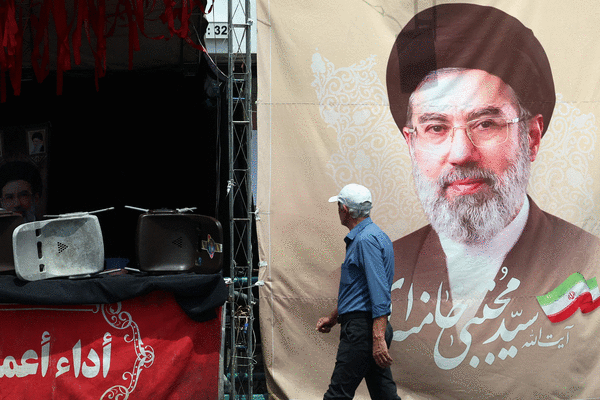
The U.S. and Iran have reached a preliminary deal to extend a ceasefire by 60 days and discuss the future of Tehran’s nuclear program, a person with knowledge of the matter said, buoying hopes for a resolution to a three-month conflict that has killed thousands and roiled the global economy.
The person, who spoke on condition of anonymity because the negotiations are private, confirmed an earlier report from Axios. President Donald Trump has yet to agree to the terms. Both countries have previously hailed progress, with Trump repeatedly indicating the U.S. was close to securing an agreement — only for the standoff to drag on.
Vice President JD Vance told reporters Thursday that the U.S. and Iran are “going back and forth on a couple of language points,” including over issues relating to Tehran’s nuclear capabilities. Iran appears to be negotiating in good faith and progress is being made, he added.
Iran’s semi-official Tasnim news agency said in a post on X that the text of the possible memorandum of understanding between the U.S. and Iran hadn’t been finalized, citing a source it didn’t identify.
U.S. Treasury Secretary Scott Bessent declined to confirm an interim deal had been reached, saying only that negotiations continued. He reiterated Trump’s three “red lines” — reopening the Strait of Hormuz, Iran surrendering highly enriched uranium and ending its nuclear program — remain in place.
A fragile truce has been in place since early April, interrupted by isolated military strikes. Axios reported that Trump asked for “a couple of days” to think about the agreement.
In a post on X, Iranian President Masoud Pezeshkian says he had “emphasized Iran’s commitment to diplomacy” in calls with the prime ministers of Malaysia and Pakistan.
Fada-Hossein Maleki, an Iranian lawmaker and member of the country’s parliamentary commission for national security, said negotiations have shown “significant progress,” according to the semi-official Iranian Students’ News Agency. The U.S. still has to decide whether to accept several Iranian conditions, the ISNA quoted Maleki as saying, without giving details.
Pakistan, a mediator in the negotiations, said Foreign Minister Ishaq Dar will be in Washington on Friday for a meeting with U.S. Secretary of State Marco Rubio to discuss “Pakistan’s efforts to promote regional peace and stability through dialogue and diplomacy.”
The MSCI All Country World Index, the broadest measure of global equities, climbed 0.4% to an all-time high as easing tensions fueled expectations for lower oil prices and stronger economic growth. Brent crude fell as much as 1.4% to $92.37 a barrel, down from as high as $126.41 a month ago.
The U.S.-Iran memorandum of understanding would guarantee that shipping through the Strait of Hormuz remains unrestricted, Axios reported. Iran would have to remove all mines from the strait within 30 days, according to the report.
The U.S. struck Iranian military targets twice this week, including Iranian drones fired at a commercial ship and a launch unit near Hormuz, which it characterized as defensive. Both sides have condemned the other for violating the truce.
The effective closure of Hormuz since the start of the war in late February has curbed about a fifth of the world’s oil and liquefied natural gas supplies, leading to a surge in prices and boosting inflation.
The U.S. Treasury Department said it took action against Iran’s Persian Gulf Strait Authority, accusing it of launching a new attempt “to monetize its campaign of state-sponsored terror by extorting vessels transiting the Strait of Hormuz.”
Iran has expanded its claimed jurisdiction and set out new rules for vessels seeking to transit the waterway. That involves seafarers dealing with the new Iranian agency and sometimes getting payment requests of as much as $2 million for safe passage.
The Islamic Revolutionary Guard Corps said 26 commercial ships and oil tankers transited the waterway in the space of 24 hours after obtaining permission, Tasnim reported Thursday, citing an IRGC statement.
The U.S. president has instituted his own blockade of Iranian ports and called for allies to assist with the effort to open the strait so commercial vessels can resume safe passage. He’s also threatened to resume major airstrikes against Iran — all to little avail.
Trump finds himself caught between Iranian demands for financial relief and an end to attacks, pressure from Republican hawks not to compromise, and his own past criticism of previous agreements. Beyond Tehran’s nuclear program, negotiators still need to decide how much of Iran’s $24 billion in frozen assets will be released and how quickly.
Here’s more on the Iran war:
•When Tehran oil infrastructure caught fire in March following Israeli strikes, the blaze produced toxic fumes detectable across an area the size of Italy, fresh research shows.
•At least three empty LNG tankers are heading toward the Gulf of Oman outside the Strait of Hormuz, ship-tracking data shows, indicating they could be preparing to pick up gas cargoes from the Persian Gulf.
•Israel stepped up attacks on Lebanon, killing at least 14 people and striking Beirut. That potentially complicates U.S.-Iran talks on an interim peace deal.
--------
—With assistance from Golnar Motevalli, Fiona MacDonald, Meghashyam Mali, Catherine Lucey, Derek Wallbank, John Harney, Richard Henderson and Tooba Khan.
©2026 Bloomberg L.P. Visit bloomberg.com. Distributed by Tribune Content Agency, LLC.




Comments