Chicago school board delays charter renewals after heated debate
Published in News & Features
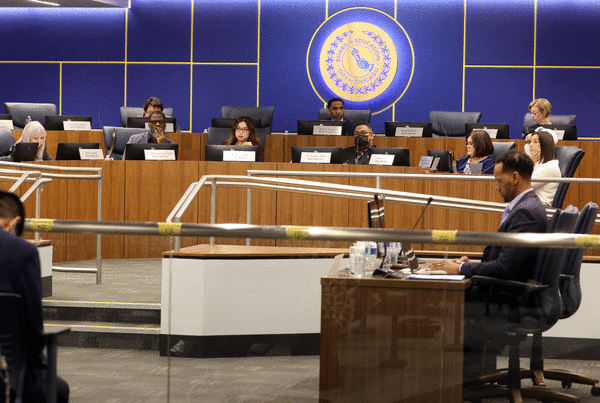
CHICAGO – The Chicago Board of Education voted to delay contract renewals for seven charter operators, as board members sparred over stricter oversight standards for the publicly-funded but independently-operated schools.
In a contentious, late-night debate Thursday, 11 board members — all of whom are mayoral-appointed or aligned with the Chicago Teachers Union, a staunch charter critic — said they needed additional time and information from the district before voting.
The intensified scrutiny comes after a string of charter operators have struggled financially over the past two years.
“An accurate sense of finances has been eluding us, resulting in harm to students and cost to the district,” said appointed board member Karen Zaccor, District 4A on the North Side. “We are not here to be a rubber stamp.”
Others argued that waiting until the board’s June 10 meeting would leave families uncertain about their schools’ future just as summer break begins. The operators under review, which serve roughly 8,300 students across 16 campuses, had been assigned proposed renewal terms ranging from four to seven years.
“What is it that you’re going to learn in the next 12 days that’s going to make you all ready to take a vote?” said board member Ellen Rosenfeld, elected to represent District 4B on the North Side. “There is absolutely no reason to put this off.”
Chicago Public Schools CEO Macquline King, who typically does not weigh in publicly on board policy debates, also offered an unusually pointed warning.
“The fact that these votes will not move forward will cause instability and concern,” King said. “It may seem to us that it’s just two weeks, but for a child, that could be a lifetime.”
The maneuver followed the abrupt closure of the ASPIRA network in March, which operated two high schools in Avondale before falling into insolvency. Charter schools are overseen by independent boards but receive district funding and operate under contract with CPS.
Prior to the vote, district leaders unveiled new practices aimed at bolstering charter monitoring, including mid-cycle reviews and revised budget templates with three-year financial projections. Previously, there were no formal checkpoints through the school year, and the district relied on lagging indicators to exercise oversight, administrators said.
CPS has also developed a financial early-warning process, which checks for factors such as declining enrollment and operational deficiencies.
“You see a car that’s ahead of you, veering it off. Our process now has been amplified to be in that car ahead of time, to be with that person before they get in the car,” Conrad Timbers-Ausar, the district’s acting chief portfolio officer, told the board.
Still, some board members said that they needed more clarity on the new strategies, and the levers the district can use to hold charter schools accountable.
“I think every student and parent … can rest assured that the contracts will be renewed as proposed, but my feeling is we need to lock down the reforms before we vote,” said appointed member Ed Bannon, who represents District 1A on the Northwest Side.
Historically, the board has approved charter renewals in January and February, giving operators several months’ notice before their contracts expired at the end of June. But in recent years, the district has pushed back that process, inching renewals closer to the summer.
Andrew Broy, the president of the Illinois Network of Charter Schools, said the delayed process creates instability for school leaders. He and other charter advocates have urged the board to grant 10-year renewals to high-performing networks, the maximum allowed under state law.
“There’s uncertainty about length of term, about hiring decisions, about staffing,” Broy said. “It’s the same problem at late budget releases. You don’t have certainty about your existence.”
The majority of the 21-member board is backed by CTU and also favored shorter terms in the last renewal cycle.
Earlier in the spring, a similar bloc of board members had pressed the district to revise its charter evaluation criteria, according to a letter obtained by Tribune. The group proposed giving greater weight to financial data and to how schools serve special education and English language learner students, increasing those categories to 35% and 25% of the overall evaluation, respectively.
“After being allowed to function for years without significant oversight (until recently), the touted innovation can only be found sporadically,” the letter said.
The district ultimately did not change its rubric. In fact, administrators found that assigning greater weight to finances this renewal cycle may have resulted in longer terms for some of the operators, several board members told the Tribune.
“We cannot continue to change the rules every time the outcome does not fit someone’s narrative,” said elected member Angel Gutierrez, who represents District 8A on the Southwest Side. “We cannot keep moving the goal post because the data, the process, or the recommendations do not produce the political conclusions someone’s wanted from the beginning. Enough is enough.”
Epic Academy in South Shore is slated to close in June amid dwindling enrollment and financial woes. In 2024, the board voted to absorb five of seven Acero charter schools also slated for closure, a move district officials projected would cost upwards of $30 million.
Charter leaders and advocates have contended that charters are underfunded by CPS compared to district-run schools. CTU, meanwhile, has countered that the model has caused financial mismanagement and worse student and labor outcomes.
“This isn’t about punishing charter operators, and it’s not about how any particular school is run,” Jen Conant, CTU’s charter division chair, told the board. “It’s about protecting students, families, and the district from the chaos and instability that we have seen in the charter sector.”
____
©2026 Chicago Tribune. Visit at chicagotribune.com. Distributed by Tribune Content Agency, LLC.





Comments