Minneapolis police rarely responded to ICE calls but still spent millions on overtime
Published in News & Features
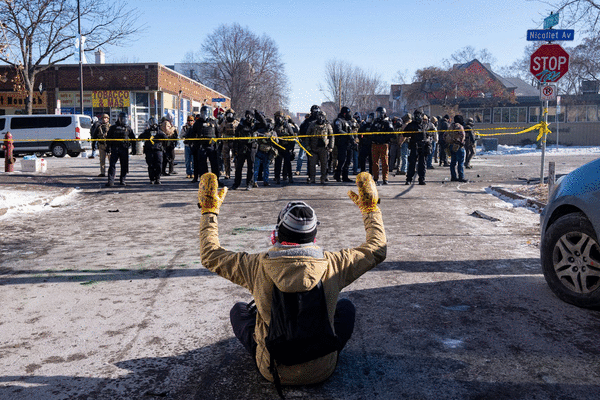
MINNEAPOLIS — Minneapolis police rarely responded to immigration-related emergency calls during Operation Metro Surge, even as the department spent $10 million on overtime and standby pay preparing for unrest that largely never materialized.
In December, then-Minneapolis police Chief Brian O’Hara urged citizens to call 911 if they witnessed apparent kidnappings by masked people in the street and were unsure if they were actually law enforcement. He also vowed to fire officers who failed to intervene in cases where federal agents used unlawful force.
A rise in emergency calls about ICE followed.
In early December, a Minneapolis grocery store owner called 911 to report agents were in his parking lot, harassing customers and refusing to leave.
In January, a Minneapolis resident complained to a 911 dispatcher that about a dozen agents were tear-gassing protesters near downtown.
Two days later, another caller reported being chased by an SUV as agents inside pointed their firearms.
The Minneapolis Police Department didn’t respond to any of those calls, according to a review of police calls by the Minnesota Star Tribune. The analysis also found that only a small fraction of the city’s calls to police during the surge, some 50,000 in all, were immigration-related.
The Star Tribune collected more than 350 emergency calls pertaining to Metro Surge spanning Dec. 3 to Jan. 31. In roughly a quarter of those calls, police chose not to directly respond to reported ICE activities or protests. Among the other complaints, police rarely logged direct interventions or filed criminal reports.
The low response and high payouts have city leaders questioning what drove the police department’s hefty personnel spending, including $22,000 in overtime to an officer who claimed overtime for 32 days straight. Some officers also made $20,000 for working standby, earning a portion of their hourly wage to be on call and ready to report for duty within an hour.
O’Hara is now out of the chief job after interfering with an investigation into sexual misconduct allegations against him that remain unsubstantiated. But the fallout over the department’s hefty overtime bills are likely to persist, with some City Council members calling the totals outrageous.
“That’s astronomical. That’s insane,” Council Member Aisha Chughtai said of the police payouts during a recent budget committee meeting. “Just to be ready to work, you receive $20,000 over the course of one month, not for actual work done. That is mind-boggling.”
Police department officials defend the payouts, saying overtime restrictions during the upheaval after the 2020 police murder of George Floyd led things to spiral out of control.
Deputy Chief of Patrol Mark Klukow, who made staffing decisions during most of the surge, said police responded to major events, such as the agent-involved shooting deaths of protesters Renee Good and Alex Pretti, and the shooting of resident Julio Cesar Sosa-Celis.
“We didn’t really believe that Eat Street had a chance to make it through that night after Alex Pretti was murdered,” Klukow said, adding that police leaders wanted to make sure the Whittier neighborhood wouldn’t meet the same fate as E. Lake Street six years ago.
A prominent Minnesota police chief, Bloomington’s Booker Hodges, cast doubt on the Police Department’s $6 million overtime bill in January.
“That is a lot of money to spend on overtime,” he said in an interview. “I mean, that’s huge.”
In early December, O’Hara attracted national attention when he vowed to fire officers if they failed to intervene when federal immigration officers cross the line. It was the front end of a surge when several thousand federal immigration agents descended on Minnesota, and O’Hara was pushing back against the enforcement action.
“If unlawful force is being used by any law enforcement officer against any person in this city and one of our officers is there, absolutely, I expect them to intervene, or they’ll be fired,” O’Hara said.
But police rarely responded to calls despite video capturing numerous examples of questionable force by federal agents.
On the morning of Jan. 25, Matt Blum called 911 to report ICE agents pointing their guns at a group of observers outside the City View Apartments in north Minneapolis. The agents were yelling at a gathering of observers and shoving some of them, he recalled.
“Then at some point, they drew their weapons, sort of pointing them at people,” Blum said. “So I just did the only thing I could think of, which is to call the police and say, ‘Hey, nothing has happened yet, nobody’s been shot, but you could see it developing.’”
Police never came, according to Blum and a police report. The federal agents ended up threatening observers with pepper spray before driving away, Blum said. While nobody was harmed that morning, Blum worried it would have taken very little for tensions to escalate.
Residents also called with concerns about federal agents surveilling and harassing children at schools. MPD didn’t send a squad car. Others reported being followed, taunted and assaulted by ICE agents.
The 911 calls came from nearly every neighborhood, with police closing about a quarter of those incidents due to the presence of ICE agents or protesters, often monitoring the situations via camera feeds. Dozens more were cancelled, listed as “gone upon arrival” or deemed unfounded by police. Some calls were duplicates and others about protests.
As of March, only two incidents were being investigated by the MPD despite O’Hara’s earlier warnings that he would discipline officers if they failed to intervene if federal agents committed unlawful acts.
O’Hara declined interview requests for this story, but MPD spokesman Sgt. Garrett Parten clarified the former chief’s earlier vow.
“It’s our duty to intervene at that moment. And his point was, we were never in a position to do that,” Parten said in an interview before O’Hara’s resignation.
Minneapolis police also declined to aid federal agents calling for help.
On Jan. 5, an ICE agent called police saying he was “trapped” inside a vehicle in south Minneapolis while a “hostile crowd” threw snowballs at him. Police didn’t respond, and the agent eventually left the scene. A week later, ICE agents stopped city community service officers to complain about protesters tailing them. The officers left without taking action.
Occasionally, police did take action: On Jan. 19, police rushed to help a 5-year-old Spanish-speaking child who called and said his parents hadn’t come home after working overnight. Logs show police could not find the child, despite knocking on several doors in the area of the call.
The following day, when an armed homeowner called to report someone trying to break into their house, police arrived and found a Hispanic man trying to force his way into the house to evade ICE.
While police declined to engage in the majority of immigration-related calls, officials justify the $10 million in overtime because they were ready to dispatch if things spiraled out of control.
As part of the all-hands-on-deck approach, O’Hara ordered all officers to wear their uniforms so they could be ready to deploy. The order came as officers were set to lose double overtime.
The department has about 300 fewer officers than it did in 2020, and routinely racks up about a half-million dollars in overtime a week to police the streets in normal times. Police were working about 2,000 overtime hours in the weeks just before the surge.
But in the first half of January, overtime ballooned to nearly 14,000 hours, according to MPD data. After an ICE agent killed Good on Jan. 7, more than 1,000 scheduled days off were canceled and 500 shifts were extended, O’Hara has said.
The payouts are substantial.
In that roughly one-month span, 118 officers were paid between $8,000 and $20,000 for being on standby for 250 to 475 hours from early January to early February. That means some officers were on standby 62% of the time during that 32 days.
The council has asked for more details about what police were doing while getting paid for overtime and standby hours.
Hodges, a former assistant commissioner of the Minnesota Public Safety Department, said Bloomington spent about $35,000 on overtime for about 60 officers responding to protests at hotels where ICE agents were staying and other incidents. However Bloomington, the state’s fourth-largest city, is fully staffed with 135 officers, while the city of Minnesota employs about 640.
“Even if you took my number times five ... you’re still barely cracking $200,000,” Hodges said. “Were they paying people to sit around at the precinct or at home?”
Klukow, the MPD incident commander, said they did not do that.
“We were not calling people in to sit behind closed doors and wait to be needed,” he said.
Police were assigned to “strike teams” and stationed at vigils, memorials and protests. Officers protected infrastructure, monitored demonstrations on security cameras, and were stationed, two at a time, in hotels after some were vandalized by protesters targeting federal agents.
In 2020, the department had been told to be careful about using overtime, Klukow said, and paid a price by not having officers in place to curtail chaos.
Having officers take a “visible posture” after the shootings of Pretti, Good and Sosa-Celis likely deterred violence and disorder, he said.
“Many of us that are in leadership positions now were watching leadership back in 2020 fail to meet the moment,” he said. “And those lessons were learned.”
The comments are little comfort to Edgar Rodriguez, who called 911 about ICE agents harassing customers in the parking lot of his Minneapolis grocery store. Emergency call logs show the call was cancelled by a police supervisor.
Employees managed to keep the doors locked, preventing federal immigration agents from entering, Rodriguez said.
“It was the same as the riots [in 2020],” Rodriguez said. “We had to deal with everything on our own.”
_____
—Jeff Day, Liz Sawyer, Abby Simons and Paul Walsh of the Minnesota Star Tribune contributed to this story.
_____
©2026 The Minnesota Star Tribune. Visit at startribune.com. Distributed by Tribune Content Agency, LLC.




Comments