Putin steps up Kyiv missile strikes seeking momentum in war
Published in News & Features
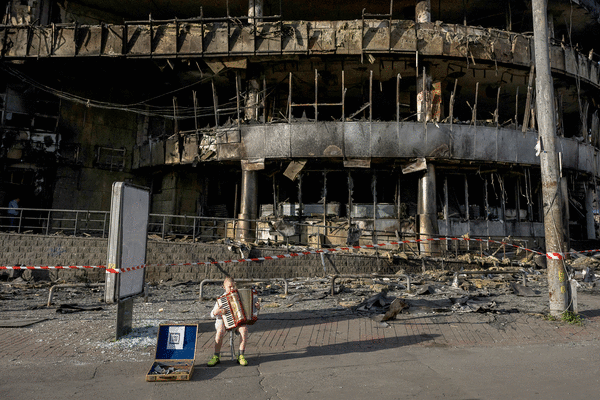
With the battlefield largely at a stalemate, Russia is ramping up ballistic missile attacks on Ukraine to try to regain the strategic initiative by overwhelming air defenses and demoralizing its population.
The threat of sustained strikes indicates Russian President Vladimir Putin remains committed to his war aims despite a string of recent setbacks that have fueled rising criticism at home. It follows a record Ukrainian drone attack on Moscow and its surrounding region, and as Kyiv has waged an increasingly effective campaign targeting Russian oil refineries.
“Moscow feels it has to respond somehow to the strikes that Kyiv has been carrying out with increasing success,” said Alexander Gabuev, Berlin-based director of the Carnegie Russia Eurasia Center. “Right now, Russia sees a window of opportunity because Kyiv’s stockpiles of Patriot interceptors have been significantly depleted.”
Ukraine is struggling to replenish reserves of air-defense missiles amid increased demand stoked by the Middle East war. U.S.-led peace talks with Russia and Ukraine have also stalled as the Trump administration has focused on the war with Iran.
Russian Foreign Minister Sergei Lavrov advised U.S. Secretary of State Marco Rubio in a phone call Monday to evacuate U.S. citizens and diplomats from Kyiv after Moscow announced a campaign of “systematic strikes” against the Ukrainian capital. That came a day after Ukraine faced one of the biggest Russian air barrages of the war, including with a hypersonic Oreshnik missile that was used for the first time since January.
Russia fired 30 Iskander-M missiles in Sunday’s attack, causing widespread destruction and injuries across the Ukrainian capital. The assault targeted several major cities and included 90 missiles and 600 drones, Ukraine’s Air Force said.
Ukraine said it intercepted 11 of the missiles, a neutralization rate of 37% that was well below the 67% recorded during the previous major barrage on Kyiv on May 14, according to Bloomberg calculations based on daily data from Ukraine’s Air Force Command.
“Unfortunately, there were too many missiles for our air defense resources to handle,” Serhiy Beskrestnov, an advisor to the defense minister, said on Facebook following Sunday’s attack.
The situation appears even more difficult in regions outside Kyiv that lack the kind of cover provided by U.S.-made Patriot air-defense systems for the capital. Ukraine failed to intercept any of the 14 Iskander-M ballistic missiles launched in the May 18 attack that targeted areas from Odesa in the south to Dnipro in central Ukraine and Chernihiv in the north, according to the Air Defense service
The latest campaign mirrors tactics Moscow employed in the winter as Russia pounded energy infrastructure in an attempt to freeze Ukrainians into submission. The attacks deprived hundreds of thousands of people of water and power in the conflict’s coldest winter so far, though they failed to wring any concessions from Ukraine to bring an end to the war.
Still, it remains unclear whether Russia has the ability to maintain large-scale attacks with ballistic missiles for a sustained period.
Russia hasn’t received a response from the U.S. to its latest warning about strikes on Kyiv, Kremlin spokesman Dmitry Peskov told reporters on Tuesday.
While it denies targeting civilians, Russia has repeatedly hit residential buildings and civilian infrastructure in waves of attacks on cities since the start of the 2022 full-scale invasion.
Ballistic missiles are particularly difficult to intercept because they travel much faster than drones and along steeper trajectories, leaving air defenses very little time to respond. Russia’s Iskander-M missiles inflict most damage while slower-going cruise missiles are easier to intercept and mostly serve to deflect air defenses.
Ukraine’s shortage of western-made anti-ballistic munitions is amplified by Russia’s ability to continue producing missiles. The share of Iskander-M in attacks declined from 55% in January to less than 30% in March, but has been growing again and exceeded 41% so far in May.
Moscow framed the strikes as retaliation for a Ukrainian drone attack on a college in the Russia-occupied Luhansk region that it said killed 21 students. Putin vowed retaliation for the attack in the city of Starobilsk in televised comments at the Kremlin on Friday.
Ukraine’s General Staff said its forces hit the headquarters of a Russian drone unit operating in Starobilsk and it rejected Putin’s allegation that civilian facilities were hit.
Lavrov told Rubio that Russia’s strikes would target relevant “decision-making centers,” according to the Russian Foreign Ministry. The ministry earlier Monday urged all foreign nationals, including staff of diplomatic missions and representatives of international organizations, to leave Kyiv and advised the city’s residents to avoid military and administrative infrastructure.
European Union ambassador to Kyiv Katarina Mathernova called Russian threats “a sign of desperation” and said western diplomats were not planning to relocate.
“The E.U. is not going anywhere. We are staying in Kyiv,” she wrote in a Facebook post. “We are staying with Ukraine.”
On the call with Rubio, Lavrov accused Europe and Ukraine of undermining agreements that Russia says Putin reached with U.S. President Donald Trump during their 2025 summit in Alaska, according to the Russian readout.
Rubio told reporters on Tuesday that his Russian counterpart called him to “relay the message directly to the president” about the strikes. Kyiv has been “a very dangerous place now for a number of years,” he said.
“Well, this is what happens with these wars. I mean, they just continue to escalate,” Rubio said in Jaipur, India. “And the U.S. stands ready and prepared to help do whatever we can to help facilitate the end of this war.”
Putin is demanding that Ukraine withdraw its forces from the eastern Donetsk region as part of any deal to end the war. Ukraine rejects that demand, refusing to cede territory that Russia’s army has failed to capture in fighting since 2014.
While Trump returned to the White House in January last year pledging to bring a rapid end to Europe’s worst conflict since World War II, more than 16 months of U.S. diplomacy have failed to reach a breakthrough.
European allies and Canada have largely taken over the responsibility for financing military aid for Kyiv. But the key air defense capabilities continue to be produced in the U.S. and supply is being strained by the war in Iran.
“There is a bilateral escalation from both Ukraine and Russia,” said Tatiana Stanovaya, founder of R.Politik.
While the Kremlin is concerned about the pause in U.S.-led talks and trying to win back American attention, “we are more likely to see a new escalation than a softening of the position” from Russia, she said.
--------
—With assistance from Alex Kokcharov (Analyst).
©2026 Bloomberg L.P. Visit bloomberg.com. Distributed by Tribune Content Agency, LLC.






Comments