Alaska Legislature adjourns with eye toward special session
Published in News & Features
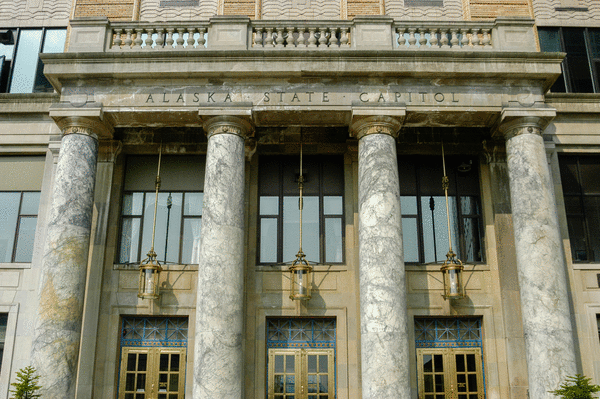
JUNEAU, Alaska — The regular legislative session of the Alaska Legislature ended Wednesday night, with lawmakers already looking ahead to a special session focused on advancing a long-sought natural gas pipeline.
The Senate adjourned sine die at 8 p.m. The House followed suit at 9:45 p.m. after a long and tearful series of goodbyes from departing lawmakers.
"I would say farewell, except I get to see you all tomorrow," House Speaker Bryce Edgmon said moments before lawmakers dispersed for the night, with a plan to return Thursday at 10 a.m. for the special session called by Gov. Mike Dunleavy.
It was a relatively calm and jovial conclusion to what had been a frenetic end-of-session sprint that included an ill-fated effort to negotiate an agreement between the governor and lawmakers on tax breaks for gas line developers.
The budget, often mired in contentious debates over the size of the Permanent Fund dividend and other new spending items, passed without a hitch in the House and Senate in the final hours of the session. Lawmakers attributed the smooth process in large part to the war in Iran and the windfall in unexpected oil revenue that it yielded.
The war changed the budget-making process "enormously," said Senate President Gary Stevens.
"We're all sorry that it took a war to do that, but we are going to be doing much better," said Stevens.
Lawmakers introduced a total of 683 bills, of which 111 passed during the two-year cycle that began last year. More than 30 of them were adopted on the last day of the session. Last-minute legislative efforts covered a wide range of topics, including education funding, public safety reforms, a corporate income tax update and campaign finance.
The war in Iran, which began six weeks into this year's legislative session, bifurcated lawmakers' priorities, allowing them to consider ideas that had previously been seen as cost-prohibitive.
"It has been the tale of two halves, no question about it," said Edgmon, a Dillingham independent who led a caucus that numbered 14 Democrats, five independents and two Republicans. "The first half was centered around fiscal austerity, and having to impose fiscal discipline on every bill that was going through, looking at lean maintenance-level budgets."
"The start of the conflict in the Middle East really changed the tenor of the session (and) upended the thinking of the first half," Edgmon said.
House Majority Leader Chuck Kopp, an Anchorage Republican, said lawmakers "were very fortunate to be in a position where we have the revenue to fund a lot of things to the degree that we had hoped."
"I don't think any of us are happy about the war in Iran to have gotten us there, but we are certainly reaping the benefit of the revenue," he said.
It allowed lawmakers to adopt a nearly $500 million supplemental budget bill in March, without drawing from savings. It also allowed the majorities in the House and Senate to advance what had been their top priority for the two-year cycle: more education funding.
After updating the statutory K-12 school funding formula last year, lawmakers returned to the topic again this session with a focus on school maintenance funding in the capital budget and an infusion of up to $144 million in one-time spending on public education. They also passed a bill that could grant schools tens of millions of dollars a year in subsequent fiscal years.
Stevens, whose caucus numbers nine Democrats and five Republicans, said education funding was their "major success" despite lingering concerns across the state over planned school closures.
The unexpected revenue also changed the role of the minority in the closely divided House. It removed the need to draw from the Constitutional Budget Reserve, which can only be done with support from three-quarters of lawmakers, giving the narrow 21-member House majority latitude to advance their priorities without needing to rely on minority votes for the budget.
But the revenue windfall also masked the long-acknowledged structural deficit that in recent years has left the Legislature without sufficient funds to cover basic social services. Though lawmakers began the session with a promise to consider new taxes, they ended the session Wednesday having passed only one revenue bill, which is expected to bring in only $15 million annually.
"Next year will be a very, very difficult session, because when the war in Iran ends and oil goes back down to $50, $60, $70 (per barrel), we are right back to a $2-billion-a-year structural deficit, and there is no avoiding that," said Sen. Bill Wielechowski, an Anchorage Democrat.
Having aligned majorities in the House and Senate for the first time since 2016 "worked extremely well," said Stevens.
"I feel like the legislative process is difficult by design. Some days we do well, some days wisdom is chasing after us, but we're running faster," said Kopp. "But on the whole, I would say the two bodies worked well together in the Senate and the House, and we did get a number of very significant things done in a way that is really going to benefit our state."
The House and Senate succeeded in passing two complex priority bills that had been years in the making — one to reinstate a pension plan for public employees and another to update the state's election laws — only to watch the governor veto them.
Still, the authors of those policies hailed the adoption of the bills as a victory that will pave the way for their ultimate passage into law in future legislative sessions.
"We did our best, we passed the bills, and that's all we can really do," said Wielechowski. "We passed what we think were bipartisan, fair bills, and it's for a future Legislature to pick them up again."
Ultimately, the last few weeks of the session were consumed by work on the Alaska LNG megaproject and Gov. Mike Dunleavy's proposal to grant tax breaks to project developers.
The gas line "certainly was the large elephant in the room as we closed out the session," said Edgmon.
During the special session, most lawmakers are set to go home while the House and Senate finance committees seek a compromise to advance the gas pipeline.
"We're going to try to come up with a compromise bill to move that project forward, something that works for the Legislature, works for the governor, and works for the boroughs involved and the rest of the state," said Senate Finance Co-Chair Bert Stedman, a Sitka Republican.
As the session adjourned, lawmakers and staffers alike were cheerful, flooding the hallways — which had been occupied until hours earlier by nervous lobbyists awaiting the fate of last-minute bills — with singing and clapping.
It was a moment for levity after months of tense debates, and one in which to fete retiring legislators, who include Stevens, leaving after 25 years in the Legislature; Bethel Democratic Sen. Lyman Hoffman, who has served for 39 years; Anchorage Democratic Rep. Andy Josephson, leaving after 13 years; and Eagle River Republican Rep. Dan Saddler, leaving after 11 years.
"It is time for me to find out what life is like outside the grind of campaigns and fundraising and organizations and caucus formations and subcommittees and committees and prayers, pledges, and daily calendars, and — Lord help us — special sessions, even when they're not that damn special anymore," said Saddler, wiping away tears on the House floor.
©2026 Anchorage Daily News. Visit at adn.com. Distributed by Tribune Content Agency, LLC.






Comments