Scientists bet on AI to save gray whales from ship strikes off California coast
Published in News & Features
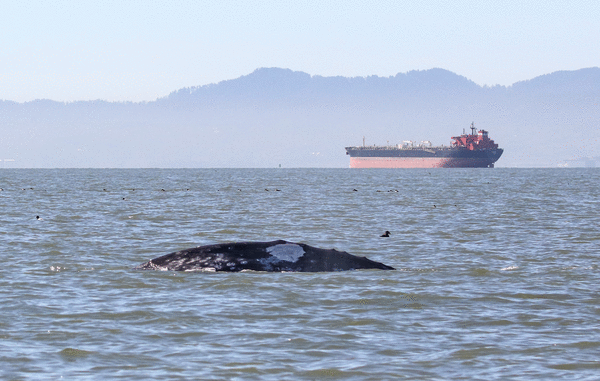
LOS ANGELES — The leading killer of gray whales is not natural causes, disease or predators but human-made ship strikes.
Last year, 21 gray whales were found dead around San Francisco Bay and 40% of those were from ship collisions. This year, seven whales have already died during whale season, which peaks this month. As climate change alters the food chain in the Arctic, more and more gray whales are moving into San Francisco Bay in search of food, putting them in harm’s way.
Now, there’s a thermal camera monitoring system that tracks the location of whales using AI and then alerts nearby ships to re-route their course in order to avoid hitting them.
“It is heartbreaking to see these starving whales stumbling around in the middle of the hustle and bustle of San Francisco Bay,” Douglas McCauley, director of the Benioff Ocean Science Laboratory at UC Santa Barbara, said in a news release from the lab. “Every day is a nail-biter. But what gives me hope is seeing how all the right partners in the Bay Area community have come together to do something. This new system will save whales’ lives. We are all proud of this.”
The system uses Flir thermal cameras and AI-powered detection technology developed by WhaleSpotter to detect the whales’ heat signature from up to four nautical miles, according to the release. Scientists then put the locations on the Whale Safe website to share with bay mariners and the U.S. Coast Guard.
There are between 11,700 and 14,450 Eastern North Pacific gray whales worldwide, which is about half the population of about 27,000 that were around in 2016, according to the National Oceanic and Atmospheric Administration. The current population is the lowest ever recorded since the late 1960s and ‘70s.
According to a study published in April, about 18% of the gray whales in the bay between 2018 and 2025 died, with at least 40% of them killed by ship strikes.
Last month, Rep. Sam Liccardo, D-San Jose, introduced a bill that would create a “whale desk” in the U.S. Coast Guard’s San Francisco station, where mariners can report whale sightings to alert vessel operators in an effort to try to prevent more collisions.
“Researchers track these whales daily, but we can scale their impact by crowdsourcing data from the many more numerous commercial and recreational boats, and building a centralized alert system,” Liccardo said in a release. “A whale desk will protect these magnificent creatures and help mariners avoid costly, harrowing collisions. Together, let’s Save Willy.”
The first part of the whale-detection network was installed on Angel Island, with the second planned MV Lyra, a vessel operated by SF Bay Ferry connecting Vallejo to downtown San Francisco, according to the release. Scientists hope to expand the network to the entire bay, including the Golden Gate Bridge and Alcatraz.
Seamus Murphy, executive director of SF Bay Ferry, said the system includes monitoring and educating mariners.
“Testing the thermal monitoring system designed and provided by the Benioff Ocean Science Laboratory is the next evolution of our work, and we’re thrilled to soon have one of the bay’s two monitoring cameras on our ferry,” he said. “We remain committed to bringing together fellow vessel operators to protect whales with the best available technology and protocols.”
©2026 Los Angeles Times. Visit at latimes.com. Distributed by Tribune Content Agency, LLC.






Comments